
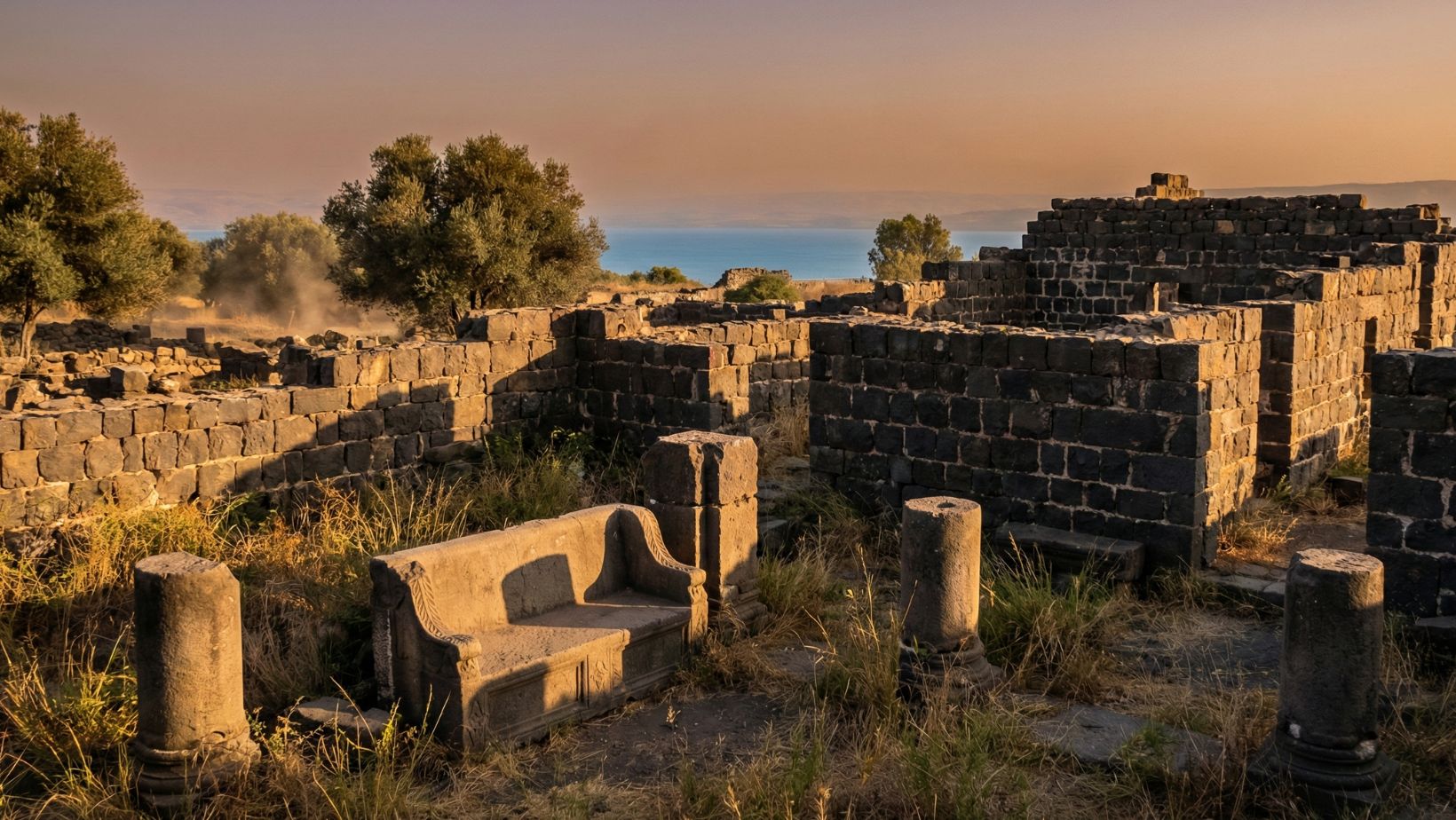
Chorazin is best known as one of the “Evangelical Triangle” cities (along with Capernaum and Bethsaida) where Jesus performed most of His “mighty works.” Despite witnessing the power of the Kingdom of God firsthand, the town is famously remembered not for its faith, but for its failure to repent. In the Gospels, it stands as a solemn warning that proximity to the divine and the witnessing of miracles do not guarantee salvation; rather, they bring greater accountability. Today, its black basalt ruins sit on a hill overlooking the Sea of Galilee, a silent testimony to the judgment Jesus pronounced upon it.
Quick Facts
- Name: Chorazin (Hebrew: Korazim)
- Location: Upper Galilee, approx. 2.5 miles north of Capernaum
- Biblical Era: New Testament (Ministry of Jesus)
- Key Event: Cursed by Jesus for unrepentance (Matthew 11:21)
- Status: A ruin (now an archaeological park)
- Industry: Known for high-quality wheat production
- Key Artifact: The “Seat of Moses” found in its synagogue
- Associated Cities: Capernaum, Bethsaida (The “Cities of Woe”)
Name Meaning
Chorazin: The etymology is somewhat uncertain. It may derive from the Hebrew root karoz, meaning “herald” or “proclaimer,” leading to the meaning “Place of Proclamation.” Others suggest it relates to “furnace of smoke” due to the black volcanic rock (basalt) used to build the city.
Lineage / Origins
Foundation: Chorazin was a Jewish town established in the 1st or 2nd century BCE. It was not a pagan city but a center of Jewish life and observance.
Location: Situated in the volcanic hills of Korazim above the northern shore of the Sea of Galilee. Unlike the fishing villages of Capernaum and Bethsaida, Chorazin was inland and agricultural.
Biblical Era / Context
Time: Specifically highlighted during the roughly three-year ministry of Jesus (c. 27–30 AD).
Setting: A prosperous town built entirely of black basalt stone. It was within easy walking distance of Capernaum (Jesus’ headquarters), making it a frequent stop for Jesus and His disciples.
Cultural Context: The Babylonian Talmud mentions Chorazin for its excellent wheat, stating that wheat for the Temple offerings should be brought from there. This indicates it was a wealthy, observant, and significant Jewish community.
Major Roles / Identity
The Unrepentant Witness: Chorazin represents those who see the clearest evidence of God’s power but refuse to change their hearts.
The Privileged: Along with Capernaum and Bethsaida, it received more light and revelation than the sinful Gentile cities of Tyre, Sidon, or Sodom.
The Example of Judgment: Jesus uses Chorazin to establish a principle of divine justice: “To whom much is given, much will be required.”
Key Characteristics
Hard-heartedness: Despite the “mighty works” (miracles) done in their streets, the collective response of the town was indifference or refusal to repent.
Religious but Lost: The town had a prominent synagogue and was ritually observant (producing Temple wheat), yet missed the Messiah walking in their midst.
Permanence: While other cities were rebuilt or continue to exist, Chorazin (and Bethsaida) fell into ruin and were abandoned, matching the severity of the woe pronounced upon them.
Main Historical Events in Scripture
The Ministry of Jesus: Although specific miracles performed in Chorazin are not detailed one-by-one in the Gospels (unlike Capernaum), Jesus states clearly that “mighty works” were done there. This implies many unrecorded healings and teachings took place (John 21:25).
The Pronouncement of Woe: Jesus publicly rebukes the city. He compares Chorazin unfavorably to Tyre and Sidon (pagan Gentile cities known for wickedness), saying that if those pagan cities had seen what Chorazin saw, they would have repented long ago in sackcloth and ashes (Matthew 11:21).
Major Relationships
Capernaum & Bethsaida: The sister cities of the “Triangle.” They share the distinction of being the primary focus of Jesus’ ministry and the primary targets of His rebuke for unbelief.
Tyre & Sidon: Used by Jesus as a contrasting foil. These Gentile cities will receive a more bearable judgment than Chorazin because they acted in ignorance, whereas Chorazin rejected the truth in full view.
Jesus: He likely visited often as a neighbor to Capernaum, but eventually, He became their judge.
Notable Passages
Matthew 11:21–22: “Woe to you, Chorazin! Woe to you, Bethsaida! For if the mighty works done in you had been done in Tyre and Sidon, they would have repented long ago in sackcloth and ashes.”
Luke 10:13: A parallel passage where Jesus reiterates the woe while sending out the seventy-two disciples, emphasizing the gravity of rejecting His messengers.
Legacy & Impact
The Seat of Moses: Archaeological excavations in Chorazin uncovered a basalt chair in the synagogue known as the “Seat of Moses” (referencing Matthew 23:2). This gives us physical context for Jesus’ teaching about the scribes and Pharisees “sitting in Moses’ seat.”
Theology of Judgment: Chorazin serves as a primary case study for the doctrine of degrees of punishment in hell. Jesus implies that judgment is based on the amount of light/revelation a person or culture has rejected.
Symbolism / Typology
Black Basalt: The city is built of dark volcanic stone. Symbolically, this mirrors the “stony heart” of its inhabitants who could not be softened even by miracles.
The Withered Fig Tree: Like the fig tree that had leaves but no fruit, Chorazin had the “leaves” of religion (synagogues, Temple wheat) but lacked the “fruit” of repentance.
Extra-Biblical References
Eusebius (Onomasticon): The early church historian (4th Century) describes Chorazin as a deserted ruin, noting that the destruction prophesied by Christ had come to pass.
The Talmud (Menahot 85a): Praises the quality of wheat from Chorazin, confirming its agricultural prosperity during the Second Temple period.







Leave a Reply