
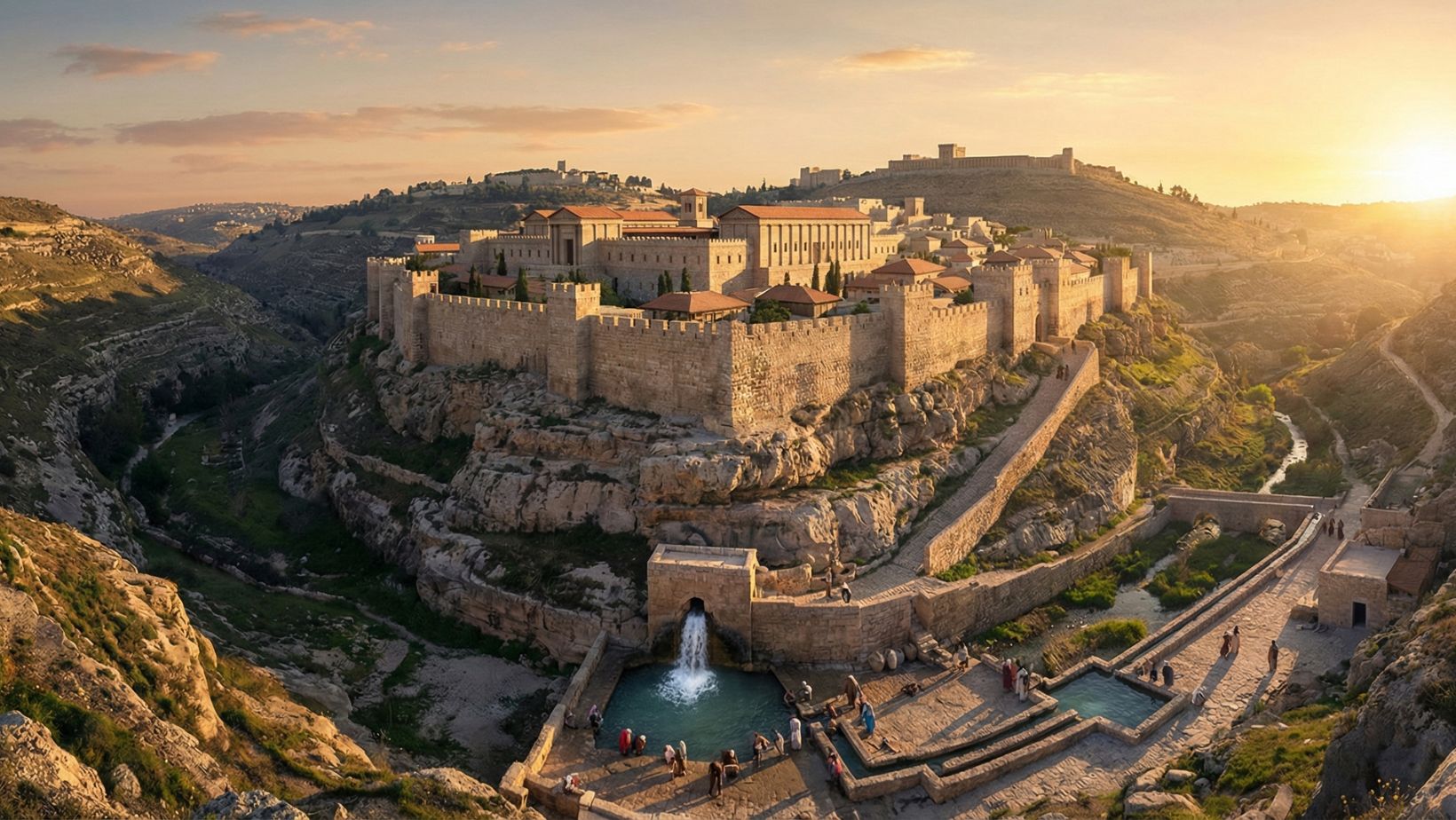
The City of David is the historic birthplace of Jerusalem, representing the archaeological heart of the ancient city. Originally a Jebusite fortress known as Zion, it was captured by King David over 3,000 years ago to serve as the capital of the United Kingdom of Israel. This narrow ridge, located just south of the present-day Old City walls, served as the political and spiritual center where the Ark of the Covenant was first brought and where the Davidic dynasty began its rule.
- Name: City of David (Hebrew: Ir David)
- Location: A narrow ridge south of the Temple Mount, Jerusalem
- Era: Established as Israelite capital ~1000 BCE
- Founder: King David (captured from the Jebusites)
- Key Landmarks: Gihon Spring, Hezekiah’s Tunnel, Pool of Siloam, The Stepped Stone Structure
- Biblical References: 2 Samuel 5, 1 Chronicles 11, Nehemiah 3
- Significance: Royal seat of the Davidic kings and the site of the original Zion
- Symbol: A harp or a crown — representing Davidic kingship and worship
Name Meaning
City of David refers specifically to the fortified settlement that King David established after conquering the stronghold of Zion. In the Bible, it is often synonymous with Zion, originally referring to the physical fortress and later evolving into a spiritual term for the dwelling place of God and the future hope of Israel.
Lineage / Historical Background
Origin: Originally the Jebusite city of Jebus, a Canaanite stronghold deemed impregnable due to its steep valleys and secure water source.
Conquest: David’s general, Joab, entered the city through the water shaft, allowing David to take the fortress without a massive siege.
Expansion: David built his palace here with cedar from Tyre, and his son Solomon later expanded the city northward to include the Temple Mount (Mount Moriah).
Biblical Era / Context
Time: The transition from the period of the Judges to the United Monarchy.
Setting: Strategically located between the territories of Benjamin and Judah, making it a neutral site to unify the twelve tribes.
Cultural Context: The city represents the shift from a nomadic or tribal existence to a centralized kingdom with a permanent capital and a national sanctuary.
Major Roles / Identity
Political Capital: The administrative headquarters for the kings of Judah for over 400 years.
Spiritual Center: The location where the Tabernacle sat before the Temple was built.
Military Fortress: A naturally defensible site surrounded by the Kidron and Tyropoeon Valleys.
Archaeological Treasure: The most excavated site in the Holy Land, revealing the daily lives of biblical figures.
Key Character Traits (The City’s Nature)
Resilience: Withstood numerous sieges, most notably the Assyrian siege under King Sennacherib.
Sanctity: Regarded as “the holy city” because of its association with God’s presence and the Davidic covenant.
Provision: Centered around the Gihon Spring, which provided life-sustaining water in a semi-arid climate.
Main Life Events
The Conquest: David takes the stronghold of Zion and renames it (2 Samuel 5).
Arrival of the Ark: David brings the Ark of the Covenant into the city with dancing and celebration (2 Samuel 6).
Hezekiah’s Preparations: Facing Assyrian invasion, King Hezekiah carves a 1,750-foot tunnel to divert water inside the city walls (2 Kings 20).
The Exile: The city and its palaces are destroyed by the Babylonians in 586 BCE.
The Return: Nehemiah rebuilds the walls of the city and the “stairs that go down from the City of David” (Nehemiah 3).
Major Relationships
King David: The city’s namesake who transformed it from a local fort to a world capital.
The Gihon Spring: The city’s “lifeblood,” essential for its survival and the site where Solomon was anointed king.
The Temple Mount: Located immediately to the north, creating a physical link between the King’s palace and God’s house.
The Prophets: Isaiah and Jeremiah walked these streets, delivering oracles to the kings of Judah.
Notable Passages
2 Samuel 5:7: “Nevertheless, David captured the fortress of Zion—which is the City of David.”
Psalm 48:1–2: “Great is the Lord… in the city of our God, his holy mountain. Beautiful in elevation, the joy of the whole earth, is Mount Zion.”
Isaiah 2:3: “For out of Zion shall go forth the law, and the word of the Lord from Jerusalem.”
Legacy & Impact
The Davidic Covenant: The city is the physical anchor of God’s promise that a descendant of David would sit on the throne forever.
Messianic Hope: The concept of the “New Jerusalem” and the “City of God” in the New Testament is rooted in the history of this site.
Archaeological Witness: Modern excavations have uncovered bullae (seal impressions) bearing the names of officials mentioned in the Book of Jeremiah, proving the historical accuracy of the biblical record.
Symbolism / Typology
The Stronghold: Symbolizes God as a refuge and fortress for His people.
Hezekiah’s Tunnel: Represents human wisdom and faith working together under divine pressure.
The Royal City: Foreshadows the Kingdom of Heaven and the reign of the “Son of David,” Jesus Christ.
Extra-Biblical References
The Siloam Inscription: An ancient Hebrew inscription found inside Hezekiah’s tunnel describing its construction.
Amarna Letters: Mention the city (as “Urusalim”) centuries before David’s conquest, confirming its ancient status.
Pilgrimage Road: A massive stepped street recently uncovered that led pilgrims from the Pool of Siloam up to the Temple.







Leave a Reply