
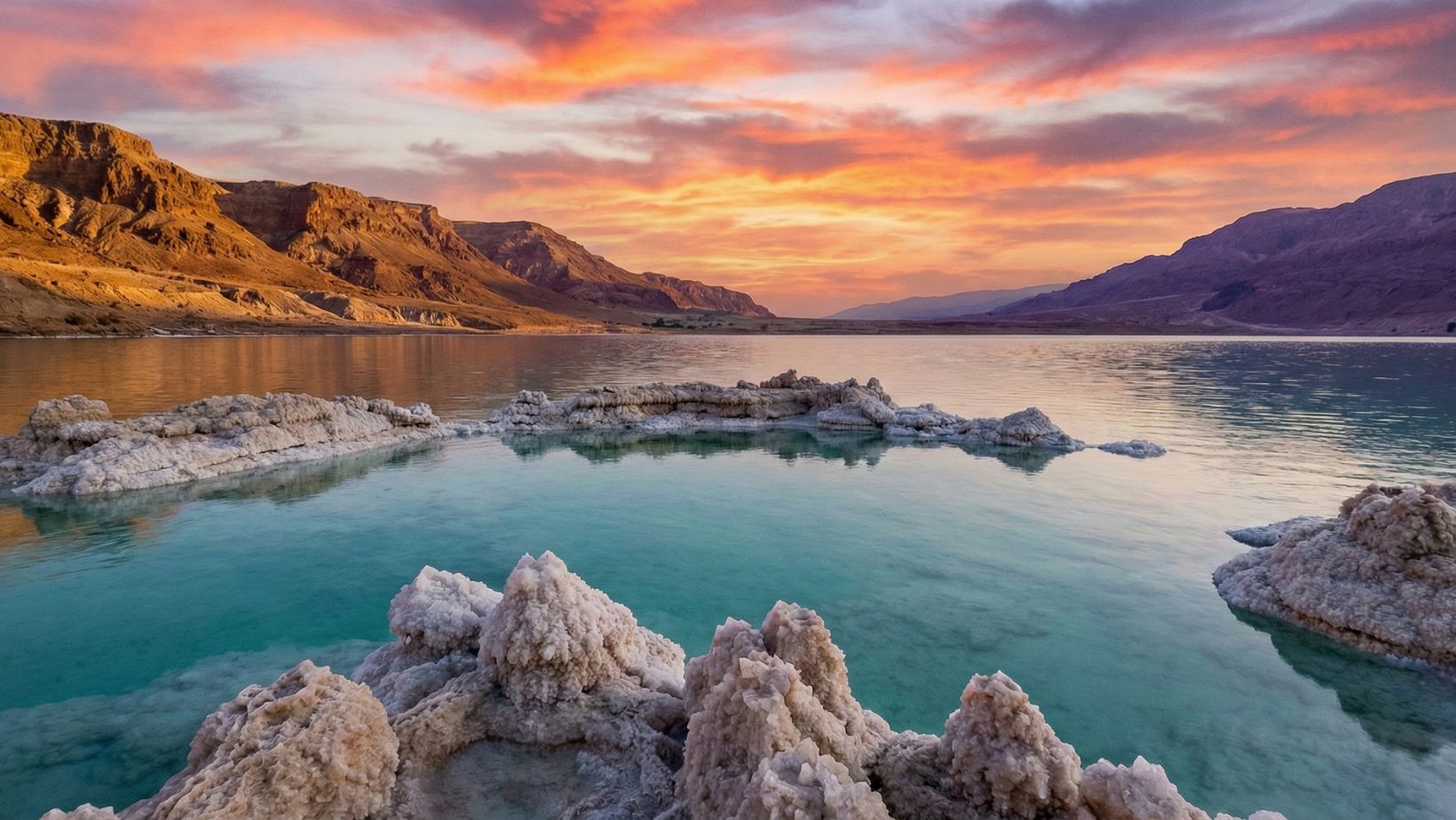
The Dead Sea, biblically known as the “Salt Sea” or the “Sea of the Arabah,” is a geological wonder and a site of profound biblical significance. Located in the Jordan Rift Valley, it is the lowest point on the face of the earth. In Scripture, it serves as a natural border, a backdrop for dramatic historical events, and a powerful theological symbol. While its waters are famous for being unable to sustain life due to extreme salinity, the prophets used this desolate landscape to paint a miraculous picture of God’s future redemptive power, where living waters would one day heal even this lifeless sea.
Quick Facts
- Biblical Names: The Salt Sea (Yam HaMelah), Sea of the Arabah, The Eastern Sea
- Location: The Jordan Rift Valley, bordered by Judah (Israel) to the west and Moab (Jordan) to the east
- Inlet: The Jordan River
- Outlet: None (water escapes only through evaporation)
- Physical Trait: Lowest elevation on land (~430 meters below sea level); hypersaline
- Key Events: Battle of the Kings (Gen 14), Destruction of Sodom & Gomorrah, Ezekiel’s Vision
- Nearby Locations: En Gedi, Masada, Qumran, Sodom, Gomorrah, Zoar
- Symbolism: Judgment, desolation, and the miraculous power of God to bring life from death
Name Meaning
“Salt Sea”: (Hebrew: Yam HaMelah) refers to the high mineral content that prevents macroscopic aquatic life. “Sea of the Arabah”: Refers to its location in the geological depression known as the Arabah. “Eastern Sea”: Used by prophets (like Ezekiel and Joel) to distinguish it from the “Western Sea” (the Mediterranean).
Geographical / Physical Context
Location: Situated in the deep trench of the Jordan Rift Valley. To the west lie the Judean wilderness and mountains; to the east rise the high plateaus of Moab and Edom.
Composition: It is nearly 10 times saltier than the ocean. The water is rich in minerals like magnesium, sodium, and potassium.
Topography: It is a terminal lake, meaning water flows in (primarily from the Jordan River) but does not flow out. The intense heat causes evaporation, leaving behind vast salt deposits.
Biblical Era / Context
Patriarchal Age: The fertile plains near the sea (the Valley of Siddim) were once lush “like the garden of the Lord” before the destruction of Sodom and Gomorrah (Genesis 13:10).
Conquest and Judges: It served as a boundary marker for the tribes of Israel, specifically the eastern border of Judah (Joshua 15:5).
Prophetic Era: Prophets utilized the sea’s barren nature to illustrate the severity of God’s judgment and the magnitude of His future restoration.
Major Roles / Identity
Natural Barrier: Its length and cliffs made it a formidable defensive border against invaders from the east (Moab and Ammon).
Place of Refuge: The caves and oasis springs along its western shore (like En Gedi) provided hiding places for David when he fled from King Saul.
Site of Divine Judgment: The southern basin is traditionally associated with the submerged ruins of Sodom and Gomorrah.
Prophetic Symbol: A visual representation of death that awaits the healing touch of God’s river (Ezekiel 47).
Key Characteristics
Barrenness: A landscape of salt pillars, mudflats, and lifeless water, representing a fallen world.
Buoyancy: The density of the water allows objects (and people) to float effortlessly.
Preservation: The dry climate and salt content preserve organic materials, which proved vital for the survival of the Dead Sea Scrolls found in the nearby Qumran caves.
Main Biblical Events
The War of the Kings: Four kings from the east fought five kings from the plain (including the kings of Sodom and Gomorrah) in the Valley of Siddim (the Salt Sea), leading to the capture of Lot (Genesis 14).
Judgment of Sodom: God rained sulfur and fire on the cities of the plain; Lot’s wife looked back and became a “pillar of salt,” an image forever linked to this region (Genesis 19).
David’s Strongholds: David hid in the “strongholds of En Gedi,” a fresh spring oasis on the barren shore of the Dead Sea, sparing Saul’s life in a nearby cave (1 Samuel 24).
Battle of Jehoshaphat: A vast army from Moab and Ammon marched around the Dead Sea to attack Judah. King Jehoshaphat prayed, and God caused the armies to destroy one another (2 Chronicles 20).
Ezekiel’s Vision: Ezekiel saw a river flowing from the Temple in Jerusalem down to the Dead Sea, making the salt water fresh and swarming with fish (Ezekiel 47:1–12).
Major Relationships (Associated Figures)
Abraham & Lot: Lot chose the fertile Jordan valley down to this sea; Abraham rescued him there.
David: Found refuge in the cliffs overlooking the sea.
Ezekiel: Prophesied the sea’s supernatural restoration.
The Essenes (Qumran): An ascetic Jewish sect that lived on the northwest shore, preserving the Dead Sea Scrolls.
Notable Passages
Genesis 14:3: “All these joined forces in the Valley of Siddim (that is, the Salt Sea).”
Numbers 34:12: “…and the border shall go down to the Jordan, and its limit shall be at the Salt Sea.”
Ezekiel 47:8: “And he said to me, ‘This water flows toward the eastern region and goes down into the Arabah, and enters the sea; when the water flows into the sea, the water will become fresh.’”
Legacy & Impact
Archeological Treasure: The arid environment surrounding the sea preserved the Dead Sea Scrolls, the most significant discovery of biblical manuscripts in history, confirming the reliability of the Old Testament text.
Geological Uniqueness: It remains a world-famous site for its mineral healing properties and unique geography.
Theological Hope: It stands as a permanent reminder that no situation is too “dead” for God to revive.
Symbolism / Typology
The “Dead” Heart: Because the sea receives water (from the Jordan) but never gives it out (no outlet), it becomes stagnant and lifeless. This is often used as a metaphor for a selfish spirit—one that takes blessings but does not give to others.
Judgment: The salt and sulfur remind believers of God’s holiness and judgment on sin (Sodom).
Restoration: In the New Heaven and Earth, there is no more sea of death. Ezekiel’s vision of the river of life healing the Dead Sea foreshadows the Holy Spirit and the Gospel penetrating the most hopeless, death-filled places of the human soul to bring life.
Extra-Biblical References
Josephus: The Jewish historian described the sea in detail, noting that the ruins of the five cities of the plain were still visible in his day (1st Century AD).
Madaba Map: A 6th-century mosaic map on a church floor in Jordan depicts the Dead Sea with boats, suggesting a different water level or artistic license in the Byzantine era.







Leave a Reply