
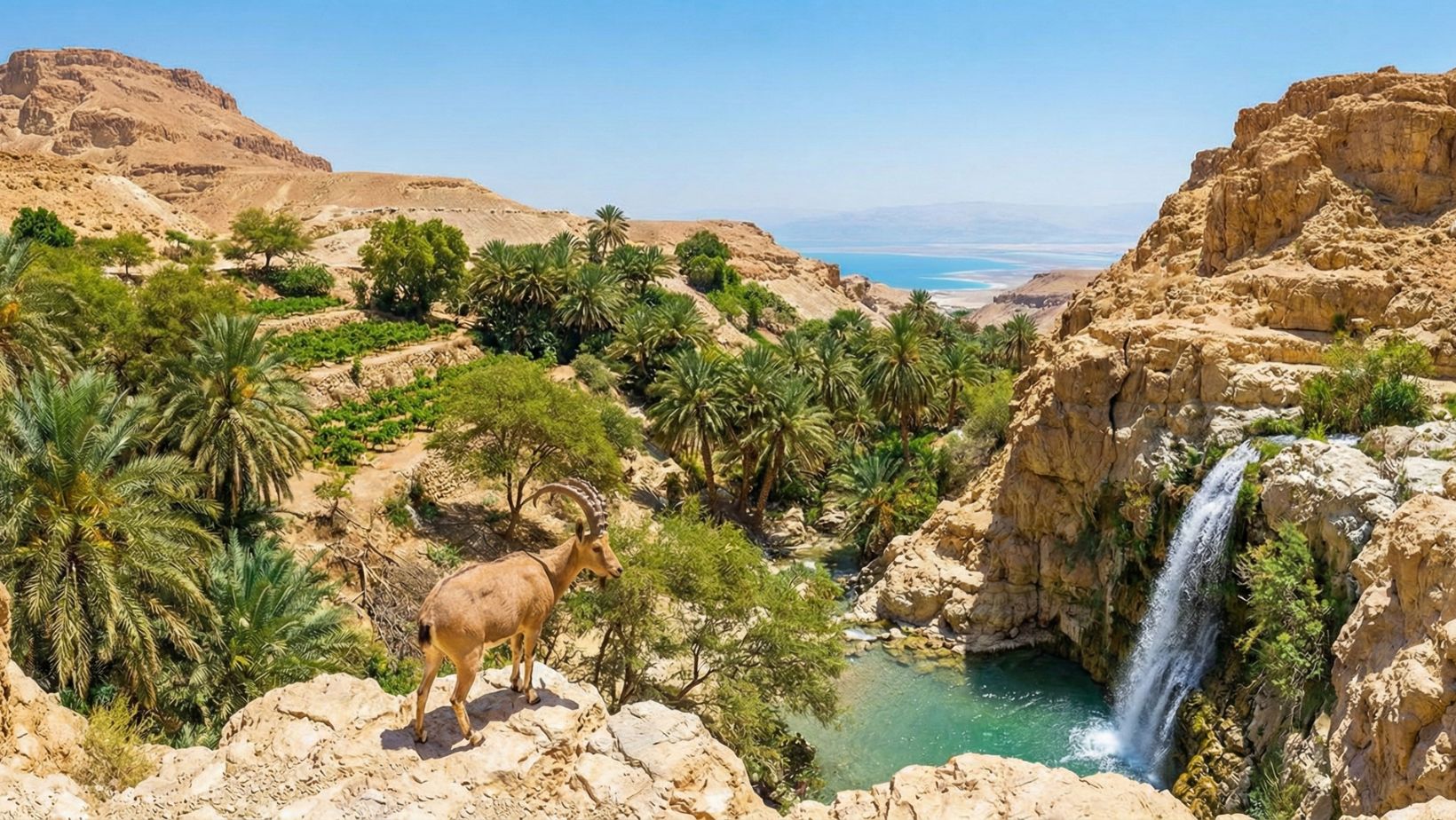
En Gedi is a prominent oasis located on the western shore of the Dead Sea, historically known as a place of refuge, life, and abundance amidst a barren wilderness. In biblical narrative, it serves as the dramatic backdrop where the future King David sought sanctuary from King Saul, and where he demonstrated extraordinary mercy by sparing Saul’s life in a cave. Beyond its role as a stronghold, En Gedi is celebrated in Scripture for its vineyards, beauty, and as a prophetic symbol of the life-giving power of God that will one day heal even the Dead Sea.
- Name: En Gedi (Hebrew: Ein Gedi)
- Meaning: “Spring of the Kid” or “Spring of the Young Goat”
- Location: Western shore of the Dead Sea, in the Judean Wilderness
- Territory: Tribe of Judah (Joshua 15:62)
- Key Associated Figures: David, King Saul, Solomon, Jehoshaphat, Ezekiel
- Primary Feature: Freshwater springs, waterfalls, and caves in a desert region
- Biblical Role: A natural fortress (stronghold); a source of spices and vineyards
- Modern Status: A major nature reserve and archaeological site in Israel
- Symbol: The Ibex (wild goat) and fresh living water
Name Meaning
Hebrew Etymology: The name is derived from two Hebrew words: Ein (meaning spring or fountain) and Gedi (meaning a young goat or kid).
Significance: The name “Spring of the Kid” perfectly describes the location, which to this day is populated by herds of Nubian Ibex (wild goats) that dwell in the rocky crags and drink from the freshwater waterfalls.
Geography / Location
Region: Situated in the Wilderness of Judah, bordering the Dead Sea (the lowest point on earth).
Terrain: Characterized by steep, rocky cliffs, deep canyons (wadis), and limestone caves.
Contrast: It represents a stark contrast between the arid, salty, desolate landscape of the Dead Sea and the lush, green vegetation fueled by the freshwater springs of the oasis.
Biblical Era / Context
Time: Spans from the conquest of Canaan (Joshua) through the Monarchy (David/Solomon) to the Prophets (Ezekiel).
Political Context: Served as a border region and a strategic lookout point due to its elevation and resource availability.
Economic Context: Famous in antiquity for the production of dates, vineyards, and specifically the highly engaged “balsam” (persimmon) perfume, which was a major export.
Major Roles / Identity
The Stronghold: A place of hiding and safety for fugitives, most notably David.
The Garden: A symbol of fertility and beauty, referenced in poetry for its henna blossoms and vineyards.
The Prophetic Symbol: Used by Ezekiel to illustrate the future restoration of Israel, where the deadly waters of the Dead Sea will become fresh.
Key Characteristics
Refuge: The abundance of caves and difficult terrain made it nearly impossible for a large army to root out a small group of defenders.
Life-Giving: In a region of death (the Dead Sea), En Gedi provides constant fresh water.
Mercy: It is historically linked to the concept of mercy, as it was the specific site where David chose not to kill the Lord’s anointed.
Main Biblical Events
Tribal Allotment: Listed as one of the cities in the inheritance of the tribe of Judah (Joshua 15:62).
David and Saul: David fled to the “strongholds of En Gedi” to escape Saul. Saul pursued him with 3,000 men. In a cave at En Gedi, David cut off a corner of Saul’s robe while the king relieved himself, sparing his life to prove his loyalty (1 Samuel 23:29–24:22).
Invasion of Judah: During the reign of King Jehoshaphat, a coalition of Moabites and Ammonites gathered at En Gedi (then called Hazazon Tamar) to attack Jerusalem. Jehoshaphat prayed, and God delivered Israel (2 Chronicles 20:1–2).
Prophetic Vision: Ezekiel prophesied that water flowing from the Temple would heal the Dead Sea, making it fresh so that fishermen would stand from En Gedi to En Eglaim (Ezekiel 47:10).
Major Relationships / Associated Figures
David: The fugitive who found physical safety in the rocks and spiritual strength in God while hiding here. Many believe Psalms such as Psalm 57 or 63 reflect his time in this wilderness.
King Saul: The pursuer who received mercy rather than judgment in the caves of En Gedi.
Solomon: Uses En Gedi as a metaphor for beauty in the Song of Songs, comparing his beloved to “a cluster of henna blossoms from the vineyards of En Gedi” (Song of Solomon 1:14).
Notable Passages
1 Samuel 23:29: “And David went up from there and lived in the strongholds of En Gedi.”
1 Samuel 24:4: The men said to David, “This is the day the Lord spoke of when he said… ‘I will give your enemy into your hands’… Then David crept up unnoticed and cut off a corner of Saul’s robe.”
Song of Solomon 1:14: “My beloved is to me a cluster of henna blossoms from the vineyards of En Gedi.”
Ezekiel 47:10: “Fishermen will stand along the shore; from En Gedi to En Eglaim there will be places for spreading nets.”
Legacy & Impact
Theology of Refuge: En Gedi serves as a physical representation of God as a “Rock” and “Fortress.” When David wrote of God as his refuge, he likely had the physical safety of En Gedi in mind.
Model of Grace: The interaction between David and Saul at En Gedi is one of the Bible’s primary examples of respecting God’s sovereignty and refusing to take vengeance into one’s own hands.
Historical Industry: Archaeological excavations have revealed ancient synagogues and evidence of a thriving secret industry of balsam perfume production that existed there for centuries.
Symbolism / Typology
Living Water: En Gedi represents Christ as the Living Water. Just as the spring sustains life in the desert, Christ sustains the believer in a fallen world.
The Cave: Symbolizes the “secret place of the Most High” (Psalm 91), where one finds protection.
Future Restoration: The prophecy of fishermen at En Gedi symbolizes the ultimate redemption of creation, where even the “dead” places will teem with life.
Extra-Biblical References
Josephus: The Jewish historian Flavius Josephus mentions En Gedi frequently, noting its excellence in palm trees and balsam.
Pliny the Elder: The Roman author described En Gedi as a town second only to Jerusalem in fertility and palm groves, though by his time it had become a “heap of ashes” due to war.
Archaeology: The Chalcolithic Temple and the ancient synagogue with a mosaic floor warning the community not to reveal the “secret of the town” (believed to be the balsam oil recipe) are key historical findings.







Leave a Reply