
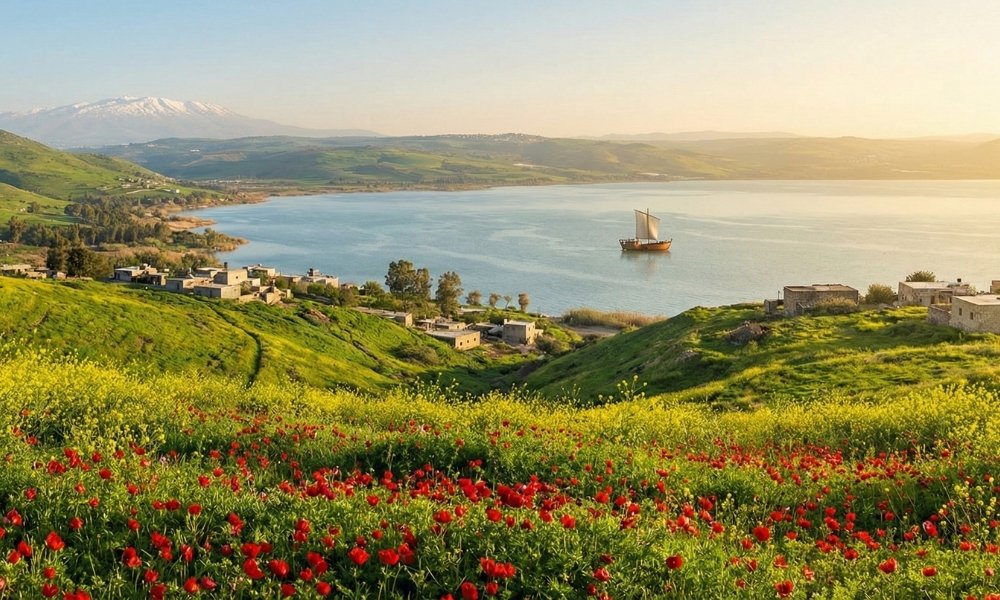
Galilee is the lush, northern region of Israel that served as the cradle of Christianity and the primary setting for the vast majority of Jesus’ life and public ministry. Distinct from the arid, religiously rigid region of Judea to the south, Galilee was known for its fertile soil, thriving fishing industry, and a population that was culturally distinct—often looked down upon by the Jerusalem elite as rustic or unrefined. It was here, among fishermen and farmers rather than priests and politicians, that Jesus called His disciples, delivered the Sermon on the Mount, and performed most of His recorded miracles, fulfilling the ancient prophecy that a “great light” would dawn in “Galilee of the Gentiles.”
Quick Facts
- Name: Galilee (Hebrew: Ha-Galil)
- Meaning: “The Circle,” “The District,” or “The Circuit”
- Location: Northern Israel, between the Mediterranean Sea and the Jordan River
- Key Body of Water: The Sea of Galilee (Lake Kinneret)
- Ruler (Jesus’ Time): Herod Antipas (Tetrarch)
- Tribal Territory: Asher, Naphtali, Zebulun, and Issachar
- Key Cities: Nazareth, Capernaum, Cana, Tiberias, Nain, Sepphoris
- Key Prophecy: Isaiah 9:1–2 (Light dawning in Zebulun and Naphtali)
- Demographics: A mix of Jews and Gentiles; highly populated and agricultural
Name Meaning
Ha-Galil: The name comes from a Hebrew root meaning “circle” or “roll.” It is short for Galil Ha-Goyim, meaning “District of the Nations” or “Circle of Gentiles” (Isaiah 9:1). This reflects the region’s history as a borderland frequently inhabited by or conquered by foreign nations, giving it a more cosmopolitan and mixed character than Judea.
Geography / Setting
Upper vs. Lower Galilee: The region is divided geographically into two parts:
- Upper Galilee: The northern section, characterized by high, rugged mountains and deep valleys. It was more isolated and difficult to access.
- Lower Galilee: The southern section, featuring rolling hills and broad, fertile valleys (like the Jezreel Valley). This is where most biblical events occurred (Nazareth, Cana, Nain, Capernaum) as it was more accessible and milder in climate.
The Sea of Galilee: The heart of the region is the freshwater lake (Kinneret) which sits roughly 700 feet below sea level, acting as a basin that traps heat and supports a tropical microclimate for agriculture and fishing.
Biblical Era / Context
Time: Prominent from the Settlement (Joshua) through the Roman Period.
Cultural Context:
- The “Outsiders”: Galileans were culturally distinct from Judeans. They spoke Aramaic with a heavy northern accent (which gave Peter away during Jesus’ trial).
- Religious Zeal: While the Jerusalem elite often viewed them as lax in observance, Galileans were actually known for their fierce independence and religious zeal. Many zealot revolts against Rome started in Galilee.
- Economy: Unlike Judea, which relied heavily on the Temple economy, Galilee was prosperous through agriculture (olives, grain, wine) and fishing.
Major Roles / Importance
The Headquarters of the Messiah: Jesus spent roughly 30 years of his life in Nazareth and 3 years in ministry centered in Capernaum—both in Galilee. He only traveled to Jerusalem for the mandatory feasts.
Fulfillment of Prophecy: The region that was first to suffer under the Assyrian invasion (Zebulun and Naphtali) was prophesied by Isaiah to be the first to see the light of the Messiah.
The Disciple Hub: Eleven of the twelve apostles were Galileans (Judas Iscariot, likely from Kerioth in Judea, was the only exception). The early church was initially known as a movement of “Galileans.”
Main Events
The Annunciation: The angel Gabriel appeared to Mary in Nazareth, a town in Lower Galilee (Luke 1).
The Great Light: Jesus moved his home from Nazareth to Capernaum, formally launching his ministry in the region (Matthew 4).
The Sermon on the Mount: Delivered on a hillside overlooking the Sea of Galilee, likely near Tabgha (Matthew 5–7).
Walking on Water: Occurred on the Sea of Galilee during a storm (Mark 6).
The Transfiguration: Traditionally located on Mount Tabor (Lower Galilee) or Mount Hermon (Upper Galilee border), where Jesus revealed His glory (Matthew 17).
The Great Commission: After His resurrection, Jesus directed the disciples to meet Him at a specific mountain in Galilee, where He commanded them to “make disciples of all nations” (Matthew 28:16–20).
Key Character Traits (Of the Region)
Receptive: While Jerusalem (the center of religious power) rejected Jesus, the “common people” of Galilee heard Him gladly. The Galilean villages were the primary recipients of His healing grace.
Despised: The Pharisees asked, “Search and see that no prophet arises out of Galilee” (John 7:52), highlighting the prejudice the region faced.
Notable Passages
Isaiah 9:1–2: “In the past he humbled the land of Zebulun and the land of Naphtali… Galilee of the nations. The people walking in darkness have seen a great light.”
Matthew 26:73: “Surely you are one of them; your accent gives you away.” (Spoken to Peter).
Acts 1:11: “Men of Galilee, why do you stand here looking into the sky?”
John 1:46: “Nathanael asked him, ‘Can anything good come out of Nazareth?’”
Legacy & Impact
“The Galilean”: The Roman Emperor Julian the Apostate (4th Century) reportedly died saying, “You have conquered, O Galilean,” acknowledging the triumph of Christ.
Universalism: Because Galilee was a “crossroads of the nations” (the Via Maris trade route passed through it), Jesus’ ministry there foreshadowed the Gospel going out to the Gentiles.
Symbolism / Typology
Light in Darkness: Galilee represents the arrival of hope in a place of hopelessness. It signifies that God often chooses the foolish, the weak, and the ignored things of the world to shame the wise (1 Corinthians 1:27).
The Microcosm: The mix of Jews and Gentiles in Galilee served as a microcosm for the future Church, which would include people from all nations.







Leave a Reply