
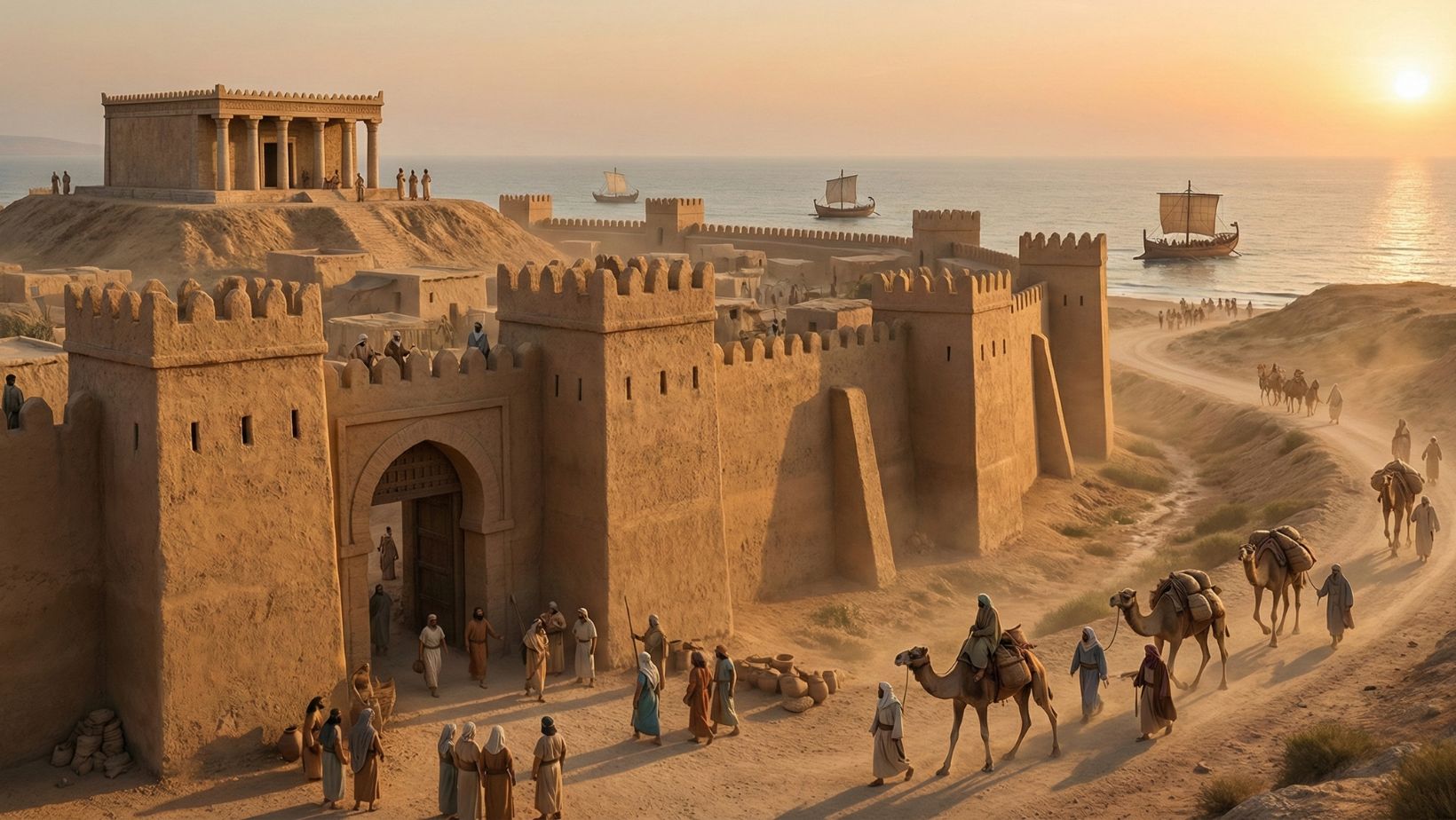
Gaza is one of the oldest cities in the world and serves as a significant location throughout the biblical narrative, primarily known as the stronghold of Israel’s perennial adversaries, the Philistines. Situated on the Mediterranean coast, it was a vital strategic outpost on the “Via Maris” trade route connecting Egypt and Canaan. In the Bible, Gaza is most famous as the site of Samson’s imprisonment and dramatic death, but it also appears in the New Testament as the setting for the spread of the Gospel to Africa. It represents a place of fierce conflict, idolatry, and ultimately, the demonstration of God’s power over foreign gods.
Quick Facts
- Hebrew Name: Azzah
- Meaning: “Strong,” “Mighty,” or “Fortified”
- Region: The Coastal Plain (Southwest Canaan)
- Status: Capital of the Philistine Pentapolis (League of 5 Cities)
- Key Inhabitants: Avvites, Anakim (Giants), Philistines
- Primary Deity: Dagon
- Famous Visitor: Samson (Judge of Israel)
- New Testament Mention: Acts 8:26 (The desert road)
Name Meaning
Gaza (Azzah): Derived from the Hebrew root az, meaning “strong” or “fierce.” The name reflects the city’s military character as a heavily fortified trading hub that was difficult to conquer.
Geography / Strategic Importance
The Gateway to Egypt: Gaza was the last major stop for travelers leaving Canaan and entering the Sinai desert toward Egypt. Whoever controlled Gaza controlled the lucrative trade routes between the continents of Africa and Asia.
The Coastal Plain: Unlike the hill country where the Israelites settled, Gaza was in the flat, fertile coastal lands, allowing for chariot warfare—a military advantage the Philistines held over Israel.
Biblical Era / Context
The Conquest (Joshua): Although Joshua conquered much of the land, he was unable to fully drive the inhabitants out of Gaza. It became one of the few places where the Anakim (a race of giants) remained (Joshua 11:22).
The Judges (Samson): During the time of the Judges, Gaza was the epicenter of Philistine power. It was a thriving metropolis of pagan worship and commerce, standing in stark contrast to the tribal villages of Israel.
The Prophets: Major prophets like Amos, Jeremiah, and Zephaniah frequently pronounced judgment on Gaza for its slave trading and cruelty toward Israel.
Main Events
The Survival of the Giants: When Israel swept through the Promised Land, the giant Anakim were wiped out from the mountains but found refuge in Gaza, Gath, and Ashdod (Joshua 11:22). This lineage likely produced Goliath.
Samson and the City Gates: In a display of supernatural strength and mockery of the Philistines, Samson visited a prostitute in Gaza, then ripped the massive city gates (bars and posts included) from the ground and carried them 40 miles uphill to Hebron (Judges 16:1–3).
Samson’s Imprisonment and Death: After being betrayed by Delilah, Samson was blinded and forced to grind grain in a Gaza prison. During a festival to the god Dagon, he prayed for strength one last time and pushed apart the central pillars of the temple, killing himself and thousands of Philistine leaders (Judges 16:21–30).
The Ark of the Covenant: When the Philistines captured the Ark, they moved it between their cities, including Gaza. The city was struck with tumors/plagues until they returned the Ark with a guilt offering of “five gold tumors and five gold rats” corresponding to their five rulers (1 Samuel 6).
Philip and the Ethiopian Eunuch: In the New Testament, an angel commands Philip to go “south to the road—the desert road—that goes down from Jerusalem to Gaza.” It was on this road that Philip baptized the Ethiopian official, marking the expansion of Christianity into Africa (Acts 8:26).
Notable Passages
Joshua 11:22: “No Anakim were left in Israelite territory; only in Gaza, Gath and Ashdod did any survive.”
Judges 16:3: “But Samson lay there only until the middle of the night. Then he got up and took hold of the doors of the city gate, together with the two posts, and tore them loose…”
Judges 16:30: “Samson said, ‘Let me die with the Philistines!’ Then he pushed with all his might, and down came the temple on the rulers and all the people in it.”
Acts 8:26: “Now an angel of the Lord said to Philip, ‘Go south to the road—the desert road—that goes down from Jerusalem to Gaza.’”
Legacy & Symbolism
The Persistent Enemy: Gaza symbolizes the “unconquered territory” in the believer’s life—the sins or strongholds that are not fully dealt with and remain to cause trouble later.
The Failure of False Gods: The destruction of Dagon’s temple in Gaza by a blind, enslaved servant of Yahweh serves as a theological statement: even in the enemy’s strongest sanctuary, the God of Israel is supreme.
Redemption of the Road: In the Old Testament, the road to Gaza was a path of war and slavery. In the New Testament, that same road becomes the path of evangelism and salvation for the nations (Ethiopia).







Leave a Reply