
Jabesh-gilead is a significant biblical city located east of the Jordan River in the territory of Manasseh. Though a location rather than a person, the “men of Jabesh-gilead” collectively display a distinct character arc in Scripture defined by deep kinship, desperate need, and extraordinary gratitude. The city is best known for its unwavering loyalty to King Saul—first as the recipients of his first military victory, and finally as the courageous guardians of his dignity after his tragic death. Their story weaves together the violent era of the Judges with the rise of the Monarchy, highlighting themes of honor and remembrance.
Quick Facts
- Name: Jabesh-gilead (Hebrew: Yavesh Gil’ad)
- Meaning: “Dryness of Gilead” or “Well-drained soil of Gilead”
- Region: Gilead (East of the Jordan River)
- Tribe: Manasseh (Half-tribe)
- Key Allies: Tribe of Benjamin, King Saul
- Key Enemy: Nahash the Ammonite
- Major Virtue: Courageous loyalty and gratitude
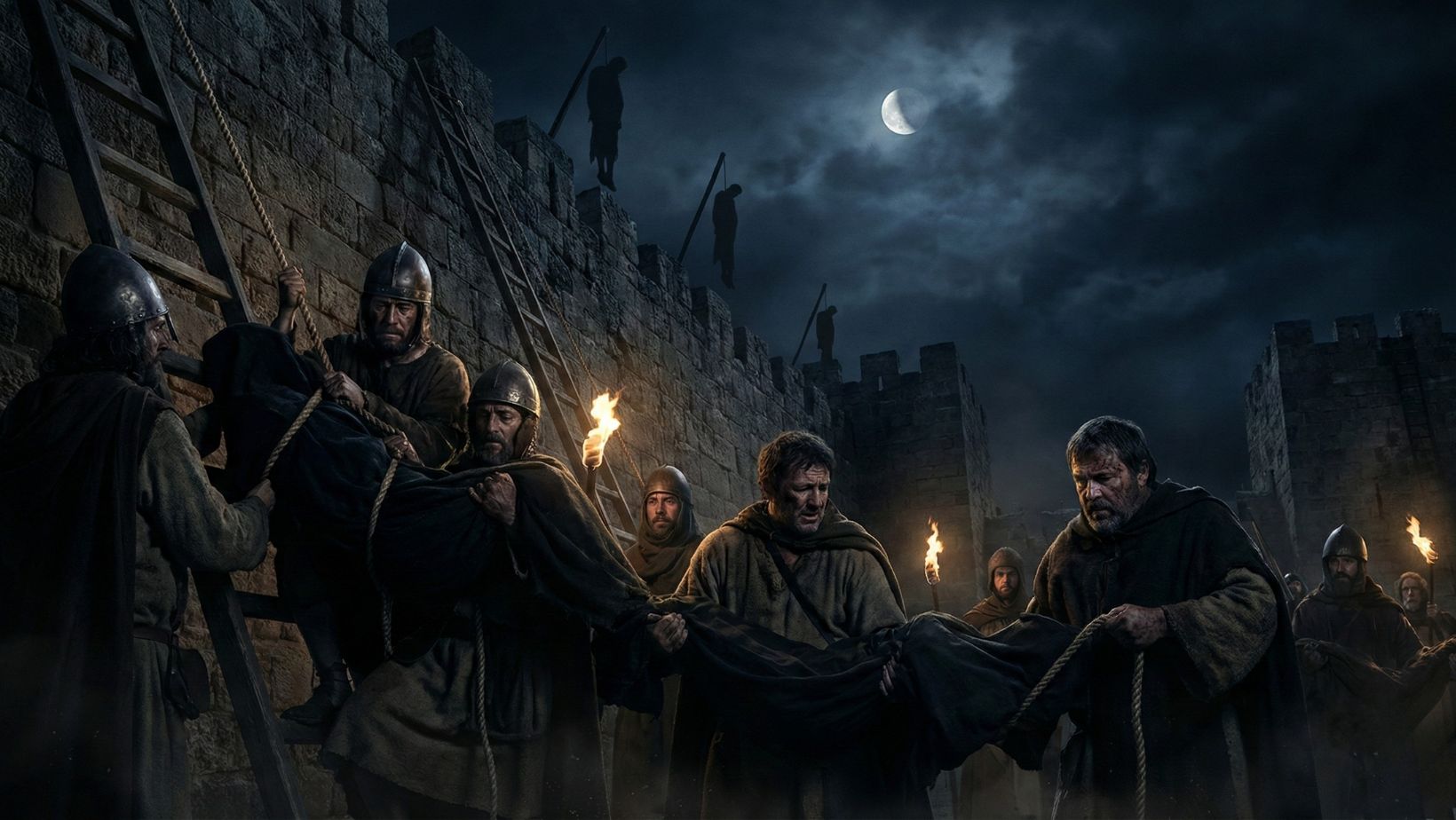
- Famous Act: Retrieving the bodies of Saul and his sons from the walls of Beth-shan
Name Meaning
Jabesh: Derived from a root meaning “dry” or “withered.” This likely refers to the specific geography of the site, situated on a wadi (seasonal stream) that might have run dry or had well-drained soil suitable for specific agriculture. Gilead: The mountainous region east of the Jordan River, known for its balm, spices, and rugged terrain.
Geography / Location
Site: most scholars identify it with Tell el-Maqlub, located on the Wadi Yabis (which preserves the ancient name). Strategic Importance: It commanded a view of the Jordan Valley and was accessible to the city of Beth-shan across the river, making the night raid to retrieve Saul’s body physically possible but perilous.
Biblical Era / Context
Time: Late Judges period (~1100 BCE) through the early Monarchy (King David’s reign). Political Situation: As a trans-Jordanian city, Jabesh was vulnerable to attacks from the Ammonites to the east. It also shared a unique blood-tie with the tribe of Benjamin due to the events in Judges 21.
Major Roles / Identity
The Kinsmen of Benjamin: Following the civil war against Benjamin (Judges 20), the Israelites needed wives for the surviving Benjaminites to prevent the tribe’s extinction. Jabesh-gilead was the only city that did not attend the assembly at Mizpah. As punishment, the city was attacked, but 400 young virgins were spared and given to the men of Benjamin. This made the future King Saul (a Benjaminite) and the people of Jabesh distant kin.
The Rescued Victims: The city was besieged by Nahash the Ammonite, who threatened to gouge out the right eye of every man in the city as a condition of surrender. This crisis launched Saul’s career as king when he rallied Israel to save them.
The Heroic Undertakers: When Saul died and his body was desecrated by the Philistines, the men of Jabesh were the only ones brave enough to intervene, reclaiming his body to give him a proper burial.
Key Character Traits (The Men of Jabesh)
Valiant: They were described as “valiant men” (ish hayil) for their daring night raid into enemy territory (1 Samuel 31:12). Loyal: They did not forget who had saved them. Decades after Saul rescued them, they returned the favor to his corpse. Honor-bound: In a culture of shame and honor, they refused to let their king’s body remain a public spectacle of disgrace.
Main Life Events
The Massacre and Forced Marriage (Judges 21): The city’s failure to join the national assembly led to a punitive slaughter, leaving only 400 women who became matriarchs of the restored tribe of Benjamin.
The Siege and Salvation (1 Samuel 11): Threatened with mutilation by the Ammonites, the elders of Jabesh asked for seven days’ respite. Saul, filled with the Spirit of God, butchered oxen and sent pieces throughout Israel to muster an army. He shattered the Ammonite siege, securing Jabesh’s freedom and cementing his kingship.
The Rescue of Saul’s Body (1 Samuel 31 / 1 Chronicles 10): After the Battle of Gilboa, the Philistines fastened the headless bodies of Saul and his sons to the wall of Beth-shan. Hearing this, the valiant men of Jabesh marched all night, took the bodies down, burned them (likely to prevent further desecration), and buried their bones under a tamarisk tree in Jabesh.
David’s Overture (2 Samuel 2): When David became king, his first diplomatic act was to send messengers to Jabesh-gilead, blessing them for their kindness to Saul and inviting their loyalty.
Major Relationships
King Saul: The central figure in the city’s history. He was their savior, their kinsman, and the object of their devotion. Nahash the Ammonite: The cruel warlord whose threat to blind them sparked Israel’s unification under a king. King David: Recognized their valor and sought to integrate them into his new kingdom, respecting their loyalty to his predecessor.
Notable Passages
1 Samuel 11:1–2: “And Nahash the Ammonite came up, and encamped against Jabesh-gilead… And Nahash the Ammonite answered them, On this condition will I make a covenant with you, that I may thrust out all your right eyes, and lay it for a reproach upon all Israel.”
1 Samuel 31:11–13: “And when the inhabitants of Jabesh-gilead heard of that which the Philistines had done to Saul; All the valiant men arose, and went all night, and took the body of Saul and the bodies of his sons from the wall of Beth-shan, and came to Jabesh, and burnt them there.”
2 Samuel 2:5: “David sent messengers… and said unto them, Blessed be ye of the LORD, that ye have shewed this kindness unto your lord, even unto Saul, and have buried him.”
Legacy & Impact
A Model of Gratitude: Jabesh-gilead stands as a biblical exemplar of remembering past kindnesses. They risked their lives not for a living king who could reward them, but for a dead one who had once saved them. The Dignity of the Body: Their actions underscore the importance of proper burial and respect for the human body in Judeo-Christian tradition. Closure for Saul: While Saul’s life ended in tragedy and spiritual failure, the tenderness of the men of Jabesh provides a grace note at the end of his dark story—he was still loved by those he had saved.
Symbolism / Typology
The Tamarisk Tree: They buried Saul under a tamarisk tree. Abraham also planted a tamarisk (Genesis 21:33). It is a tree of the desert, symbolizing endurance and a “memorial” in a dry land. The Night March: Represents the courage to walk into darkness to redeem what the enemy has stolen and shamed.




Leave a Reply