
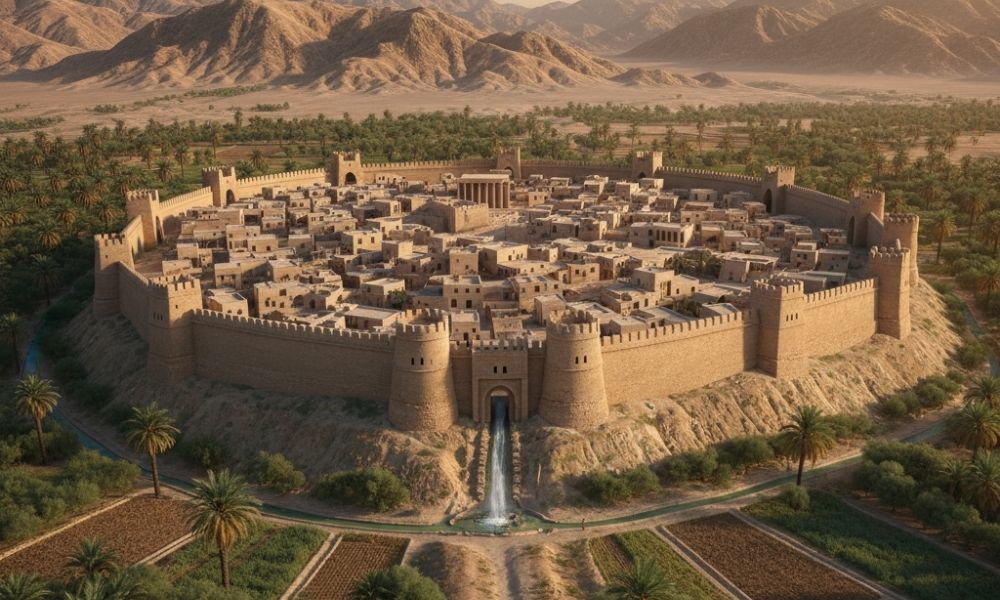
Jericho is one of the oldest continuously inhabited cities in the world, located near the Jordan River in the Jordan Valley. In the Bible, Jericho is best known as the first city conquered by the Israelites after crossing the Jordan under Joshua’s leadership. Its miraculous fall – when the walls collapsed after Israel marched and shouted – symbolizes God’s power and faithfulness to His promises.
Quick Facts
Name: Jericho (Hebrew Yeriḥo, meaning “City of Palms” or “Fragrant”)
Location: West of the Jordan River, near the Dead Sea
Region: Canaan / Later the territory of Benjamin
Modern Site: Tell es-Sultan, near present-day Jericho in the West Bank
Founded: c. 9000–8000 BCE (prehistoric settlement)
Biblical Significance: First city conquered in the Promised Land (Joshua 6)
Key Figures: Joshua, Rahab, Israelites
Symbol: The fallen walls – a sign of divine victory
Name Meaning
“City of Palms” — reflecting the fertile oasis and palm trees surrounding it (Deuteronomy 34:3).
“Fragrant” — may derive from the Hebrew word for “moon” or “fragrance,” suggesting beauty and fertility.
Historical & Biblical Context
Jericho was a fortified Canaanite city when Israel entered the Promised Land after 40 years in the wilderness. It stood as a symbol of strength and human power — yet God demonstrated His supremacy by giving it into Israel’s hands without traditional warfare.
Era: Late Bronze Age (c. 1400 BCE)
Setting: The Israelites had crossed the Jordan River during harvest season (Joshua 3–4) and were beginning their conquest of Canaan.
Major Biblical Events
1. The Fall of Jericho (Joshua 6)
- God commanded Joshua and the Israelites to march around the city once a day for six days, with priests carrying the Ark of the Covenant.
- On the seventh day, they marched seven times, blew the trumpets, and shouted.
- The walls collapsed, and Israel took the city — sparing only Rahab and her family for her faith and protection of the spies.
- The city was burned and placed under a curse: “Cursed before the LORD is the man who rebuilds this city, Jericho” (Joshua 6:26).
2. Rahab’s Faith (Joshua 2)
- Rahab, a Canaanite woman, hid the Israelite spies and professed faith in Israel’s God.
- She and her family were saved, becoming part of Israel — and part of the lineage of Jesus Christ (Matthew 1:5).
3. Rebuilding and Curse (1 Kings 16:34)
- Centuries later, Hiel of Bethel rebuilt Jericho, fulfilling Joshua’s curse: his firstborn and youngest sons died during the process.
4. Elisha and the Waters (2 Kings 2:19–22)
- The prophet Elisha purified Jericho’s spring with salt, healing its waters — a miracle symbolizing God’s restoration and blessing.
5. Jericho in the New Testament
- Jesus passed through Jericho, where He healed blind Bartimaeus (Mark 10:46–52) and saved Zacchaeus the tax collector (Luke 19:1–10).
- Jericho thus becomes a place not only of judgment but also of grace and transformation.
Symbolism / Themes
- Faith and Obedience: The walls fell not by human effort but by trusting God’s command.
- Divine Power: God brings victory in impossible situations.
- Judgment and Mercy: Rahab’s rescue shows God’s mercy even amid judgment.
- Transformation: From a cursed city to a site of healing and salvation in Jesus’ ministry.
Archaeological Notes
- Excavations at Tell es-Sultan reveal ancient walls and destruction layers dating to the Late Bronze Age.
- Scholars debate the exact timing, but the biblical account aligns with evidence of a fortified city that suffered sudden collapse.
Legacy & Impact
Jericho stands as a testament to faith — that obedience to God leads to victory, no matter the odds. Its story continues to inspire believers to trust in divine power rather than human strength.







Leave a Reply