
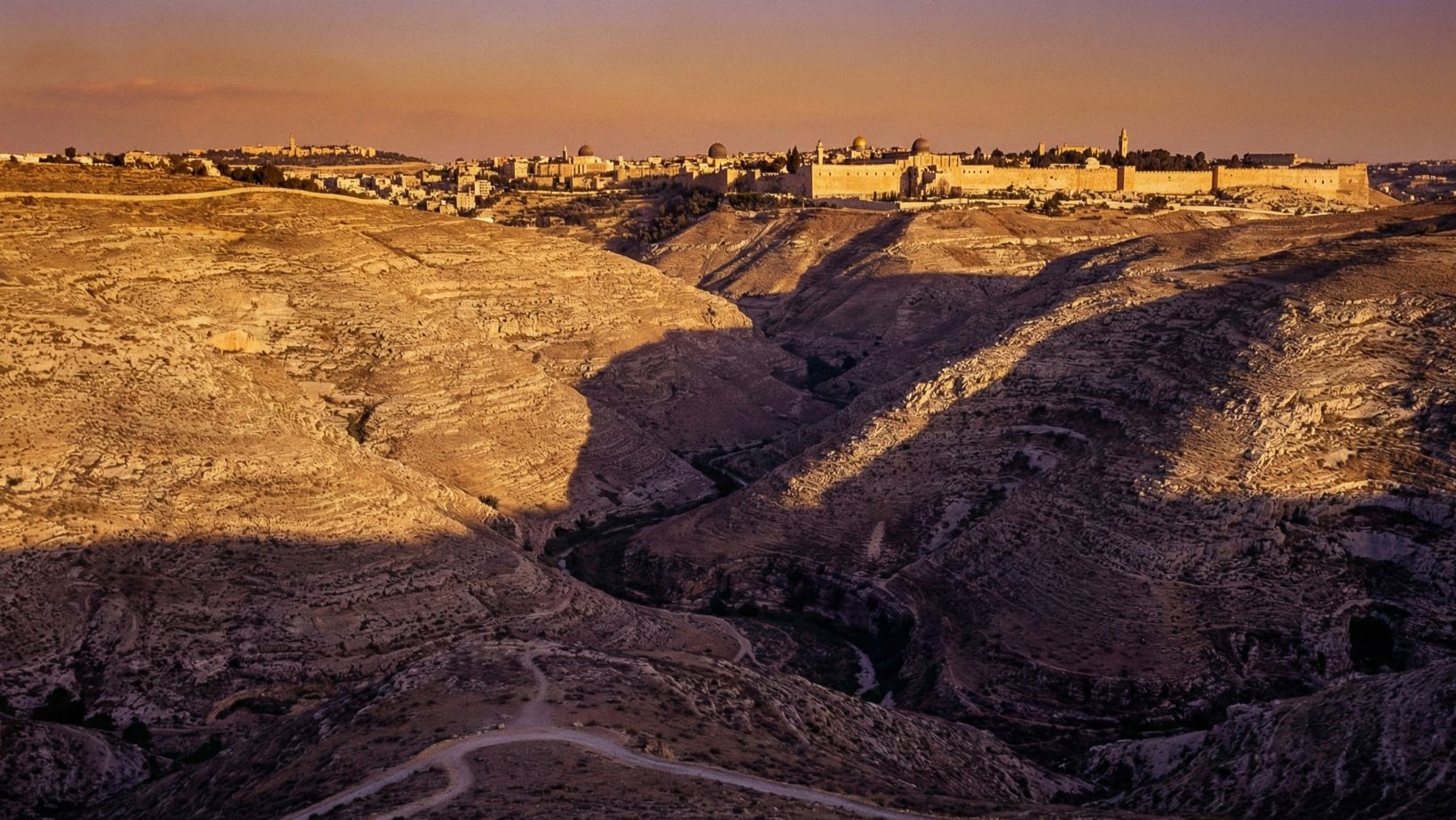
Judea is the mountainous southern region of ancient Israel, serving as the political and spiritual heartland of the Jewish people. Geographically, it corresponds roughly to the territory of the tribes of Judah and Benjamin. Historically, the name “Judea” is the Greco-Roman adaptation of “Judah,” which came into prominent use after the Babylonian exile to describe the area inhabited by the returning “Jews.” In the New Testament, it is distinct from Galilee (in the north) and Samaria (in the center). Judea is the setting for the birth of Jesus, His temptation in the wilderness, His final ministry, and His crucifixion and resurrection.
Quick Facts
- Name: Judea (Greco-Roman form of Judah)
- Meaning: “Praise” (from the patriarch Judah)
- Location: Southern region of Israel, between the Mediterranean and the Dead Sea
- Capital: Jerusalem
- Key Cities: Bethlehem, Jericho, Bethany, Hebron, Emmaus
- Terrain: Rugged hill country, central plateau, and the arid Judean Wilderness
- Roman Status: A Roman province governed by a Prefect (e.g., Pontius Pilate)
- Key Significance: The center of Jewish religious authority and Temple worship
Geography & Climate
The Hill Country: The backbone of Judea is a mountain range running north to south. These hills were the fortress of the Jewish people; while foreign armies could easily conquer the coastal plains, the rugged hills of Judea were difficult to invade.
The Wilderness of Judea: To the east of the central ridge lies a steep drop-off into the Jordan Rift Valley and the Dead Sea. This area is a rain shadow desert—barren, rocky, and filled with caves. It was a place of refuge for rebels (like David fleeing Saul) and a place of spiritual testing (Jesus’ temptation).
Historical Context
The Kingdom of Judah: After King Solomon died (~930 BCE), the nation split. The northern ten tribes became “Israel,” and the southern tribes became “Judah.” The southern kingdom remained loyal to the Davidic line and the Temple in Jerusalem.
The Roman Province: By the time of Jesus, Judea was under direct Roman occupation, unlike Galilee, which was ruled by the client king Herod Antipas. This made the political atmosphere in Judea much more tense, with frequent clashes between Jewish zealots and Roman legions.
Key Biblical Cities in Judea
Jerusalem: The “City of the Great King,” home to the Temple and the center of Jewish life. It is the site of the Last Supper, the Cross, and the Empty Tomb.
Bethlehem: The “City of David,” located about 6 miles south of Jerusalem. It is the birthplace of both King David and Jesus (Micah 5:2).
Jericho: located in the Jordan Valley at the foot of the Judean mountains. It was the first city conquered by Joshua and the site where Jesus healed Bartimaeus and met Zacchaeus.
Bethany: A village on the eastern slope of the Mount of Olives, home to Mary, Martha, and Lazarus.
Hebron: The ancient burial place of the Patriarchs (Abraham, Isaac, and Jacob) in the Cave of Machpelah.
Major Biblical Events
The Birth of Jesus (Luke 2): Joseph and Mary traveled from Nazareth (Galilee) to Bethlehem (Judea) for the census, fulfilling prophecy.
The Ministry of John the Baptist (Matthew 3): John appeared in the “Wilderness of Judea,” preaching repentance and baptizing in the Jordan River.
The Temptation of Jesus (Matthew 4): After his baptism, the Spirit led Jesus into the Judean wilderness to be tempted by the devil for 40 days.
The Raising of Lazarus (John 11): Jesus returned to Judea (specifically Bethany) to raise Lazarus, a miracle that directly precipitated the plot to kill Him by the Sanhedrin in Jerusalem.
Distinction: Judeans vs. Galileans
In the New Testament, there is a cultural tension between Judea and Galilee.
- Judeans (centered in Jerusalem) viewed themselves as the religiously pure elite, guardians of the Temple and the Law. They often looked down on Galileans as uneducated “country cousins” with funny accents (as noted during Peter’s denial in Matthew 26:73).
- Jesus (a Galilean) often faced his harshest opposition when he traveled south to Judea, where the religious establishment (Pharisees and Sadducees) held the most power.
Symbolism
The Heartland of Faith: Judea represents the established religious order and the fulfillment of the Davidic covenant.
The Wilderness: The Judean desert symbolizes the place of stripping away distractions to encounter God. It is where prophets are forged and where dependency on God is tested.
The Ascent: In Scripture, one always goes “up” to Jerusalem (Judea), not just geographically (due to elevation) but spiritually.







Leave a Reply