
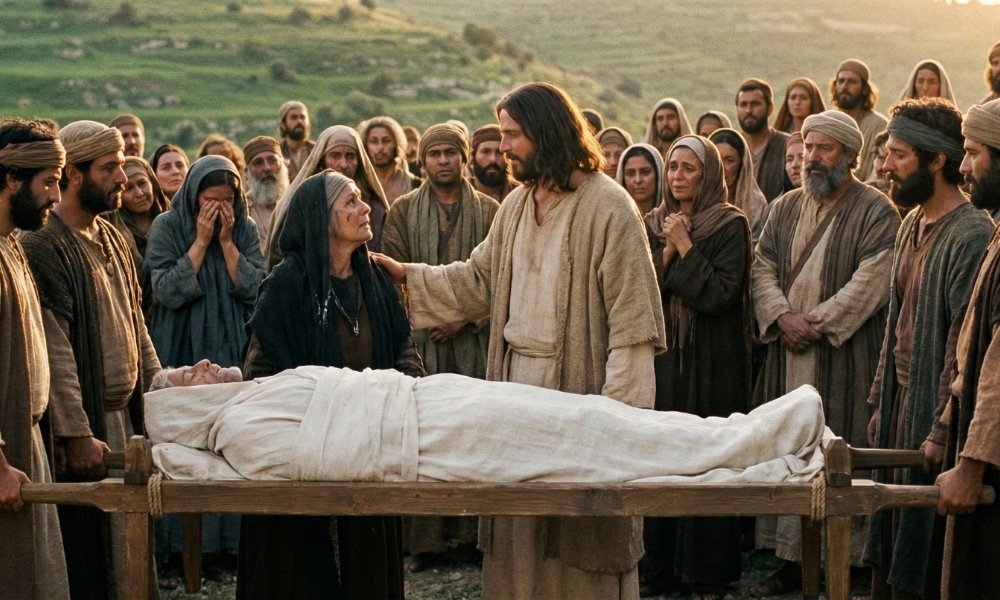
Nain is a small village in Galilee that appears only once in the Bible, yet it is the setting for one of the most tender and powerful displays of Christ’s authority. Recorded in Luke 7, it is here that Jesus interrupted a funeral procession to raise a widow’s only son from the dead. The miracle is significant not only for its power over death but also because it occurred without anyone asking for it—Jesus was moved solely by compassion for the grieving mother, whose social and economic future was being buried with her son.
Quick Facts
- Name: Nain (Hebrew: Naim)
- Meaning: “Pleasant,” “Delightful,” or “Lovely”
- Location: Lower Galilee, approx. 6 miles southeast of Nazareth
- Region: Northern slope of the Hill of Moreh
- Scripture Reference: Luke 7:11–17
- Key Figures: Jesus, The Widow of Nain, The Dead Son
- Key Event: Raising the widow’s son
- Modern Site: The Arab village of Nein
Name Meaning
Naim: Derived from a Hebrew root meaning “pleasant” or “lovely.” This likely refers to the village’s picturesque location overlooking the Jezreel Valley. The name serves as an ironic backdrop to the scene of deep grief found in the biblical narrative.
Geography / Setting
The Hill of Moreh: Nain sits on the northern slope of the Hill of Moreh. This is geographically significant because the village of Shunem is on the other side of the same hill. In the Old Testament, the prophet Elisha raised a woman’s son from the dead in Shunem (2 Kings 4). By performing a similar miracle at Nain, Jesus was geographically and spiritually identifying Himself as a prophet greater than Elisha.
The City Gate: The miracle took place at the “gate of the town.” In ancient times, cemeteries were always outside the city walls for ritual purity reasons, so the collision of the two crowds (Jesus entering, the funeral leaving) naturally occurred at the boundary.
Biblical Era / Context
Time: Early in Jesus’ Galilean ministry (c. 28–29 AD).
Social Context: In first-century Jewish society, a woman’s status and security depended on her male relatives. To be a widow was difficult; to be a widow who had lost her only son was a catastrophe. She was left without protection, income, or a future.
Major Roles / Importance
The God Who Sees: This is one of the few miracles where the text explicitly says Jesus acted because He “felt compassion” (splanchnizomai—a gut-wrenching pity), not because of the recipient’s faith.
The Great Prophet: The crowd’s reaction—”A great prophet has appeared among us!” (Luke 7:16)—shows they understood the connection to Elijah and Elisha, who had also raised the dead in this region.
Main Events
The Collision of Crowds: A large crowd was following Jesus (Life) toward the gate, while a large crowd was following the coffin (Death) out of the gate.
The Command: Jesus approached the bier (an open coffin or plank) and touched it. This was shocking, as touching a corpse or bier made a Jew ritually unclean (Numbers 19:11). Jesus did not contract uncleanness; instead, He transmitted life.
The Resurrection: He said, “Young man, I say to you, get up!” The dead man sat up and began to talk, proving the reality of his return to life.
The Reunion: The text movingly notes that Jesus “gave him back to his mother,” restoring not just a life, but a family unit.
Major Relationships
Jesus and the Widow: A relationship defined by unsolicited grace. The woman was too grief-stricken to ask for help; Jesus intervened purely out of love.
Jesus and the Crowd: The witnesses spread the news throughout Judea, setting the stage for John the Baptist (then in prison) to send messengers asking if Jesus was indeed the “Coming One.”
Notable Passages
Luke 7:13: “When the Lord saw her, his heart went out to her and he said, ‘Don’t cry.’”
Luke 7:14–15: “Then he went up and touched the bier they were carrying, and the bearers stood still. He said, ‘Young man, I say to you, get up!’ The dead man sat up and began to talk, and Jesus gave him back to his mother.”
Luke 7:16: “They were all filled with awe and praised God. ‘A great prophet has appeared among us,’ they said.”
Legacy & Impact
Hope for the Marginalized: The story is a favorite in Christian theology for demonstrating God’s special care for the vulnerable (widows and orphans).
Fore-shadowing: This resurrection (resuscitation) was a temporary victory over death, pointing toward Jesus’ own permanent resurrection.
Symbolism / Typology
The Gate: The city gate represents the boundary between the living (the city) and the dead (the cemetery). Jesus stands at the gate as the barrier that death cannot cross.
Spiritual Awakening: The command “Young man, get up” is often applied spiritually to those who are “dead in trespasses and sins” (Ephesians 2:1), needing the voice of Christ to awaken them.







Leave a Reply