
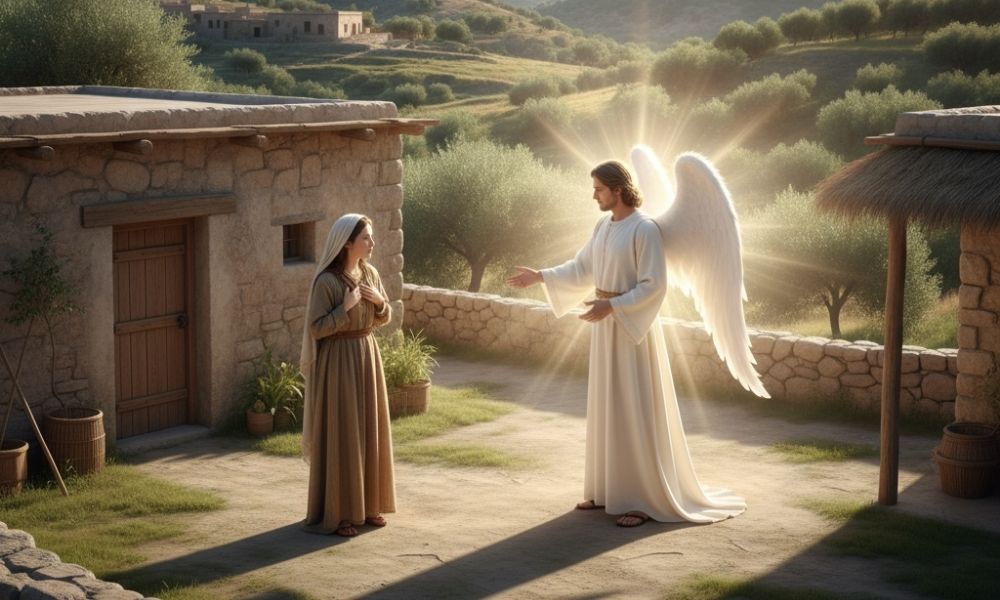
Nazareth, a modest town nestled in the hills of Galilee, holds a place of profound significance in Christian history. Though once a small and obscure village, it became forever known as the hometown of Jesus Christ, the Son of God. Nazareth’s story is one of humility, divine purpose, and the extraordinary emerging from the ordinary — a perfect reflection of God’s redemptive plan.
Quick Facts
Name Meaning: Possibly “Branch,” “Watchtower,” or “Guarded one” (from the Hebrew Netzer, meaning “branch”)
Location: Lower Galilee, northern Israel, about 15 miles (24 km) west of the Sea of Galilee
Tribe/Region: Zebulun
Era: New Testament period
Famous For: The hometown of Jesus Christ
Key Figures: Mary, Joseph, Jesus
Mentions: Gospels of Matthew, Mark, Luke, and John
Symbol: A green branch — representing new life and fulfillment of prophecy
Historical and Geographic Context
In the first century, Nazareth was a small, rural village with perhaps only a few hundred residents. It was set in a basin surrounded by hills, overlooking the fertile plains of Galilee. The region was known for agriculture and craftsmanship — trades such as carpentry, which Joseph and Jesus practiced.
Nazareth was not a place of prestige or influence; in fact, it was looked down upon by many Jews. This reputation is reflected in Nathaniel’s skeptical question in John 1:46:
“Nazareth! Can anything good come from there?”
Yet it was precisely this humble, overlooked setting that God chose for His Son to grow up, demonstrating that divine greatness is not defined by worldly status.
Biblical Significance
1. The Annunciation
Nazareth first takes center stage in Luke 1:26–27, where the angel Gabriel was sent by God to a young virgin named Mary:
“In the sixth month of Elizabeth’s pregnancy, God sent the angel Gabriel to Nazareth, a town in Galilee, to a virgin pledged to be married to a man named Joseph, a descendant of David.”
Here, in this quiet town, the greatest message in history was delivered — that Mary would conceive and give birth to the Son of God. The Incarnation — God becoming flesh — began in Nazareth.
2. Jesus’ Early Life
After Jesus’ birth in Bethlehem and the family’s flight to Egypt, Joseph was warned in a dream to return and settle in Nazareth (Matthew 2:23). This fulfilled prophecy:
“He will be called a Nazarene.”
Although the exact Old Testament verse is not quoted, the phrase likely draws on prophetic imagery such as Isaiah 11:1 — “A shoot will come up from the stump of Jesse; from his roots a Branch (netzer) will bear fruit.”
Thus, Jesus, the “Branch,” grew up in Nazareth — a living fulfillment of God’s word.
3. Jesus’ Ministry
Nazareth was the backdrop for Jesus’ early years and the beginning of His public ministry. In Luke 4:16–21, He entered the synagogue, read from Isaiah 61, and declared,
“Today this scripture is fulfilled in your hearing.”
However, the people of Nazareth rejected Him, unable to see beyond His familiar humanity. Their unbelief became a poignant reminder that faith is not born from familiarity, but from spiritual openness.
Symbolism and Spiritual Meaning
Nazareth symbolizes humility, obscurity, and divine purpose. It reveals how God often chooses what is small and lowly to accomplish His greatest works (1 Corinthians 1:27–29).
- Humility: God’s Son grew up in an insignificant town, not a royal city.
- Obedience: Mary and Joseph accepted God’s will in Nazareth with quiet faith.
- Fulfillment: The prophecies of the Messiah — the “Branch” — took root there.
- Revelation: God’s glory was first revealed to ordinary people in ordinary places.
Historical and Modern Legacy
Today, Nazareth is a thriving city in northern Israel and a major center of Christian pilgrimage. Visitors come to see sacred sites such as:
- The Basilica of the Annunciation — built over the traditional home of Mary, where Gabriel’s announcement is believed to have occurred.
- St. Joseph’s Church — marking the traditional site of Joseph’s workshop.
- Mary’s Well — where local tradition says the angel greeted Mary.
Despite its growth, modern Nazareth still reflects the same message that defined it in Scripture: God brings greatness from humility and fulfills His promises through unexpected means.
Prophetic Scripture
Isaiah 11:1 (NIV)
“A shoot will come up from the stump of Jesse; from his roots a Branch will bear fruit.”
This verse foreshadows the coming Messiah — the Netzer, or “Branch” — and ties directly to Nazareth’s name, reinforcing Jesus’ divine identity as the promised descendant of David.
Legacy Summary
Nazareth, once a small and scorned village, became the sacred setting of the Incarnation and the early life of Christ. It stands as a lasting testimony that God’s power is made perfect in humility and that His greatest works often begin in the most unexpected places.







Leave a Reply