
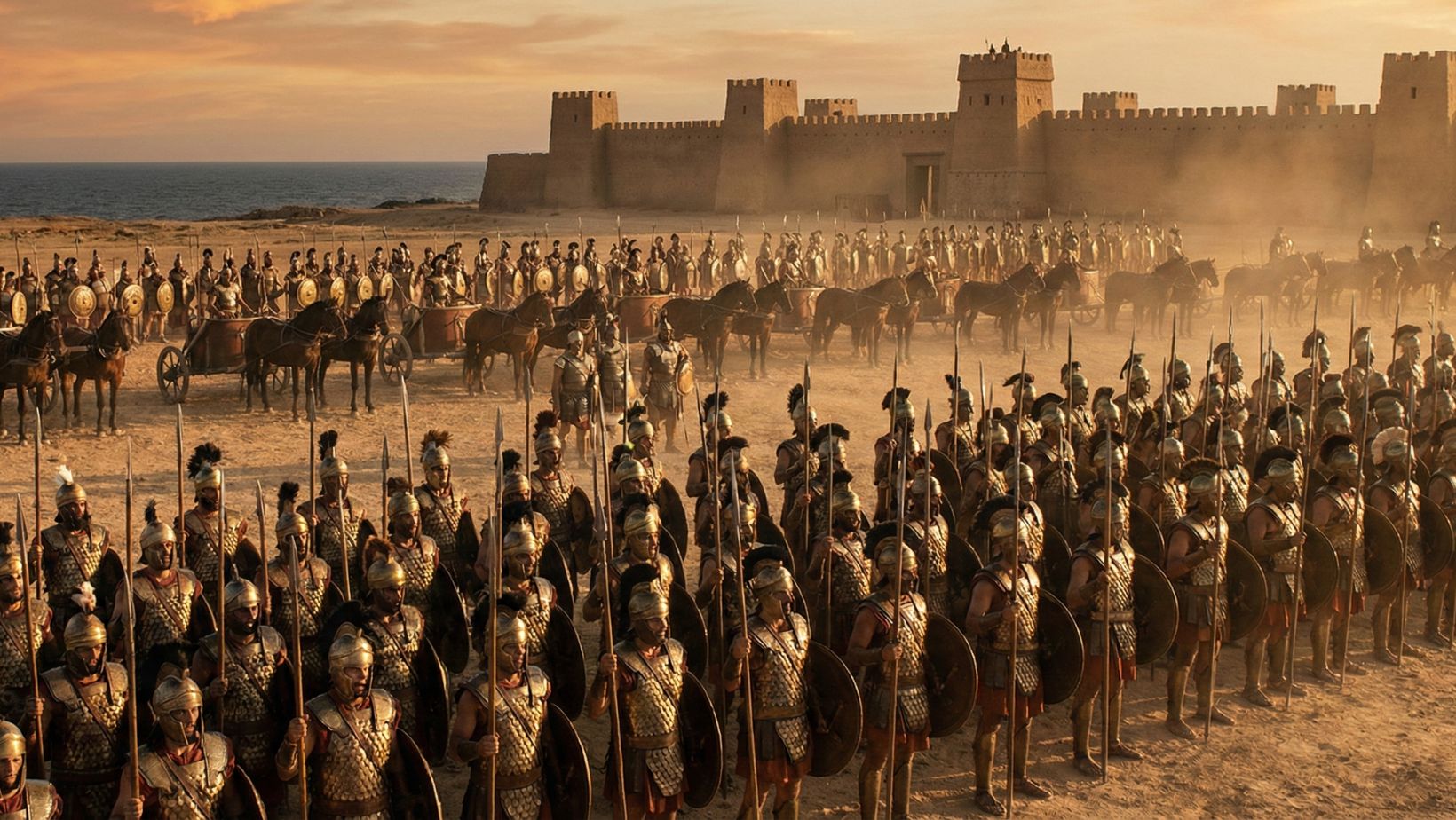
Philistia refers to the land of the Philistines, a warlike seafaring nation that settled on the southern coast of Canaan. Known in the Bible as the primary antagonists of ancient Israel during the era of the Judges and the early monarchy, the Philistines were a technologically advanced people, particularly in the use of iron. They served as a constant test of Israel’s faith and military resolve, playing a pivotal role in the events that led Israel to demand a king.
- Name: Philistines (Hebrew: Peleshet, meaning “Migrants” or “Invaders”)
- Region: The Southern Coastal Plain of Canaan (modern-day Gaza strip and southern Israel)
- Government: The Pentapolis (Confederation of five city-states: Gaza, Ashkelon, Ashdod, Ekron, Gath)
- Origins: The “Sea Peoples” from Caphtor (likely Crete/Aegean region)
- Era: Prominent from the Judges period through the Monarchy (~1200–600 BCE)
- Key Deities: Dagon, Baal-Zebub, Ashtoreth
- Famous Figures: Goliath, Achish, Delilah (associated), Ishbi-Benob
- Key Rivals: Samson, Saul, Jonathan, David
- Symbol: Iron Chariots — symbolizing military might and technological superiority
Name Meaning
The name “Philistine” comes from the Hebrew Peleshet, which implies “rolling” or “migratory,” leading to the meaning of “invaders” or “migrants.” This etymology reflects their history as a people who traveled across the Mediterranean Sea to settle in Canaan. The modern name “Palestine” is historically derived from “Philistia.”
Lineage / Origins
Ancestry: Genesis 10:14 traces them to the Casluhim, descendants of Mizraim (Egypt) and Ham, but notes they came from the region of Caphtor.
Migration: Historians identify them as part of the “Sea Peoples,” a confederation of naval raiders from the Aegean Sea (Crete/Greece) who disrupted the ancient Near East before settling on the Canaanite coast.
Geography: They occupied the fertile coastal plain, controlling the Via Maris, the major trade route connecting Egypt to Mesopotamia.
Biblical Era / Context
Time: Their power peaked during the transition from the Judges to the Kings of Israel (approx. 1100–1000 BCE).
Cultural Context: They were distinct from the Canaanites and Israelites. They were uncircumcised (a common derogatory descriptor used by Israelites), consumed pork, and brought advanced pottery and iron-working skills from the Aegean world.
Major Roles / Identity
The Perennial Enemy: They acted as the “thorn in the flesh” for Israel, often used by God to discipline His people when they fell into idolatry.
Technological Superpower: For a long time, they held a monopoly on iron technology, forcing Israelites to go to them to sharpen tools (1 Samuel 13:19–22).
Catalyst for Monarchy: Their military pressure was the primary political reason the tribes of Israel demanded a king to lead them in battle.
Key Character Traits (National)
Militaristic: They were a highly organized warrior society, utilizing heavy infantry, iron weapons, and chariots.
Persistent: Despite multiple defeats by Samson, Samuel, and David, they repeatedly regrouped and attacked.
Religious: They were deeply devoted to their pantheon, attributing their military victories to their god Dagon (1 Samuel 5).
Sophisticated: Unlike the hill-country Israelites of the Judges period, the Philistines had fortified cities, advanced art, and a complex political federation.
Main Historical Events
Settlement: Arrived and settled five major cities (The Pentapolis) along the coast.
Capture of the Ark: Defeated Israel at Ebenezer, captured the Ark of the Covenant, and placed it in the temple of Dagon, resulting in divine plagues upon their cities (1 Samuel 4–6).
Samson’s War: Engaged in a cycle of deception and violence with the Judge Samson, culminating in the destruction of their temple in Gaza (Judges 13–16).
Battle of Elah: Their champion, Goliath of Gath, challenged the armies of Israel but was defeated by the shepherd David (1 Samuel 17).
Defeat of Saul: Killed King Saul and his sons at the Battle of Mount Gilboa, fastening their bodies to the walls of Beth Shan (1 Samuel 31).
Subjugation: Eventually conquered and subdued by King David, breaking their dominance permanently (2 Samuel 5, 8).
Major Relationships
Israel: A relationship defined by hostile borders, cultural clashes, and intermittent warfare.
Samson: A complex relationship involving intermarriage, betrayal (Delilah), and mutual destruction.
David: David began as their conqueror (killing Goliath), later lived among them as a mercenary in exile (under King Achish of Gath), and finally became the King who subdued them.
God (Yahweh): Though they were pagans, they acknowledged the power of Israel’s God, especially after the plagues caused by the captured Ark.
Notable Passages
Exodus 13:17: God’s providence — “God did not lead them on the road through the Philistine country, though that was shorter.”
Judges 16:30: Samson’s death — “Let me die with the Philistines!”
1 Samuel 4:10: Military dominance — “So the Philistines fought, and the Israelites were defeated and every man fled to his tent.”
1 Samuel 17:45: David’s challenge — “You come against me with sword and spear and javelin, but I come against you in the name of the Lord Almighty.”
Legacy & Impact
Historical: The Philistines effectively vanished as a distinct people group following the Babylonian conquests (6th century BCE), though their name survives in the geographic term “Palestine.”
Theological: They serve as a reminder that God can use hostile forces to shape, discipline, and eventually strengthen His people.
Messianic: David’s victory over the Philistines is often seen as a precursor to the Messiah’s victory over the enemies of God.
Symbolism / Typology
Spiritual Warfare: In Christian allegory, the Philistines often represent the “flesh” or persistent sins that war against the spirit.
Goliath: Represents seemingly insurmountable obstacles that can only be overcome through faith in God.
Iron Chariots: Symbolize worldly power and human reliance on technology over reliance on God.
Extra-Biblical References
Egyptian Records: The mortuary temple of Ramesses III at Medinet Habu depicts the “Peleset” (Philistines) as Sea Peoples with distinctive feathered headdresses, defeated by Egypt and settled in Canaan.
Archaeology: Excavations in Ashkelon, Gath, and Ekron have revealed Aegean-style pottery, hearths, and evidence of a pork-heavy diet, confirming their non-Semitic origins.







Leave a Reply