
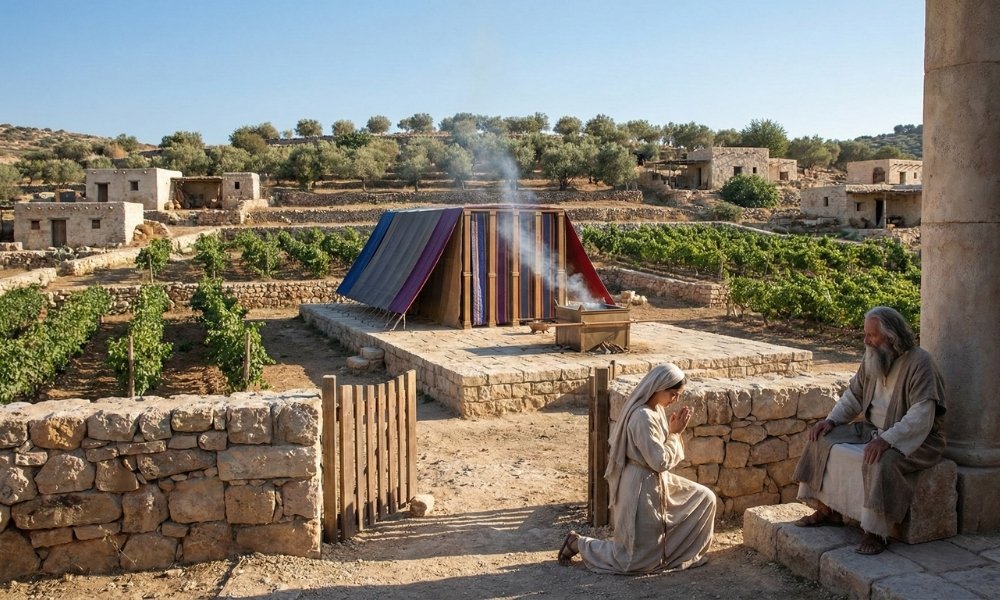
Shiloh was the first spiritual and administrative capital of Israel after the conquest of Canaan. Located in the hill country of Ephraim, it served as the resting place of the Tabernacle (Tent of Meeting) and the Ark of the Covenant for nearly four centuries during the era of the Judges. It was here that the land was divided among the tribes, where Hannah prayed for a son, and where the boy Samuel heard the voice of God. Shiloh represents the formative years of Israel’s national faith—a place of divine meeting that eventually fell into ruin due to priestly corruption, serving as a sober warning in later biblical history.
Quick Facts
- Name: Shiloh
- Meaning: “Place of Peace,” “Tranquility,” or “To whom it belongs”
- Location: Hill country of Ephraim (north of Bethel, south of Lebonah)
- Status: Central Sanctuary of Israel (pre-Jerusalem)
- Key Structures: The Tabernacle (Mishkan), later a semi-permanent structure
- Key Figures: Joshua, Eli, Hophni, Phinehas, Hannah, Samuel
- Archeology: Modern Khirbet Seilun; excavations reveal a platform for the Tabernacle and evidence of destruction by fire (c. 1050 BCE).
Name Meaning
Shiloh: Derived from the Hebrew root sh-l-h, implying peace, tranquility, or safety.
The Prophetic Connection: The name appears in Genesis 49:10 (“The scepter shall not depart from Judah… until Shiloh comes”). While debated, this is often interpreted as a reference to the Messiah (“The Peacemaker” or “He to whom it belongs”) rather than just the city itself.
Geography / Setting
Location: Uniquely, the Bible gives precise coordinates for Shiloh in Judges 21:19: “North of Bethel, south of Lebonah and east of the road that goes up from Bethel to Shechem.”
Terrain: Nestled in a valley surrounded by hills, providing natural acoustics. It was centrally located in the territory of Ephraim, the dominant tribe at the time.
Biblical Era / Context
Time: From the end of Joshua’s conquest (Late Bronze Age) through the period of the Judges, ending shortly before the Monarchy (Iron Age I).
Cultural Context: Israel was a loose confederation of tribes without a king. Shiloh was the unifying center that held them together, serving as the destination for the annual pilgrimages before the Temple was built in Jerusalem.
Major Roles / Importance
The Center of Worship: It housed the Ark of the Covenant and the Tabernacle. This was the only place where sacrifices could be legitimately offered for the nation.
Administrative Hub: Under Joshua, the casting of lots for the tribal allotments took place here (Joshua 18). It was the headquarters for the final phase of the conquest.
Judicial Center: As the home of the High Priest (notably Eli), it was where disputes were settled and guidance was sought.
Main Events
The Land Distribution: The “whole assembly” gathered at Shiloh to set up the Tent of Meeting, and Joshua distributed the remaining inheritance to seven tribes (Joshua 18:1).
The Benjamite Brides: Following a civil war, the men of Benjamin were allowed to take wives from the dancing maidens of Shiloh during a vineyard festival to save the tribe from extinction (Judges 21).
Hannah’s Vow: The barren woman Hannah came to the Tabernacle at Shiloh, weeping and praying. Her vow to dedicate her son to God resulted in the birth of the prophet Samuel (1 Samuel 1).
The Call of Samuel: The young boy Samuel, ministering to the Lord under Eli, heard God calling his name at night in the Tabernacle courts (1 Samuel 3).
The Loss of the Ark: The Israelites foolishly took the Ark from Shiloh into battle against the Philistines. The Ark was captured, and a runner brought the news to Shiloh, causing Eli to fall over and die (1 Samuel 4).
The Destruction: Though not explicitly described in narrative, Jeremiah 7:12 indicates the Philistines marched to Shiloh and destroyed it after capturing the Ark.
Key Character Traits (Of the City)
Holy yet Corruptible: It began as a place of consecration under Joshua but devolved into a place of greed and immorality under Eli’s sons, Hophni and Phinehas, who abused their priestly duties.
Transient: Shiloh represents the “temporary” dwelling of God. God eventually “abandoned the tabernacle of Shiloh” (Psalm 78:60) to choose Zion (Jerusalem).
Notable Passages
Joshua 18:1: “The whole assembly of the Israelites gathered at Shiloh and set up the tent of meeting there.”
1 Samuel 1:3: “Year after year this man [Elkanah] went up from his town to worship and sacrifice to the LORD Almighty at Shiloh.”
Jeremiah 7:12: “Go now to the place in Shiloh where I first made a dwelling for my Name, and see what I did to it because of the wickedness of my people Israel.”
Legacy & Impact
The Theology of Replacement: Shiloh serves as a theological warning. Jeremiah warned the people of Jerusalem not to trust blindly in the Temple, reminding them that God destroyed His sanctuary at Shiloh because of sin.
Archeological Verification: Excavations have uncovered the outlines of a structure with the exact dimensions of the Tabernacle, confirming the biblical account of its location and size.
Symbolism / Typology
Shiloh as Messiah: The obscure reference in Genesis 49 connects the name Shiloh to the coming King from the tribe of Judah who brings ultimate rest.
Ichabod: The tragic end of Shiloh is associated with the name Ichabod (“The Glory Has Departed”), symbolizing the terrible reality of God withdrawing His presence from His people.







Leave a Reply