
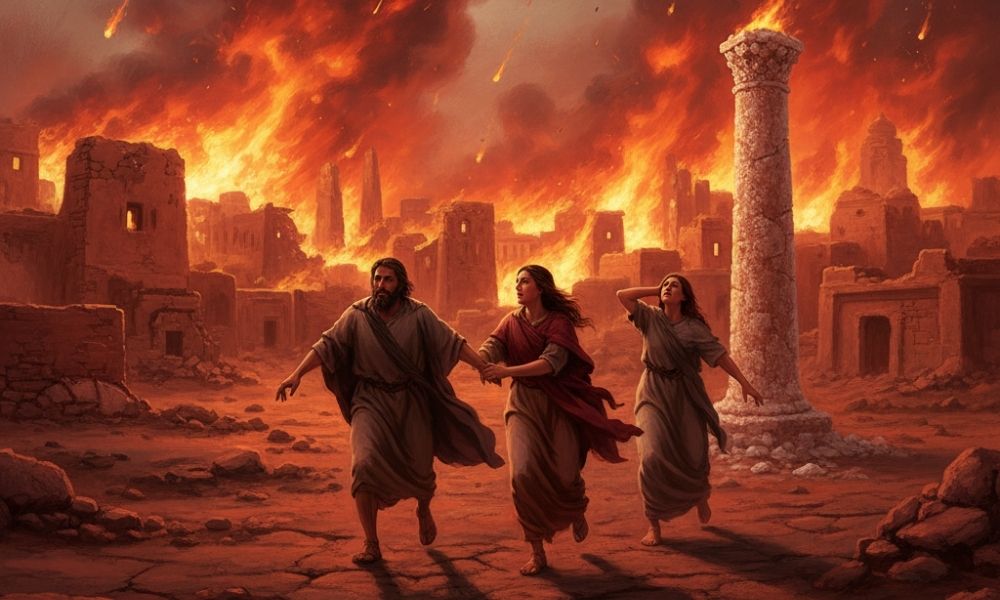
Sodom and Gomorrah

Sodom and Gomorrah were prosperous but corrupt cities destroyed by God with fire for their great wickedness — yet God spared Lot, revealing His justice and mercy.


Sodom and Gomorrah were two ancient cities destroyed by God for their extreme wickedness and moral corruption. Their story, found in Genesis 18–19, serves as one of the Bible’s clearest examples of divine justice and a lasting warning against sin and rebellion.


Quick Facts

Names: Sodom (Hebrew: Sedom, “Burning”) and Gomorrah (Hebrew: ʿAmorah, “Submersion”)
Location: Plains of the Jordan Valley, near the Dead Sea
Era: Time of Abraham (~19th century BCE)
Key Figures: Abraham, Lot, Lot’s wife, the two angels
Cause of Destruction: Rampant wickedness, violence, and sexual immorality
Judgment: Fire and brimstone from heaven (Genesis 19:24)
Survivors: Lot and his two daughters
Symbol: Divine judgment and moral corruption


Background

Sodom and Gomorrah were part of the “Cities of the Plain,” known for their prosperity and fertile land. Despite their wealth, the people became notorious for sin, arrogance, and cruelty toward strangers. God revealed to Abraham that He would destroy the cities for their evil, prompting Abraham to intercede and plead for mercy (Genesis 18:22–33).


Divine Judgment

Two angels arrived in Sodom, where Lot, Abraham’s nephew, welcomed them into his home. The men of the city surrounded the house, demanding to commit violence against the visitors — a shocking display of depravity. The angels struck the men with blindness and warned Lot to flee before God’s destruction fell.

At dawn, “the LORD rained down burning sulfur on Sodom and Gomorrah” (Genesis 19:24). The cities and their inhabitants were utterly consumed. Lot and his daughters escaped, but Lot’s wife, looking back longingly, was turned into a pillar of salt (Genesis 19:26).


Lessons and Themes

  • God’s Justice: His holiness cannot tolerate persistent sin and rebellion.
  • Mercy for the Righteous: God spared Lot, showing compassion toward the faithful.
  • Intercession: Abraham’s prayer reveals God’s readiness to show mercy if even a few are righteous.
  • Moral Warning: Their destruction became a symbol of what happens when people reject God’s truth (2 Peter 2:6; Jude 1:7).

Legacy and Symbolism

Throughout Scripture, Sodom and Gomorrah represent the height of human depravity and the certainty of divine judgment. Jesus later referred to them as examples of the final judgment awaiting unrepentant cities (Matthew 11:23–24). Yet even amid destruction, God’s mercy is displayed through the rescue of Lot — a testimony that the righteous are never forgotten.


Notable Passages

  • Genesis 18:20: “The outcry against Sodom and Gomorrah is so great and their sin so grievous.”
  • Genesis 19:24: “The LORD rained down burning sulfur on Sodom and Gomorrah.”
  • Luke 17:29: “It rained fire and sulfur from heaven and destroyed them all.”

Leave a Reply

Your email address will not be published. Required fields are marked *

Bible Characters

  • Mark (John Mark)
  • Mark (John Mark)

    John Mark was a young disciple who overcame early failure to become a trusted companion of Paul and Peter, ultimately authoring the dynamic Gospel that bears his name.


  • Matthew

    Matthew was a despised tax collector transformed by grace into a devoted apostle, whose Gospel bridges the Old and New Testaments by proclaiming Jesus as the promised Messiah and King.


  • Nabal

    Nabal was a wealthy but foolish landowner whose arrogance and refusal to show hospitality to David led to divine judgment and his sudden death.


Biblical Events

  • David lies to Ahimelech
  • Mark (John Mark)

    John Mark was a young disciple who overcame early failure to become a trusted companion of Paul and Peter, ultimately authoring the dynamic Gospel that bears his name.


  • Matthew

    Matthew was a despised tax collector transformed by grace into a devoted apostle, whose Gospel bridges the Old and New Testaments by proclaiming Jesus as the promised Messiah and King.


  • Nabal

    Nabal was a wealthy but foolish landowner whose arrogance and refusal to show hospitality to David led to divine judgment and his sudden death.


Bible Locations

  • Jezreel
  • Jezreel

    Jezreel was the fertile royal seat of King Ahab and Queen Jezebel, famous for the murder of Naboth and the site where divine judgment eventually wiped out their entire dynasty.


  • Aphek

    Aphek was a strategic military stronghold and staging ground on the Sharon Plain where the Philistines gathered to capture the Ark and where David was providentially released from the Philistine army.


  • Lachish

    Lachish was the second most powerful city in ancient Judah, a mighty fortress whose dramatic fall to Assyria and Babylon serves as a pivotal moment in biblical history and archaeology.


You May Also Like:

  • The Twelve Tribes of Israel were the tribal divisions descended from the sons of Jacob that formed the foundation of the Israelite nation and the prophetic lineage of the Messiah.

  • After burying Jacob in Canaan with great honor, Joseph reassures his fearful brothers that their past evil was overruled by God for good, and he dies in Egypt with a prophetic command that his bones be carried to the Promised Land.

  • On his deathbed, Jacob gathers his twelve sons to prophesy their destinies, disqualifying the firstborns for their sins and appointing Judah as the royal line and Joseph as the fruitful recipient of the double portion.

  • On his deathbed, Jacob adopts Joseph’s two sons as his own, deliberately crossing his hands to give the greater blessing to the younger Ephraim, declaring God as his Shepherd and Redeemer.

Bibliva

FREE
VIEW





