
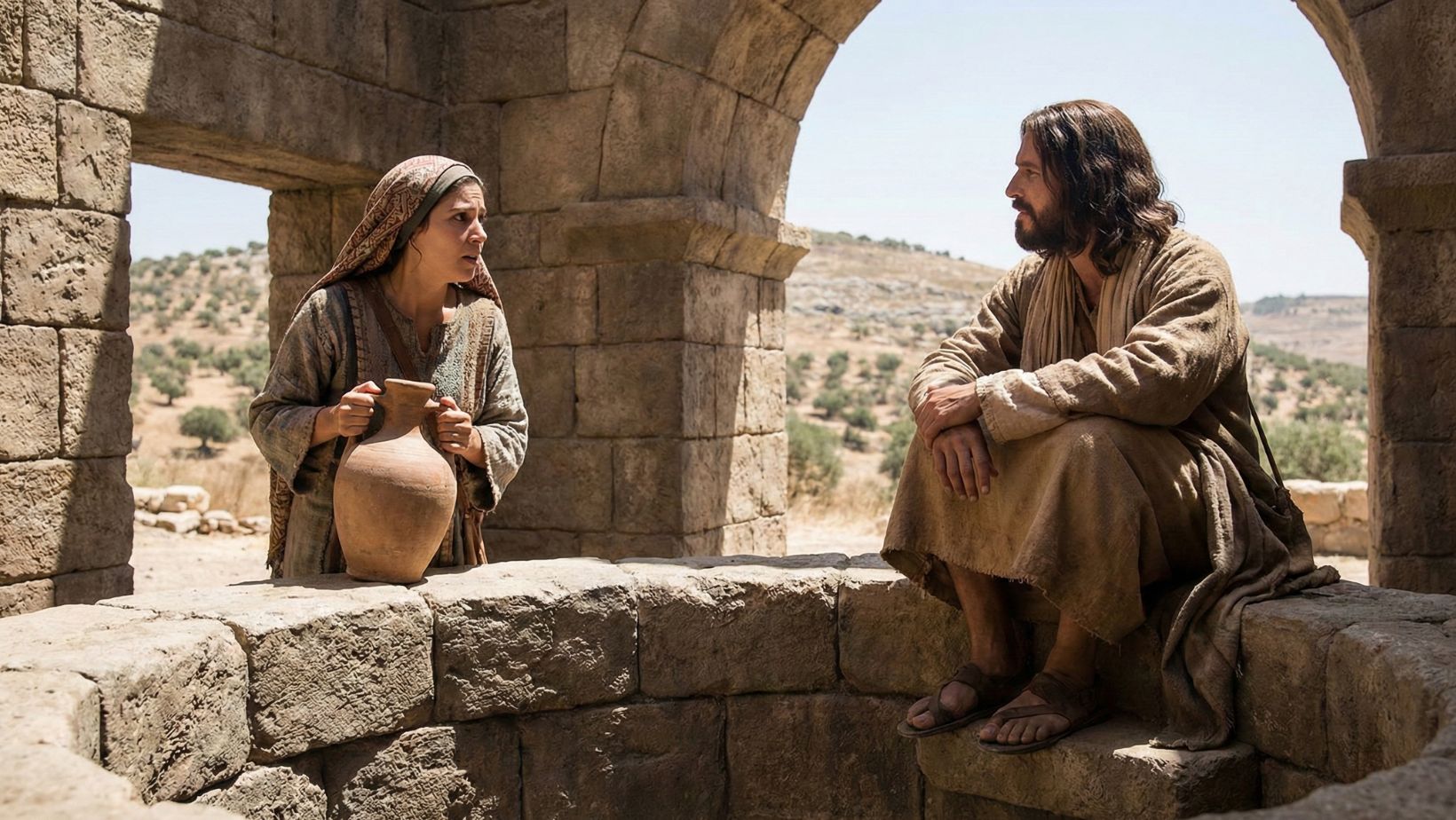
Jacob’s Well is one of the most significant and authentic landmarks in biblical history. It serves as a tangible bridge between the Old and New Testaments, connecting the Patriarchs to the Messiah. Unlike many biblical sites where the exact location is debated, the location of this well has been preserved and venerated for thousands of years. It is most famous as the setting for the conversation between Jesus and the Samaritan woman—the longest recorded conversation Jesus had with any single person in the Gospels—where He first explicitly revealed His identity as the Messiah.
Quick Facts
- Biblical Names: The Well of Jacob, The Spring of Jacob
- Location: Sychar (modern-day Nablus/Balata, in the West Bank), near the ancient city of Shechem
- Builder: Attributed to the Patriarch Jacob (c. 18th Century BCE)
- Depth: Historically approx. 40 meters (135 feet) deep; dug through solid rock
- Water Source: “Living water” (fed by underground springs, not just rain runoff)
- Key Event: Jesus offers “Living Water” to the Samaritan Woman (John 4)
- Nearby Landmark: The Tomb of Joseph (Joshua 24:32)
- Symbolism: The transition from ancestral tradition to spiritual truth; the Gospel crossing cultural boundaries
Name Meaning
“Jacob’s Well”: Named after the patriarch Jacob. While Genesis 33 records that Jacob purchased the plot of land in this area from the sons of Hamor, it does not explicitly mention him digging a well. However, biblical tradition (confirmed by the Samaritan woman in John 4:12) holds that Jacob dug this well to provide water for his vast herds and family, ensuring independence from the local city-states.
Geographical / Physical Context
Location: The well is situated in a strategic valley pass between two famous mountains: Mount Gerizim (the Mount of Blessing, holy to Samaritans) and Mount Ebal (the Mount of Cursing).
Strategic Importance: It lies on the main road running north-south through the hill country, the route travelers would take between Jerusalem (Judea) and Galilee.
Physicality: It is not a cistern (which holds stagnant rainwater) but a true well fed by running underground springs. This distinction is crucial to understanding Jesus’ reference to “living water.”
Biblical Era / Context
Patriarchal Era: Jacob bought this land upon returning from Paddan Aram. It was a place of settlement and altar-building (Genesis 33:18–20).
The Judges Era: The bones of Joseph, which the Israelites carried up from Egypt, were buried in the plot of ground Jacob bought, essentially right next to this well (Joshua 24:32).
First Century (Jesus): By Jesus’ time, the region was Samaria. Jews and Samaritans held deep ethnic and religious hostilities. Jews typically avoided this route, but Jesus “had to go through Samaria” (John 4:4), making the well a place of radical cultural confrontation.
Major Roles / Identity
A Symbol of Provision: For nearly two millennia before Christ, it provided physical survival for the people and livestock of the region.
A Meeting Place: In ancient culture, wells were social hubs. However, the meeting in John 4 took place at “the sixth hour” (noon), the hottest part of the day, suggesting the woman came then to avoid the social crowds—making the well a place of private divine appointment.
A Boundary Marker: It sat on the line between Jewish history and Samaritan territory, highlighting the schism between the two groups who claimed the same father (Jacob).
Key Characteristics
Depth: The well is famously deep. The Samaritan woman noted, “the well is deep” (John 4:11). This required a long rope and a vessel to draw water, symbolizing the effort required to sustain physical life.
Permanence: While cities in the region were destroyed and rebuilt, the well remained a constant, surviving centuries of conflict.
Holy Site: Today, the well is housed within a Greek Orthodox church (Church of St. Photina), and the water is still drinkable.
Main Biblical Events
Jacob’s Purchase: Jacob buys the land from the sons of Hamor for a hundred pieces of silver and sets up an altar called El Elohe Israel (Genesis 33:19–20).
Joseph’s Burial: The Israelites bury Joseph’s bones nearby, fulfilling his dying wish (Joshua 24:32).
Jesus and the Samaritan Woman: Jesus, tired from his journey, sits by the well at noon. He asks a Samaritan woman for a drink, violating social taboos (gender and ethnicity). He uses the physical water of the well to contrast with the “spring of water welling up to eternal life” that He offers. He reveals to her that true worship is not bound to Mount Gerizim (looming above them) or Jerusalem, but is in “Spirit and truth” (John 4:5–26).
Major Relationships
Jacob: The provider of the physical well.
Joseph: His legacy is tied to the land surrounding the well.
The Samaritan Woman: She represents the outcast who becomes the first evangelist to her city, leaving her water jar behind to tell others about the man at the well.
Jesus: The “greater Jacob” who provides superior water.
Notable Passages
John 4:6: “Jacob’s well was there, and Jesus, tired as he was from the journey, sat down by the well. It was about noon.”
John 4:13–14: “Jesus answered, ‘Everyone who drinks this water will be thirsty again, but whoever drinks the water I give them will never thirst.’”
Genesis 33:19: “For a hundred pieces of silver, he bought from the sons of Hamor, the father of Shechem, the plot of ground where he pitched his tent.”
Legacy & Impact
Universal Worship: The conversation at this well dismantled the idea that God is geographically limited to a specific temple or mountain.
Breaking Barriers: Jesus’ willingness to drink from the cup of a Samaritan woman shattered the purity laws and prejudices of His day.
Authenticity: It is one of the few sites in the Holy Land where pilgrims can say with near-absolute certainty, “Jesus sat here.”
Symbolism / Typology
Wells as Betrothal Scenes: In the OT, men often met their future wives at wells (Isaac’s servant/Rebekah, Jacob/Rachel, Moses/Zipporah). At Jacob’s Well, Jesus (the Bridegroom) meets a woman (representative of the Church/Gentiles) and invites her into a spiritual relationship.
Water vs. Spirit: The well represents the Law and human effort (deep, hard to draw from, temporary satisfaction). Jesus represents Grace and the Spirit (accessible, internal, eternal).
Jacob vs. Jesus: The woman asks, “Are you greater than our father Jacob?” The narrative answers with a resounding “Yes.” Jacob gave a hole in the ground; Jesus gave the Holy Spirit.
Extra-Biblical References
Pilgrim Accounts: The Bordeaux Pilgrim (333 AD) and Jerome (4th Century) mention the church built over the well.
Church History: The well is currently located in the crypt of the Church of St. Photina (the traditional name of the Samaritan woman) in Nablus.







Leave a Reply