
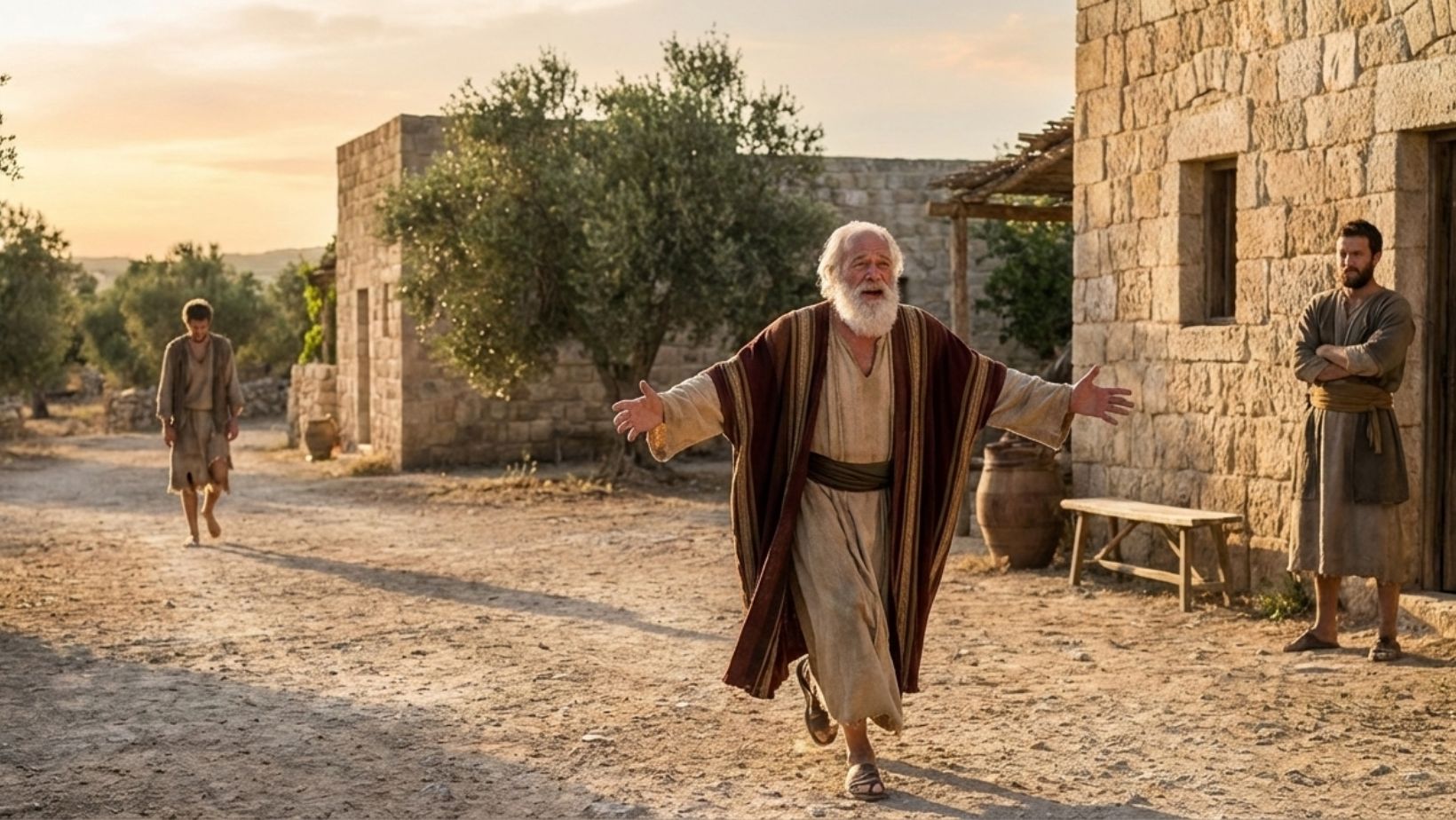
This parable, often called the “Parable of the Prodigal Son,” is the third in a trilogy of stories Jesus tells in Luke 15 to address the Pharisees’ grumbling that He welcomes sinners. It details the journey of a younger son who demands his inheritance early, squanders it in a foreign land, and returns home in shame, only to be met with lavish grace by his father. However, the story does not end there; it introduces a second “lost” son—the older brother—who, though he never left home, is alienated from his father’s heart by self-righteousness and anger. The narrative presents two approaches to God: irreligious rebellion and religious moralism, showing that God’s grace is the only remedy for both.
1. The Rebellion: The Demand and the Departure (Luke 15:11–16 NLT)
11 To illustrate the point further, Jesus told them this story: “A man had two sons. 12 The younger son told his father, ‘I want my share of your estate now before you die.’ So his father agreed to divide his wealth between his sons. 13 A few days later this younger son packed all his belongings and moved to a distant land, and there he wasted all his money in wild living. 14 About the time his money ran out, a great famine swept over the land, and he began to starve. 15 He persuaded a local farmer to hire him, and the man sent him into his fields to feed the pigs. 16 The young man became so hungry that even the pods he was feeding the pigs looked good to him. But no one gave him anything.
Commentary:
- The Shocking Request (v. 12): In Middle Eastern culture of the time, asking for an inheritance while the father was still alive was tantamount to saying, “I wish you were dead.” It was a profound public insult and a rejection of the father’s authority and love.
- The Father’s Response (v. 12): Remarkably, the father does not punish the son but grants the request. He divides the “wealth” (Greek bios, meaning “life” or “livelihood”). The father essentially tears apart his life to fund the son’s rebellion.
- The “Distant Land” (v. 13): This represents a spiritual geography as much as a physical one. It signifies life lived as far away from the Father’s will as possible.
- “Prodigal” Living (v. 13): The word “prodigal” means recklessly wasteful. The son seeks self-fulfillment through self-indulgence, a common human attempt to find satisfaction apart from God.
- The Great Famine (v. 14): External circumstances conspire with internal foolishness. The famine reveals the instability of the world the son trusted in. Sin often looks glamorous until the resources run dry.
- Absolute Degradation (v. 15): To a Jewish audience, feeding pigs was the lowest possible point. Pigs were unclean animals (Leviticus 11:7). The son has lost his money, his friends, his dignity, and his religious identity.
- The Carob Pods (v. 16): The “pods” were likely from the carob tree, used for animal feed. That he envied the pigs shows he had fallen below the status of an unclean animal in the eyes of that society.
2. The Return: Repentance and Resolution (Luke 15:17–20a NLT)
17 “When he finally came to his senses, he said to himself, ‘At home even the hired servants have food enough to spare, and here I am dying of hunger! 18 I will go home to my father and say, “Father, I have sinned against both heaven and you, 19 and I am no longer worthy of being called your son. Please take me on as a hired servant.”’ 20 So he returned home to his father.
Commentary:
- Coming to His Senses (v. 17): This phrase suggests that sin is a form of insanity or delirium. Repentance is a return to reality. He realizes that life apart from the father is not freedom, but starvation.
- The Confession (v. 18): He acknowledges his sin is primarily vertical (“against heaven”) and then horizontal (“and you”). He realizes he has forfeited his rights as a son.
- The Plan (v. 19): The son constructs a plan to pay back his debt. He asks to be a “hired servant” (misthios), a day laborer who lives independently, distinct from a bondservant who is part of the household. He is trying to negotiate a way to earn his way back into the household economy, not the family relationship. He still thinks in terms of law and merit.
- The Action (v. 20): Repentance is not just a feeling; it is an action. He leaves the pig pen and moves toward the father.
3. The Reception: Grace in Motion (Luke 15:20b–24 NLT)
20 …And while he was still a long way off, his father saw him coming. Filled with love and compassion, he ran to his son, embraced him, and kissed him. 21 His son said to him, ‘Father, I have sinned against both heaven and you, and I am no longer worthy of being called your son.’ 22 “But his father said to the servants, ‘Quick! Bring the finest robe in the house and put it on him. Get a ring for his finger and sandals for his feet. 23 And kill the calf we have been fattening. We must celebrate with a feast, 24 for this son of mine was dead and has now returned to life. He was lost, but now he is found.’ So the party began.
Commentary:
- The Father’s Vigilance (v. 20): The father saw him “while he was still a long way off,” implying he had been watching and waiting for the son’s return.
- The Undignified Run (v. 20): In first-century culture, older patriarchs did not run; it was considered undignified to lift one’s robes and expose one’s legs. The father casts aside his dignity to reach his son before the son can reach the village (where he might face hostility).
- Compassion (v. 20): The Greek word splanchnizomai refers to a visceral reaction in the gut. The father is moved by deep pity, not anger.
- Interrupted Confession (v. 21–22): The son starts his rehearsed speech, but the father cuts him off before he can get to the “make me a hired servant” part. The father refuses to let the son downgrade the relationship to an employer-employee contract.
- The Restoration Symbols (v. 22):
- The Finest Robe: Likely the father’s own robe, signifying covered shame and restored honor.
- The Ring: A signet ring representing authority and the ability to transact business for the family.
- The Sandals: Slaves went barefoot; sons wore shoes. This marks him as a free man.
- The Fattened Calf (v. 23): Meat was a luxury, reserved for major festivals or weddings. Killing the fattened calf signifies that the recovery of the son is the greatest possible occasion for joy.
4. The Resentment: The Lost Older Brother (Luke 15:25–32 NLT)
25 “Meanwhile, the older son was in the fields working. When he returned home, he heard music and dancing in the house, 26 and he asked one of the servants what was going on. 27 ‘Your brother is back,’ he was told, ‘and your father has killed the fattened calf. We are celebrating because of his safe return.’ 28 “The older brother was angry and wouldn’t go in. His father came out and begged him, 29 but he replied, ‘All these years I’ve slaved for you and never once refused to do a single thing you told me to. And in all that time you never gave me even one young goat for a feast with my friends. 30 Yet when this son of yours comes back after squandering your money on prostitutes, you celebrate by killing the fattened calf!’ 31 “His father said to him, ‘Look, dear son, you have always been with me, and everything I have is yours. 32 We had to celebrate this happy day. For your brother was dead and has come back to life! He was lost, but now he is found!’”
Commentary:
- The Older Brother’s Location (v. 25): He is “in the fields working.” He defines himself by his labor and moral performance.
- Refusal to Enter (v. 28): By refusing to enter the feast, the older brother publicly insults the father, just as the younger son did at the beginning. He shames the father in front of the guests.
- The Father’s Second Journey (v. 28): Just as the father went out to the younger son, he leaves the party to go out to the older son. He demonstrates grace to both the law-breaker and the law-keeper.
- “I’ve Slaved for You” (v. 29): This reveals the older brother’s heart. He views his relationship with the father as slavery, not sonship. He was physically at home but spiritually in a distant land.
- Self-Righteousness (v. 29): He claims he “never once refused” a command. His obedience was a strategy to put God in his debt, rather than a response of love.
- “This Son of Yours” (v. 30): He disowns his brother, refusing to say “my brother.” He also makes assumptions about the sin (“prostitutes”), perhaps projecting his own repressed desires.
- The Father’s Correction (v. 31): The father gently reminds him of his standing: “Everything I have is yours.” The older son was living like a pauper despite possessing the inheritance.
- The Necessity of Joy (v. 32): The father insists, “We had to celebrate.” Grace makes joy inevitable. To reject the celebration is to reject the heart of the father.
Theological Significance of Luke 15:11–32
- Two Types of Lostness: Jesus is teaching that one can be lost in rebellion (badness) and lost in religious moralism (goodness). The younger brother sought to escape the father’s control by leaving; the older brother sought to control the father by obeying. Both were alienated from the father’s heart.
- The Nature of Repentance: Repentance is shown to be more than just feeling bad; it is the act of turning to God and accepting His grace without trying to earn it back.
- The Cost of Grace: For the father to reinstate the younger son, he had to absorb the shame and the financial loss. This points to the Cross, where God absorbs the cost of our reconciliation.
- The Fatherhood of God: God is portrayed not as a hard taskmaster but as a loving Father who runs to welcome the repentant and pleads with the self-righteous.
Practical Applications
- Stop Negotiating: Like the younger son, we often try to come back to God with a plan to “pay Him back.” We must accept that we can only be sons and daughters by grace, not hired servants by merit.
- Check Your Heart for Elder Brother Syndrome: If you feel anger when God blesses people who “don’t deserve it,” or if you feel God owes you because of your hard work, you may be drifting into the spirit of the older brother.
- Define Yourself by Who You Are, Not What You Do: The younger son defined himself by his sin; the older son defined himself by his service. The Father defined both by his love.
- Join the Celebration: The Christian life is meant to be a celebration of grace. Refusing to rejoice in the salvation of others separates us from the heart of God.
Final Insight
The parable ends abruptly without telling us what the older brother did. This is intentional. Jesus leaves the story unresolved because He was addressing the Pharisees (the older brothers) standing right in front of Him. The ending of the story was up to them to write. The open-ended nature of the text forces every reader to answer the question: Will I stand outside in judgment, or will I go in and join the feast of grace?







Leave a Reply