
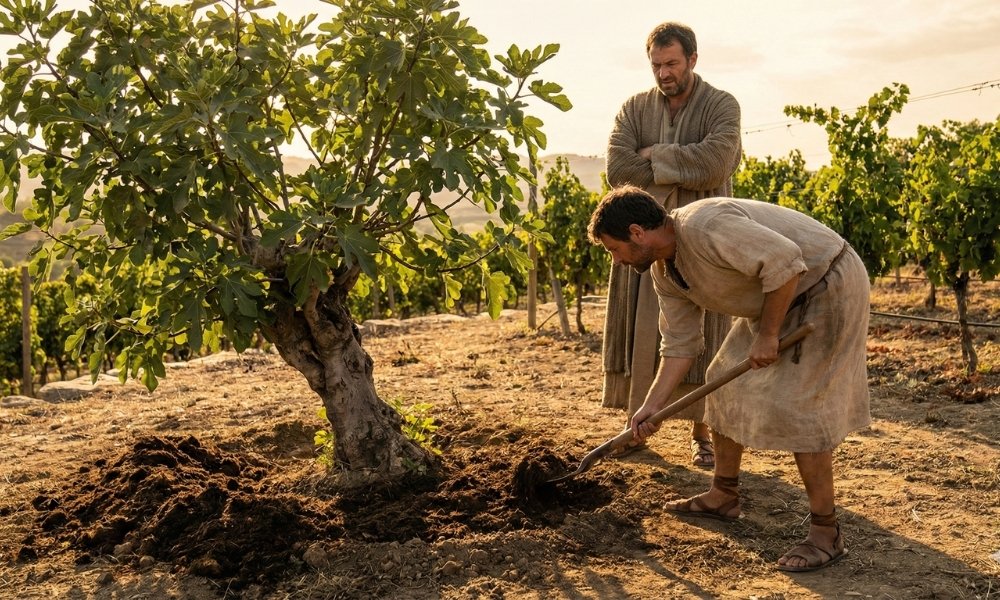
The Parable of the Barren Fig Tree is a brief but potent allegory delivered by Jesus to illustrate the urgency of repentance and the tension between divine judgment and divine patience. Recorded exclusively in the Gospel of Luke, it follows Jesus’ warnings about recent tragedies (the slaughter of Galileans and the fall of the Tower of Siloam), emphasizing that calamity is not always a sign of specific sin, but that all must repent or perish. The fig tree serves as a symbol of God’s covenant people (and by extension, any individual believer) who receive God’s care yet fail to produce the spiritual fruit of righteousness.
Quick Facts
- Name: The Barren Fig Tree
- Scripture Reference: Luke 13:6–9
- Speaker: Jesus Christ
- Genre: Parable (Similitude)
- Key Figures: The Owner (God the Father), The Vinedresser (Jesus/Intercessor), The Tree (Israel/The Individual)
- Key Symbols: Fruit (Repentance/Good Works), Three Years (Time of Patience), Manure/Digging (Grace/Intervention)
- Theme: Judgment, Mercy, The Necessity of Fruitfulness, Repentance
- Context: A call to repent following news of national tragedies
Symbolism & Name Meaning
The Fig Tree (Ficus carica): In the Old Testament, the fig tree is a standard symbol for the nation of Israel (Hosea 9:10; Jeremiah 24). Sitting under one’s fig tree symbolized peace, prosperity, and the blessing of the Covenant (Micah 4:4).
Barrenness: To be a fig tree that produces leaves but no fruit is to be deceptively alive—having the appearance of health (religious observance) without the substance (righteousness).
Origin / Historical Background
Agricultural Context: In ancient Judea, fig trees were often planted in vineyards to maximize the use of the soil. Fig trees typically take three years to reach maturity and begin fruiting. If a tree had not produced fruit after three years of maturity, it was considered a waste of soil resources (“Why should it use up the ground?”).
The “Three Years”: Many commentators view the “three years” the owner waited as symbolic of the length of Jesus’ public ministry to Israel, or simply a period of complete and sufficient testing.
Biblical Era / Context
Time: Delivered during Jesus’ journey toward Jerusalem (c. 29–30 AD).
Setting: Jesus is teaching the crowds, addressing the common theological error that victims of tragedy (like those crushed by the Tower of Siloam) were worse sinners than others. He pivots to this parable to show that everyone is living on borrowed time and grace.
Major Roles / Purpose
The Warning: The primary role of the tree is to serve as a warning against spiritual complacency. It challenges the assumption that presence in the vineyard (membership in God’s people) guarantees safety without the evidence of a changed life.
The Intercession: The vinedresser represents the role of the Mediator. He acknowledges the failure of the tree but pleads for an extension of time and offers to do the dirty work (digging and fertilizing) to help it succeed.
Main Events (In the Parable)
The Inspection: The owner comes to the vineyard specifically expecting fruit. This highlights that God looks for results, not just existence (Luke 13:6).
The Verdict: After finding nothing for three consecutive years, the owner orders the tree to be cut down. It is not just useless; it is detrimental because it depletes nutrients from the soil that could support a productive tree (Luke 13:7).
The Intercession: The vinedresser (gardener) intervenes. He does not claim the tree is good; he admits it is barren but asks for “one year more” (Luke 13:8).
The Remedial Action: The vinedresser commits to “dig around it and put on manure.” This signifies intensive care—disrupting the soil (conviction) and adding nutrients (grace/teaching)—to stimulate growth.
The Ultimatum: The story ends with a cliffhanger. “If it bears fruit next year, fine! If not, then cut it down.” The listener is left to determine the ending by their own response to Jesus (Luke 13:9).
Key Character Traits
Patience (The Vinedresser): He is willing to get his hands dirty and work extra hard to save a failing tree.
Justice (The Owner): He is rational and just; he has waited a reasonable amount of time and is concerned with the health of the entire vineyard.
Presumption (The Tree): The tree takes from the soil (sun, rain, nutrients) but gives nothing back.
Notable Passages
Luke 13:7: “So he said to the man who took care of the vineyard, ‘For three years now I have been coming to look for fruit on this fig tree and haven’t found any. Cut it down! Why should it use up the soil?’”
Luke 13:8–9: “‘Sir,’ the man replied, ‘leave it alone for one more year, and I’ll dig around it and fertilize it. If it bears fruit next year, fine! If not, then cut it down.’”
Legacy & Impact
Theology of Grace: The parable perfectly illustrates “Prevenient Grace”—the grace that goes before judgment. God does not strike down sinners immediately; He offers time and special care to bring them to repentance (Romans 2:4).
The Destruction of Jerusalem: Historically, the “one more year” can be seen as the 40-year period between Jesus’ ministry and the destruction of Jerusalem in 70 AD. The nation was given extra time and the “fertilizer” of the Apostolic witness, but ultimately rejected it and was “cut down.”
Connection to the Cursed Fig Tree: This parable (Luke 13) is often linked to the miracle of the Cursing of the Fig Tree (Mark 11 / Matthew 21). The parable is the warning (grace); the miracle is the enactment of the judgment when the warning is ignored.
Symbolism / Typology
The Manure (Dung): Represents the sometimes unpleasant or humbling means God uses to stimulate spiritual growth—trials, conviction of sin, or difficult teachings.
The Cut: Represents final judgment. There is a limit to divine patience; grace is not permission to remain fruitless forever.







Leave a Reply