
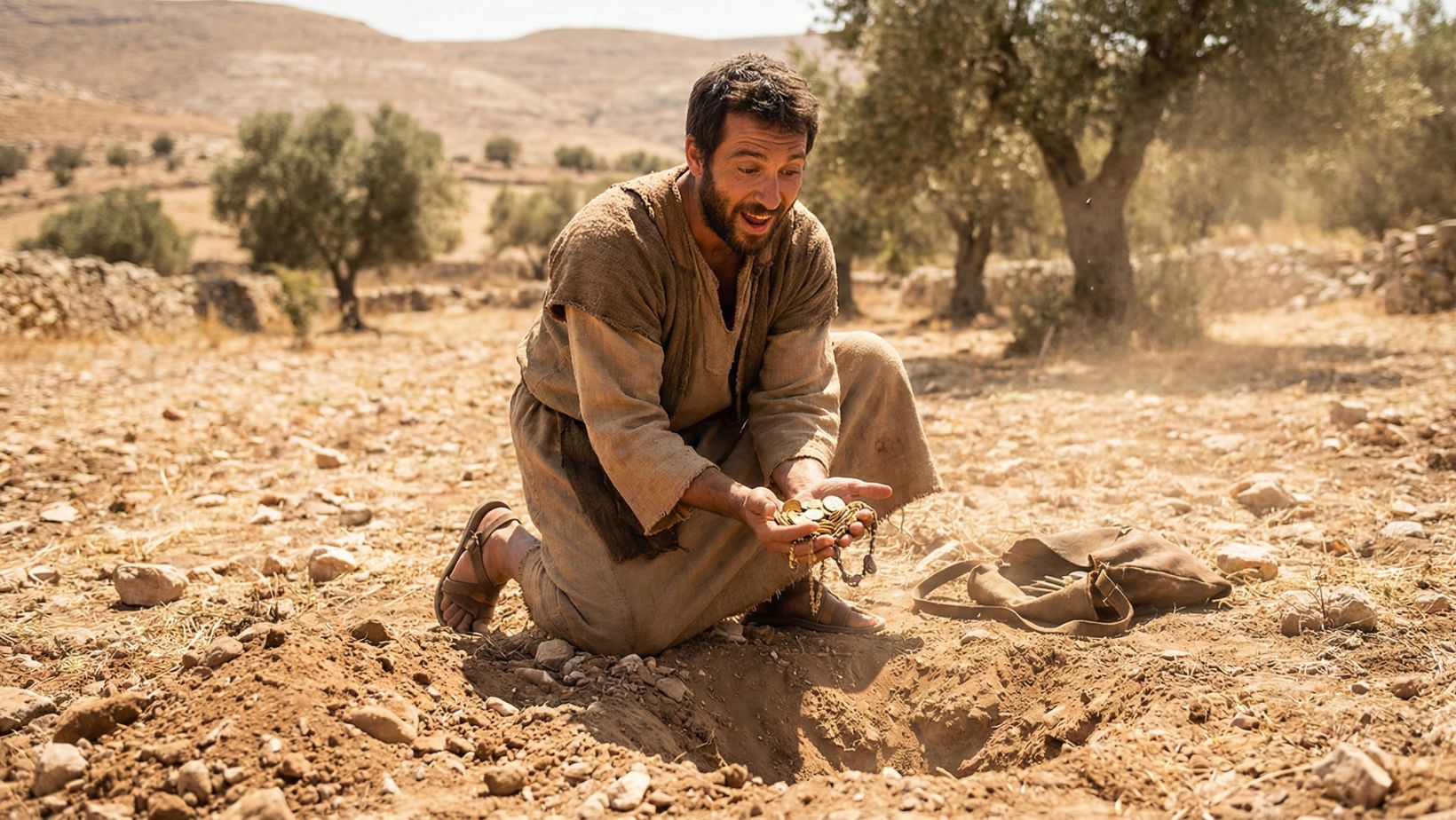
The Parable of the Hidden Treasure is one of the shortest yet most profound illustrations Jesus used to describe the Kingdom of Heaven. Found only in the Gospel of Matthew, it captures the supreme value of the Gospel and the radical, joyful response required of those who discover it. It paints a picture of the Kingdom not as a burdensome obligation, but as a prize of such immense worth that a person would gladly sacrifice everything else they own to possess it.
Quick Facts
The Text
Matthew 13:44 (ESV): “The kingdom of heaven is like treasure hidden in a field, which a man found and covered up. Then in his joy he goes and sells all that he has and buys that field.”
Biblical Context
Setting: This parable appears in the “Parabolic Discourse” of Matthew 13. While the earlier parables (Sower, Weeds, Mustard Seed) were spoken to the crowds by the sea, Jesus moved into “the house” (Matt 13:36) to speak this parable specifically to His disciples.
The “Secrets” of the Kingdom: Jesus is revealing that the Kingdom is not currently a political conquest, but a spiritual reality that is often “hidden” from the eyes of the world, recognized only by those with spiritual sight.
Cultural Background: In ancient Palestine, before banks existed, people often buried valuables in the ground to protect them from war or theft. If an owner died without revealing the location, the treasure remained hidden until discovered by someone else. Jewish law suggested that if a man found a treasure in a field, he needed to own the land to legally claim the treasure.
Key Elements & Symbolism
The Treasure: Represents the Kingdom of Heaven, the Gospel, or Christ Himself. It is the ultimate reality that satisfies the human soul and secures eternal life.
The Field: Generally interpreted as the world (based on the explanation of the Wheat and Tares in v. 38). The treasure is hidden in the world, accessible but not obvious to everyone.
The Man: Represents the individual believer who encounters the truth of God. (Alternatively, in a Christological interpretation, the Man is Jesus who gives His life to redeem the world to secure the “treasure” of His people).
The Finding: In this parable, the discovery seems accidental or unexpected. Unlike the merchant in the next parable who is looking for pearls, this man stumbles upon the treasure. This highlights the grace of God revealing Himself to those who may not have been explicitly searching.
The Selling: Represents the cost of discipleship. It is the willingness to let go of all earthly attachments, status, and sins to secure the Kingdom.
Interpretation: The Economy of the Kingdom
Value Over Cost: The central point is not the price paid, but the value gained. The man does not sell his possessions out of grim duty or obligation; he does it out of “joy.”
The Motive of Joy: This distinguishes religious legalism from true Christianity. Legalism says, “I must give up everything to be saved.” This parable says, “I get to give up everything because I found something infinitely better.”
Hiddenness: The Kingdom is not always flashy or apparent. To the casual observer, the field looks like ordinary dirt. Only the one who knows what is buried there understands why the man is buying it. This explains why the world thinks Christians are foolish for their sacrifices—they cannot see the treasure.
Comparison: Treasure vs. Pearl
The Hidden Treasure: Emphasizes the unexpected discovery of the Kingdom. (e.g., The Samaritan Woman, the Apostle Paul).
The Pearl of Great Price: Emphasizes the diligent seeker finding the Kingdom after a quest for truth. (e.g., The Ethiopian Eunuch, Cornelius).
Commonality: In both cases, the result is the same: the total liquidation of previous assets to acquire the greater prize.
Theological Themes
Salvation: The parable illustrates that while salvation is a free gift (grace), receiving it involves a transfer of allegiance. One cannot hold onto the “old life” and the “new treasure” simultaneously.
Regeneration: The man’s value system is instantly transformed. What he previously valued (his possessions) became worthless currency to be traded for the true riches.
Divine Sovereignty: The treasure was there before the man found it. God places the Kingdom within reach, but it requires a response.
Legacy & Application
The Call to Abandon: It challenges the “prosperity gospel” or “cheap grace.” Following Jesus costs everything, but the return is infinitely higher.
Jim Elliot’s Maxim: This parable is perfectly summarized by missionary Jim Elliot’s famous quote: “He is not a fool who gives what he cannot keep to gain what he cannot lose.”
Priorities: It forces the reader to ask: “What is my field? Am I willing to buy it?” and “Do I see the Kingdom as a burden or a treasure?”







Leave a Reply