
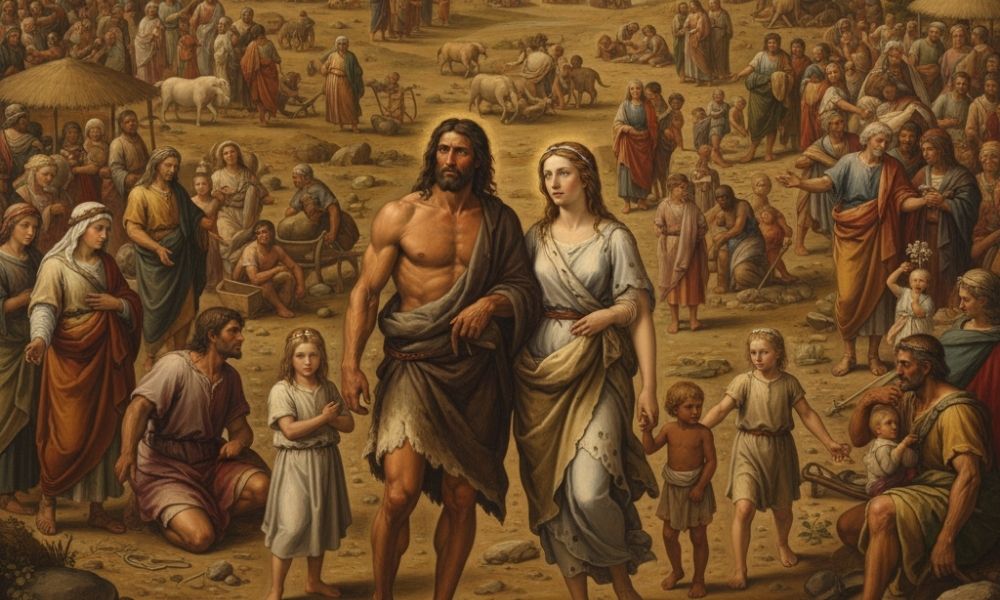
Adam, the first man created by God, is regarded as the father of all humankind. His lineage, recorded in Genesis chapters 4 and 5, marks the beginnings of human history — tracing the early generations from creation to the flood. Adam’s descendants include both the righteous line through Seth and the ungodly line through Cain. These genealogies form the foundation of the biblical story of humanity, sin, and redemption.
Quick Facts
Name: Adam (Hebrew: Adamah, meaning “man” or “from the ground”)
Wife: Eve
Children: Cain, Abel, Seth (and other sons and daughters)
Era: Creation to pre-Flood era
Age at Death: 930 years (Genesis 5:5)
Book: Genesis 1–5
Key Theme: The beginning of humanity, sin, and God’s plan of redemption
Immediate Family
- Eve: The first woman, created from Adam’s rib, mother of all living (Genesis 3:20)
- Cain: The firstborn son; became a farmer and murderer of his brother Abel (Genesis 4:8)
- Abel: The second son; a righteous shepherd whose offering pleased God (Genesis 4:4)
- Seth: Born after Abel’s death; ancestor of Noah and the righteous lineage (Genesis 4:25)
Descendants Through Cain (Ungodly Line)
The line of Cain represents human advancement coupled with growing sin and rebellion.
- Cain → father of Enoch (not to be confused with the righteous Enoch of Seth’s line)
- Enoch (son of Cain) → father of Irad
- Irad → father of Mehujael
- Mehujael → father of Methushael
- Methushael → father of Lamech
- Lamech introduced polygamy (wives Adah and Zillah).
- His children:
- Jabal (father of tent dwellers and herders)
- Jubal (father of musicians)
- Tubal-cain (a forger of bronze and iron)
- Naamah (mentioned as a daughter)
This line reflects cultural progress but spiritual decline — ending in moral corruption.
Descendants Through Seth (Godly Line)
The line of Seth represents those who “called on the name of the LORD” (Genesis 4:26) and carried forward the promise of redemption.
- Seth → father of Enosh
- Enosh → father of Kenan (Cainan)
- Kenan → father of Mahalalel
- Mahalalel → father of Jared
- Jared → father of Enoch
- Methuselah (son of Enoch) → lived 969 years, the longest human lifespan recorded
- Lamech (son of Methuselah) → father of Noah
Noah — The 10th Generation from Adam
Noah represents the continuation of Adam’s godly line and the preservation of humanity through the Flood.
- Noah’s Sons: Shem, Ham, and Japheth (Genesis 5:32)
- From them, all post-flood nations descended (Genesis 10).
- Through Shem, the line continued to Abraham, Israel, David, and finally Jesus Christ.
Theological Significance
- Adam’s descendants show the contrast between sin and righteousness.
- The line of Cain leads to corruption and judgment.
- The line of Seth leads to faith, obedience, and ultimately the Messiah.
- God’s promise of redemption begins with Adam and finds fulfillment in Christ, the “last Adam” (1 Corinthians 15:45).







Leave a Reply