
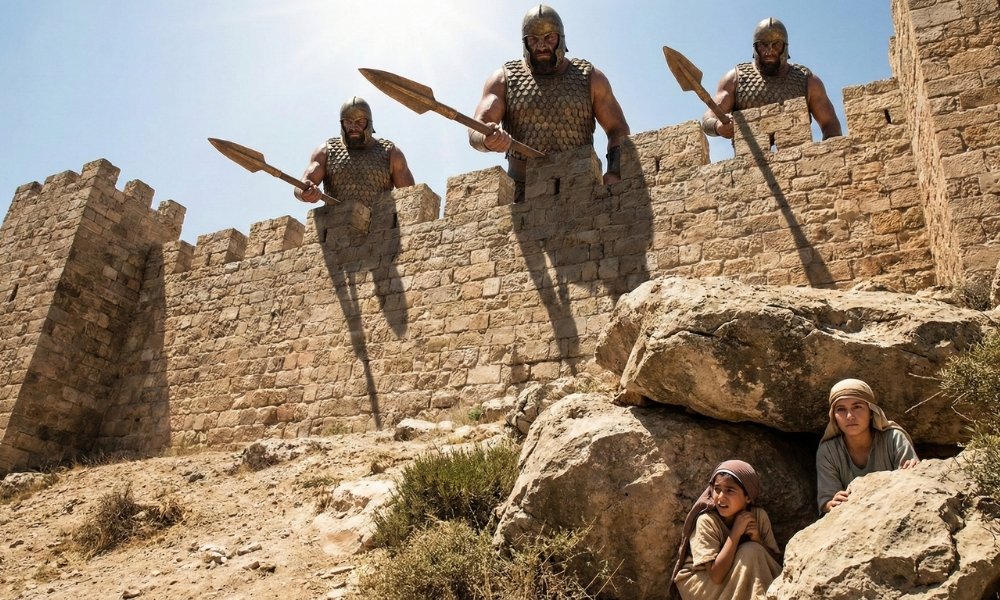
The Anakites (or Anakim) were a legendary race of giants who inhabited the hill country of Canaan, particularly around Hebron, before the Israelite conquest. Famed for their terrifying stature and military might, they became the defining symbol of the “impossible” obstacles standing between God’s people and the Promised Land. It was the sight of the Anakites that caused ten of the twelve spies to lose heart, leading Israel to wander in the wilderness for forty years. Though feared as invincible, they were eventually driven out by Joshua and Caleb, with a remnant surviving in Philistine cities to later challenge—and fall to—David and his mighty men.
Quick Facts
- Name: Anakites / Anakim (Hebrew: Anakim)
- Meaning: “Long-necked” (tall) or “Wearers of Necklaces/Chains”
- Region: Hill country of Judah (Hebron, Debir, Anab); later Gaza, Gath, Ashdod
- Era: Exodus and Conquest era through the time of King David (~1400 BCE – 1000 BCE)
- Famous Ancestor: Anak, son of Arba
- Related Groups: Nephilim, Rephaites, Philistines
- Key Characteristic: Gigantic height, fortified cities, warrior culture
- Fate: Destroyed by Joshua and Caleb; remnants assimilated/killed by David’s warriors
Name Meaning
“Anakim” is often translated as “Long-necked ones,” likely referring to their towering height. Alternatively, the root word can mean “necklace” or “neck-chain,” suggesting a people who wore distinctive ornamental chains or torcs, possibly as status symbols or military decoration.
Lineage / Family Background
Progenitor: They were descendants of Anak, who was the son of Arba (the founder of Kiriath-Arba, later known as Hebron).
Ancient Origins: Numbers 13:33 explicitly links them to the Nephilim, the mysterious “heroes of old” from the pre-flood era, stating: “We saw the Nephilim there (the descendants of Anak come from the Nephilim).”
Clans: The Bible identifies three specific clans or leaders descended from Anak who ruled Hebron:
- Ahiman
- Sheshai
- Talmai
Biblical Era / Context
Time: They appear prominently during the Israelites’ attempt to enter Canaan (Numbers) and the subsequent conquest (Joshua/Judges).
Setting: They held the high ground—the strategic hill country of Judah. Their capital, Hebron, was an ancient, fortified city.
Cultural Context: In the ancient world, physical stature often equated to military dominance. The Anakites were the “super-soldiers” of the Canaanite region, serving as the ultimate test of Israel’s trust in Yahweh.
Major Roles / Identity
The Catalyst for Rebellion: The mere sight of them caused a national crisis for Israel. The spies reported, “We seemed like grasshoppers in our own eyes, and we looked the same to them” (Numbers 13:33).
The Target of Caleb’s Faith: While the nation trembled, Caleb (at age 85) specifically requested the hill country where the Anakites lived, eager to prove that God could defeat them.
The Philistine Connection: After being driven from the hills, the survivors fled to the coastal cities of Gaza, Gath, and Ashdod (Joshua 11:22). This lineage likely produced Goliath of Gath, linking the giant-slaying narratives of Joshua to David.
Key Character Traits
Gigantic Stature: They were the standard of height in the region; other tall groups (like the Emim) were described as being “tall as the Anakim” (Deuteronomy 2:10).
Intimidation: Their reputation alone was a weapon. The common saying of the day was, “Who can stand up against the Anakites?” (Deuteronomy 9:2).
Fortification: They did not just rely on size; they built “large cities that have walls up to the sky” (Deuteronomy 1:28).
Main Life Events (Group History)
The Spies’ Report: In Numbers 13, twelve spies scouted the land. Ten returned terrified of the Anakites, sparking a rebellion that barred that generation from entering the Promised Land.
Defeat by Joshua: Decades later, Joshua waged war in the hill country, cutting off the Anakites and destroying their cities (Joshua 11:21).
Caleb’s Conquest: Caleb specifically targeted Hebron (Kiriath-Arba). He drove out the three sons of Anak—Sheshai, Ahiman, and Talmai—claiming the mountain as his inheritance (Joshua 15:14).
Survival in Philistia: A remnant escaped to the coast. This seeded the giant gene in the Philistine population, leading to future conflicts with Israel.
Final Extinction: In 2 Samuel 21, David and his specialized warriors hunted down the remaining “descendants of the giant” in Gath, effectively ending the Anakite threat.
Major Relationships
Arba: The “greatest man among the Anakites” (Joshua 14:15) and founder of their stronghold.
Caleb: Their nemesis. He did not fear them in his youth (as a spy) nor in his old age (as a conqueror).
The Nephilim: Their claimed ancestors, linking them to a primordial legacy of strength and rebellion.
Goliath: Though not explicitly called an Anakite, he lived in Gath (an Anakite refuge) and fit the physical description, making him almost certainly a descendant.
Notable Passages
Numbers 13:33: “We saw the Nephilim there (the descendants of Anak come from the Nephilim). We seemed like grasshoppers in our own eyes…”
Deuteronomy 9:2: “The people are strong and tall—Anakites! You know about them and have heard it said: ‘Who can stand up against the Anakites?’”
Joshua 14:12 (Caleb’s Request): “Now give me this hill country… You yourself heard then that the Anakites were there… but, the Lord helping me, I will drive them out…”
Legacy & Impact
The “Grasshopper Complex”: Their story serves as a cautionary tale about how fear can distort perspective, making problems look big and God look small.
Proof of Divine Power: Their defeat is used throughout Scripture to encourage Israel. If God could defeat the Anakites, He could defeat anyone.
Hebron: Their former capital became a Levitical city of refuge and later the first capital where David was crowned King of Judah.
Symbolism / Typology
The “Giants” of Life: Spiritually, Anakites represent the besetting sins, addictions, or fears that seem too strong to conquer.
Unbelief vs. Faith: The ten spies saw the giants; Caleb saw God. The Anakites are the measuring stick of our faith.
Complete Victory: Israel was commanded to drive them out completely. The remnant left in Gath eventually produced Goliath—a lesson that sins left unconquered will return to fight you later.
Extra-Biblical References
Egyptian Execration Texts: Ancient Egyptian pottery shards (c. 19th–18th century BCE) mention a group of enemies in Canaan called the Iy-anaq, widely believed by scholars to be a reference to the tribe of Anak.
Josephus: The Jewish historian Flavius Josephus wrote that even in his day (1st century CE), giant bones were occasionally found in the area, described as having bodies so large they were “terrible to hear of and incredible to see.”







Leave a Reply