
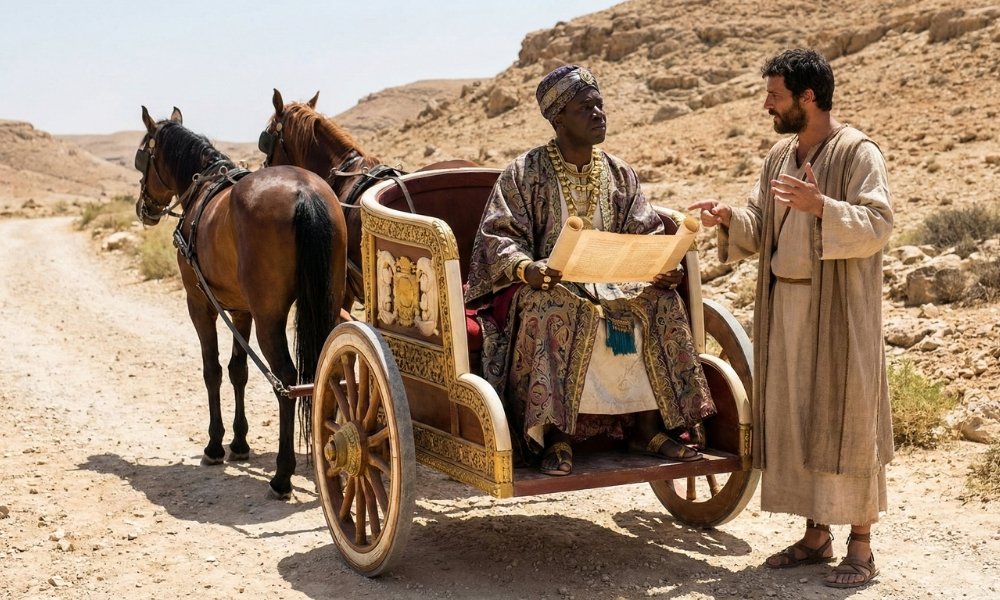
The Cushites, often referred to as Ethiopians in English translations, were a powerful nation inhabiting the region south of Egypt, corresponding to modern-day Sudan (Nubia) and northern Ethiopia. Descended from Cush, the eldest son of Ham, they established a wealthy and militant civilization that frequently interacted with Israel. In the Bible, the Cushites appear in diverse roles: as mighty warriors and archers who sometimes threatened Judah, as political allies against the Assyrians, and notably as individuals of deep faith who stood up for God’s prophets when Israelites would not. The narrative arc of the Cushites stretches from Nimrod, the first empire-builder, to the Ethiopian Eunuch, marking the reach of the Gospel to the “ends of the earth.”
- Ancestry: Descendants of Cush (Son of Ham)
- Region: The Upper Nile (Nubia/Sudan)
- Key Cities: Meroe, Napata
- Key Figures: Nimrod, Zerah, Tirhakah (Pharaoh), Ebed-Melech, The Ethiopian Eunuch
- Biblical Role: Warriors, wealthy traders, and spiritual seekers
- Fate: Kingdom persisted for centuries; early embrace of Christianity
- Symbol: The Bow (famous for archery) / The Chariot
Name Meaning
The Hebrew name Cush is derived from the root meaning “black.” The Greek translation (Septuagint) used the term Aithiops (“Burnt-face”), from which we get the English “Ethiopian.” The name was synonymous in the ancient world with people of dark skin and the exotic wealth of the African interior.
Origin / Family Background
The Hamitic Line: Cush was the firstborn son of Ham. This places the Cushites in the same broad family group as the Egyptians (Mizraim), Canaanites, and Put (Libyans).
Nimrod the Hunter: Genesis identifies Nimrod as a son of Cush. Nimrod was the first “mighty warrior” on earth and the founder of major Mesopotamian cities like Babylon and Nineveh. This suggests that the early Cushite influence extended far beyond Africa into the Tigris-Euphrates valley.
Biblical Era / Context
The Exodus: Moses married a Cushite woman, an event that sparked jealousy and criticism from his siblings, Miriam and Aaron. God defended Moses and struck Miriam with leprosy, validating the marriage and rebuking the prejudice.
The Monarchy: The Cushites were often mercenaries in Egyptian armies or acted as an independent southern superpower. During the reign of King Hezekiah, the Cushite Pharaoh Tirhakah (Taharqa) marched out to fight the Assyrians, indirectly relieving the pressure on Jerusalem.
The New Testament: In the book of Acts, a high-ranking official from the court of Candace, Queen of the Ethiopians, becomes one of the first Gentile converts to Christianity, carrying the faith back to Africa.
Key Interactions / Events
The Battle of Mareshah: Zerah the Cushite marched against King Asa of Judah with a massive army (described as a “thousand thousands”) and 300 chariots. Asa cried out to God, acknowledging that numbers did not matter to Yahweh. God struck down the Cushites, and they were crushed before the Lord, granting Judah a miraculous victory.
The Rescue of Jeremiah: When the prophet Jeremiah was thrown into a muddy cistern to die by the princes of Judah, it was a Cushite official named Ebed-Melech who went to the king to plead for his life. Ebed-Melech used ropes and rags to pull the prophet out. God later promised Ebed-Melech personal safety during the fall of Jerusalem because he trusted in the Lord.
The Baptism of the Eunuch: Philip the Evangelist was sent to a desert road to meet the treasurer of Ethiopia. The man was reading Isaiah 53 but did not understand it. Philip explained the Gospel, and the official was baptized immediately, rejoicing as he went on his way.
Major Roles / Identity
The Wealthy Nation: Cush is frequently associated with topaz, gold, and merchandise. Isaiah describes them as a “people tall and smooth-skinned,” a nation “feared far and wide.”
The Righteous Outsider: In several instances (Ebed-Melech, the Eunuch), a Cushite is portrayed as more spiritually sensitive and courageous than the native Israelites. They serve as a rebuke to God’s people, showing that faith is not a matter of ethnicity.
Notable Passages
Numbers 12:1: “Miriam and Aaron began to talk against Moses because of his Cushite wife, for he had married a Cushite.”
Psalm 68:31: “Envoys will come from Egypt; Cush will submit herself to God.”
Jeremiah 38:7: “Ebed-Melech the Cushite… heard that they had put Jeremiah into the cistern.”
Acts 8:27: “So he started out, and on his way he met an Ethiopian eunuch… in charge of all the treasury of the Kandake.”
Legacy & Impact
The Early Church: The conversion of the Ethiopian Eunuch marks the fulfillment of Psalm 68:31 (“Ethiopia shall soon stretch out her hands unto God”). Tradition holds that he returned to Africa and planted the seeds of the faith that would eventually grow into the Coptic and Ethiopian Orthodox churches.
Taharqa (Tirhakah): Historical records confirm Tirhakah as a powerful Pharaoh of the 25th Dynasty of Egypt (the “Black Pharaohs” of Nubia), verifying the biblical timeline of Hezekiah’s reign.
Symbolism / Typology
Universal Salvation: The Cushites represent the “ends of the earth.” Their inclusion in the narrative—from Moses’ wife to the Eunuch—demonstrates the universal scope of God’s redemptive plan, which transcends geography and skin color.
Archer Warriors: Often depicted with bows, they symbolize distant military power that God can either defeat (Zerah) or summon (Tirhakah) for His purposes.







Leave a Reply