
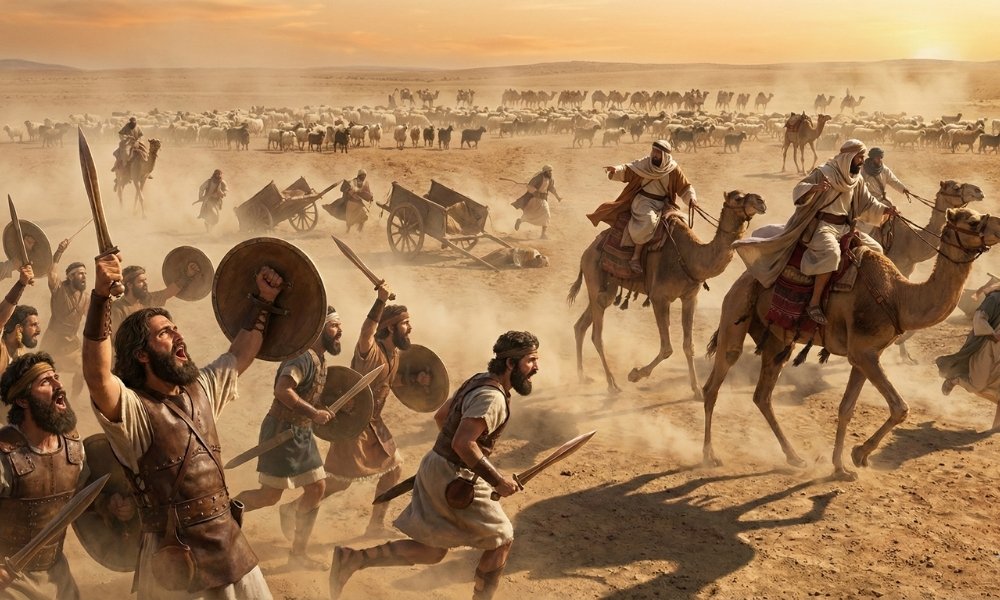
The Hagarites (or Hagrites) were a wealthy, nomadic pastoral tribe dwelling in the desert regions east of Gilead, in the Transjordan. Though their name strongly implies a descent from Hagar (the mother of Ishmael), they are distinctively noted in Scripture as a formidable military and economic power during the days of King Saul. They are best known for a massive conflict with the Israelite tribes of Reuben, Gad, and Manasseh, a battle that serves as a poignant theological lesson on the power of prayer and reliance on God during warfare. While often associated with the Ishmaelites, they appear as a distinct clan or confederation in biblical lists.
Quick Facts
- Name: Hagarites / Hagrites (Hebrew: Hagri)
- Meaning: “Of Hagar” or “Fugitive / Stranger”
- Region: The desert lands east of Gilead (bordering the tribes of Reuben and Gad)
- Era: Period of the Judges through the Monarchy (approx. 11th–10th Century BCE)
- Ancestry: Likely descendants of Hagar (through Ishmael or a distinct line)
- Key Allies: Jetur, Naphish, Nodab (Ishmaelite clans)
- Key Conflict: The war against the Transjordanian tribes (1 Chronicles 5)
- Notable Individual: Jaziz the Hagrite (King David’s overseer of flocks)
Name Meaning
“Hagarite” is a patronymic derived from Hagar, the Egyptian servant of Sarah and mother of Ishmael. The name implies “One belonging to Hagar.” Historically, this links them to the broader Ishmaelite confederation, though later biblical texts treat them as a specific ethnic or political group distinct from the general term “Ishmaelite.”
Lineage / Family Background
Origin: They are widely accepted by scholars to be descendants of Ishmael, the son of Hagar.
Clan Connections: In the account of their defeat (1 Chronicles 5:19), they are allied with Jetur, Naphish, and Nodab. Interestingly, Jetur and Naphish are explicitly listed as sons of Ishmael in Genesis 25:15. This confirms the Hagarites were a dominant tribe within the Ishmaelite confederacy.
Distinct Identity: By the time of the psalmist (Psalm 83:6), the Hagarites are listed separately from the Ishmaelites, suggesting they had developed into a specific, recognizable power distinct from the main body of Ishmael’s descendants.
Biblical Era / Context
Time: Their prominence peaks during the reign of King Saul (1 Chronicles 5:10).
Setting: They occupied the expansive pasturelands east of the Jordan River, likely stretching into the modern Syrian Desert and Northern Arabia.
Cultural Context: They were “People of the East” (Bene Kedem)—bedouin-style nomads who dwelt in tents, possessed vast herds of livestock (camels, sheep, donkeys), and were skilled in desert warfare.
Major Roles / Identity
The Wealthy Adversary: The Hagarites were not merely raiders; they possessed immense wealth. The plunder taken from them included 50,000 camels, 250,000 sheep, and 2,000 donkeys (1 Chronicles 5:21), indicating a massive economic footprint.
The Theological Foil: In 1 Chronicles 5, the Hagarites serve as the “strong enemy” that compels Israel to pray. The text emphasizes that Israel won not because of superior skill, but because they “cried out to God in battle.”
Royal Servants: Not all Hagarites were enemies. Jaziz the Hagrite is listed in 1 Chronicles 27:30 as the official overseer of King David’s flocks, suggesting that individual Hagarites were integrated into Israelite society and valued for their pastoral expertise.
Main Life Events (Group History)
Expansion in Gilead: The Hagarites controlled the pasturelands east of Gilead, preventing the tribes of Reuben and Gad from expanding.
The War with the 2.5 Tribes: During the days of Saul, the Reubenites, Gadites, and the half-tribe of Manasseh mustered 44,760 warriors to attack the Hagarite confederacy.
The Divine Defeat: The battle turned when the Israelites cried out to God. The Hagarites were crushed, their population took heavy casualties (“many fell slain”), and they were dispossessed. The Israelites then dwelt in their tents until the Assyrian exile.
Confederacy Against Israel: In Psalm 83, the Hagarites are listed as members of a multi-national coalition (alongside Edom, Moab, and Philistia) plotting to wipe Israel out as a nation.
Major Relationships
Hagar: Their matriarchal namesake.
Ishmaelites: Their broader kin group.
The Transjordan Tribes (Reuben/Gad): Their primary territorial rivals who eventually conquered them.
David: While his ancestors fought them, David employed a Hagarite (Jaziz) in his cabinet, showing his willingness to utilize foreign talent.
Notable Passages
1 Chronicles 5:10: “In the days of Saul they made war on the Hagarites, who fell by their hand; and they dwelt in their tents throughout all the region east of Gilead.”
1 Chronicles 5:20: “They were helped against them, and the Hagarites were delivered into their hand… for they cried out to God in the battle, and He granted their urgent plea because they trusted in Him.”
Psalm 83:6: “The tents of Edom and the Ishmaelites, of Moab and the Hagarites…”
1 Chronicles 27:30: “…over the flocks was Jaziz the Hagrite. All these were officials of King David’s property.”
Legacy & Impact
The Power of Prayer in War: The defeat of the Hagarites is one of the clearest OT examples of “spiritual warfare” affecting physical outcomes. The text explicitly pauses the historical narrative to explain the theological reason for the victory: trust in God.
Historical Verification: The Hagarites are likely the same people referred to in ancient Assyrian inscriptions as the “Hagaranu,” confirming their historical existence as a significant Arab tribe.
Etymological Drift: In later periods, the term “Hagarene” (or Agarene) became a general term used by Byzantine and medieval Christian writers to refer to Saracens or Arabs/Muslims generally, owing to the Hagar connection.
Symbolism / Typology
Flesh vs. Spirit: As descendants of Hagar, they historically represent the “children of the bondwoman” (Galatians 4). Their defeat by the Israelites (children of promise) reinforces the biblical theme that the spirit must conquer the flesh.
Transience: They are described as dwelling in tents—movable and temporary. Their dispossession symbolizes the temporary nature of worldly wealth (their massive herds) compared to the inheritance of God’s people.







Leave a Reply