
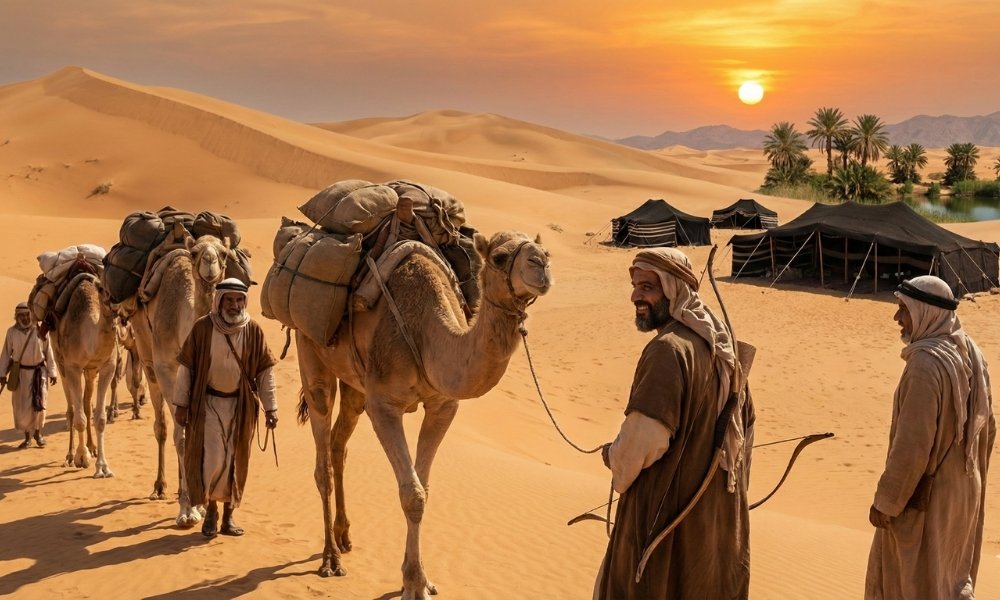
The Ishmaelites were the nomadic descendants of Ishmael, the firstborn son of Abraham and his Egyptian servant Hagar. Blessed by God because of his Abrahamic lineage, Ishmael was promised to become a great nation and the father of twelve princes. They inhabited the vast desert wilderness stretching from the border of Egypt across northern Arabia to Assyria. Known as fierce independent warriors and skilled archers, they lived as Bedouins in tents and controlled major caravan trade routes. While they were not the children of the covenant promise (which went to Isaac), they remained a significant power in the biblical world, often interacting with Israel through trade, intermarriage, and conflict.
- Ancestry: Descendants of Ishmael (Son of Abraham and Hagar)
- Region: The Desert of Paran / Northern Arabia
- Lifestyle: Nomadic Bedouins, Archers, Traders
- Key Figures: Ishmael, Nebaioth, Kedar, Basemath (Esau’s wife)
- Biblical Role: The “Wild Donkey” of a man; wealthy caravan merchants
- Fate: Became the twelve tribes of the desert; ancestors of Arab peoples
- Symbol: The Wild Donkey / The Bow
Name Meaning
The name “Ishmael” (Yishma-El) means “God Hears.” This name was given by the Angel of the Lord to Hagar in the wilderness, signifying that God had heard her cry of misery when she was mistreated. It serves as a perpetual reminder that God’s attention extends to the outcast and the marginalized.
Origin / Family Background
The Firstborn: Ishmael was born to Abraham when he was 86 years old, the result of Sarah’s plan to build a family through her servant Hagar. When the true heir Isaac was born 14 years later, conflict arose. Sarah demanded Hagar and Ishmael be expelled.
The Divine Promise: Though Ishmael was sent away into the desert of Beersheba with only some bread and a skin of water, God did not abandon him. God promised Abraham, “I will make the son of the maidservant into a nation also, because he is your offspring.” Ishmael grew up in the Desert of Paran and became an expert archer.
The Twelve Princes: Just as Jacob (Israel) had twelve sons, Ishmael became the father of twelve tribal chiefs (Nebaioth, Kedar, Adbeel, Mibsam, etc.), fulfilling the prophecy that he would be a great nation.
Biblical Era / Context
The Patriarchal Age: They lived in the wilderness “to the east” of their brothers. They were the masters of the desert, living in “hostility toward all their brothers,” which can also be translated as living “in the presence of” or “defiant against” them.
The Joseph Story: The Ishmaelites appear as the caravan traders traveling from Gilead to Egypt, carrying spices, balm, and myrrh. It was this caravan that purchased Joseph from his brothers for twenty shekels of silver and sold him to Potiphar in Egypt.
The Monarchy: By the time of David and Solomon, the Ishmaelite tribes (particularly Kedar) were famous for their massive flocks of sheep and their black goat-hair tents.
Key Interactions / Events
Hagar’s Rescue: When Hagar and Ishmael ran out of water in the desert and the boy was dying, God opened Hagar’s eyes to see a well of water. This well, Beer Lahai Roi (“The Well of the Living One Who Sees Me”), became a landmark of divine provision for the outcast.
Esau’s Rebellion: Esau, the brother of Jacob, saw that his Canaanite wives displeased his father Isaac. To spite his parents and reconnect with his Abrahamic roots, Esau went to Ishmael’s family and married Mahalath (or Basemath), the daughter of Ishmael. This united the two non-chosen lines of Abraham (Edom and Ishmael).
The Psalm of the Desert: Psalm 83 lists the Ishmaelites among the confederation of enemies plotting against Israel, along with Edom, Moab, and Hagrites, showing that the political relationship remained tense throughout history.
Major Roles / Identity
The Wild Donkey: The Angel prophesied that Ishmael would be “a wild donkey of a man; his hand will be against everyone and everyone’s hand against him.” In biblical imagery, the wild donkey is not a beast of burden but a symbol of noble, untamable freedom—a creature that scorns the noise of the city and roams the mountains at will.
The Trader: While Israel was agrarian (farmers/shepherds), the Ishmaelites were the logistics experts of the ancient world, moving luxury goods across the harsh deserts that others could not survive.
Notable Passages
Genesis 16:11-12: “You shall name him Ishmael, for the Lord has heard of your misery. He will be a wild donkey of a man…”
Genesis 21:20: “God was with the boy as he grew up. He lived in the desert and became an archer.”
Genesis 37:25: “A caravan of Ishmaelites was coming from Gilead. Their camels were loaded with spices, balm and myrrh.”
Psalm 120:5: “Woe to me that I dwell in Meshech, that I live among the tents of Kedar [a prominent Ishmaelite tribe]!”
Legacy & Impact
Arab Lineage: Traditionally, Ishmael is regarded as the spiritual and physical ancestor of many Arab tribes. The connection is acknowledged in both Jewish and Islamic tradition, reinforcing the concept that the conflict in the Middle East is, at its core, a family dispute between half-brothers.
Kedar: The tribe of Kedar (Ishmael’s second son) became so prominent that “Kedar” is often used in the Bible as a synonym for all Bedouin Arabs. They were renowned for their archers and their “black tents” (Song of Solomon 1:5), made from goat hair.
Symbolism / Typology
Hagar and Sarah (The Two Covenants): In the New Testament (Galatians 4), Paul uses the story of Hagar and Ishmael as an allegory. Hagar (the slave woman) represents the Covenant of Law and earthly Jerusalem (slavery to sin/rules), while Sarah (the free woman) represents the Covenant of Grace and the heavenly Jerusalem. Ishmael symbolizes those born of the flesh (human effort), while Isaac symbolizes those born of the Spirit (divine promise).
God of the Outcast: Ishmael’s story is a powerful testament that God blesses even those who are not part of the “main” storyline of redemption. He hears the cries of the rejected and makes them great in their own right.







Leave a Reply