
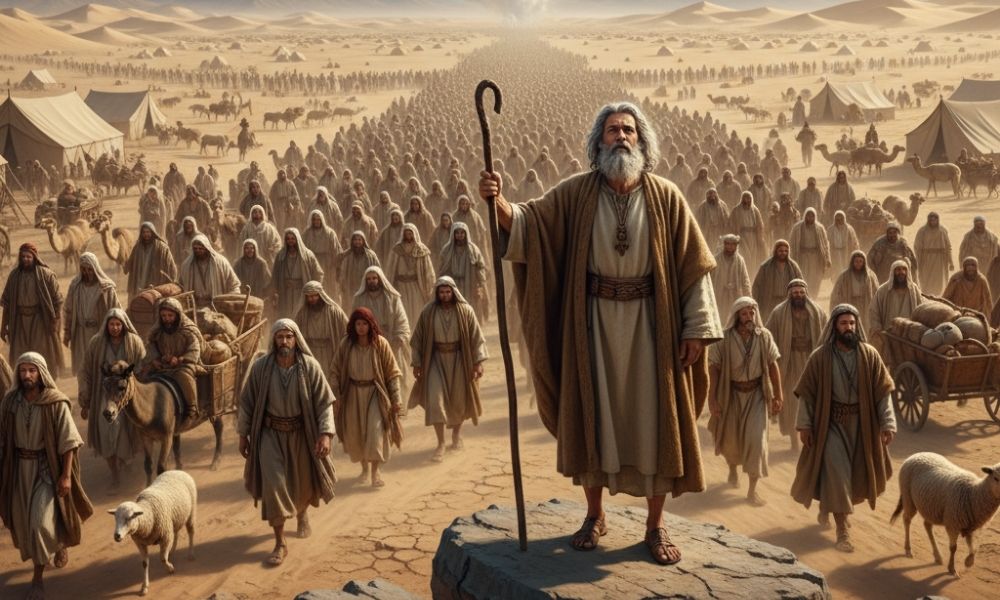
The Israelites were the descendants of Jacob (also called Israel) and are the people through whom God established His covenant and revealed His law. They play a central role in the Old Testament as God’s chosen nation, set apart to bring His light and truth to the world. Their history spans from the patriarchs (Abraham, Isaac, and Jacob) to the formation of the nation of Israel, their exodus from Egypt, the giving of the Law at Sinai, the conquest of Canaan, the era of the kings and prophets, and ultimately the exile and restoration.
Quick Facts
Name Meaning: “Israel” means “He struggles with God” (Genesis 32:28)
Ancestor: Jacob (renamed Israel by God)
Tribal Structure: 12 tribes descended from Jacob’s sons
Covenant: Chosen people of God through Abraham, Isaac, and Jacob
Law: Given through Moses at Mount Sinai
Era: From c. 2000 BCE (patriarchs) to the post-exilic period (~400 BCE)
Land: Canaan (later called Israel and Judah)
Religion: Worship of Yahweh, the one true God
Scripture: The Hebrew Bible (Tanakh / Old Testament)
Origins and Covenant
The Israelite identity began with Abraham, whom God called to leave his homeland and promised to make into a great nation (Genesis 12:1–3). This covenant passed to Isaac and then to Jacob, whose twelve sons became the founders of the twelve tribes of Israel. God’s covenant included promises of land, descendants, and blessing — not only for Israel but for all nations through them.
Exodus and Nationhood
The Israelites grew into a large people while enslaved in Egypt. Under Moses, God delivered them through the Exodus, performing miracles such as the parting of the Red Sea. At Mount Sinai, they received the Law (Torah), becoming a covenant nation called to holiness and obedience to God.
The Promised Land and Kingdom
Under Joshua, the Israelites entered and conquered Canaan, the land promised to Abraham. Later, during the united monarchy under King Saul, David, and Solomon, Israel reached its height of power and spiritual influence. Jerusalem became the nation’s capital and the center of worship, where Solomon built the Temple.
Division and Exile
After Solomon’s reign, the kingdom divided into Israel (north) and Judah (south). Both kingdoms eventually fell due to disobedience and idolatry:
- Israel was conquered by Assyria in 722 BCE.
- Judah was taken into Babylonian exile in 586 BCE.
Despite their failures, God promised restoration through the prophets, foretelling a coming Messiah from the line of David.
Restoration and Legacy
After exile, a remnant of Israelites returned to rebuild Jerusalem and the Temple under leaders like Ezra and Nehemiah. The Israelite people eventually became known as the Jews, from the tribe of Judah. From this nation came Jesus Christ, fulfilling God’s promise of salvation for all humanity.
Faith and Significance
The Israelites represent God’s faithfulness to His covenant promises. Their history demonstrates His justice, mercy, and plan for redemption. Through them came the Law, the Prophets, and the Messiah — the foundation of both Judaism and Christianity.
Symbol
Star of David (Magen David): A modern emblem symbolizing the heritage and unity of the descendants of Israel.







Leave a Reply