
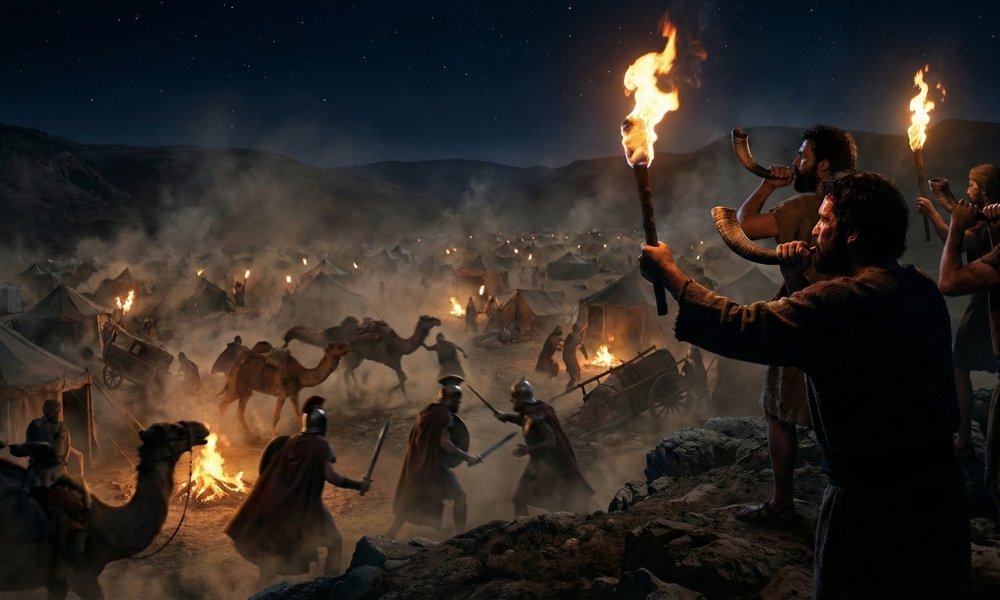
The Midianites were a nomadic tribal group inhabiting the northwestern regions of the Arabian Desert, east of the Gulf of Aqaba. In the biblical narrative, they occupy a unique dual role: they are both the hospitable kin who sheltered Moses for forty years and the oppressive marauders who were miraculously defeated by Gideon. As descendants of Abraham through his second wife Keturah, they were distinct from the Israelites (descendants of Sarah) but shared a common patriarchal heritage. They were renowned caravan traders who controlled the “King’s Highway” trade route, famously purchasing Joseph from his brothers and selling him into Egypt.
- Ancestry: Descendants of Midian (Son of Abraham and Keturah)
- Region: NW Arabia (East of the Red Sea/Gulf of Aqaba)
- Lifestyle: Nomadic shepherds and caravan traders
- Key Figures: Jethro (Reuel), Zipporah, Cozbi, Zebah, Zalmunna
- Biblical Role: Moses’ in-laws; Gideon’s oppressors
- Key Event: The Day of Midian (Gideon’s victory)
- Fate: Power broken by Gideon; assimilated into other Arab tribes
- Symbol: The Camel Caravan
Name Meaning
The name “Midian” is derived from a Semitic root meaning “strife,” “contention,” or “judgment.” This meaning is reflected in their history, which is characterized by conflict and judgment—both the judgment they brought upon Israel as a scourge and the judgment God eventually executed upon them.
Origin / Family Background
Abraham’s Other Family: While the focus of Genesis rests on Isaac (Sarah’s son) and Ishmael (Hagar’s son), Abraham had a third family. After Sarah died, he took another wife named Keturah. She bore him six sons, one of whom was Midian.
The Eastward Separation: To prevent conflict with the chosen heir Isaac, Abraham gave gifts to the sons of Keturah and sent them away to the “land of the east.” The Midianites settled in the desert regions, becoming a confederation of tribes rather than a centralized kingdom.
Biblical Era / Context
The Patriarchs: They appear early as the merchants who bought Joseph from his brothers. The text alternates between calling them “Ishmaelites” and “Midianites,” suggesting these groups intermingled or that “Ishmaelite” was a general term for desert traders.
The Exodus: Midian was the place of Moses’ exile. When he fled Egypt after killing the slave driver, he sat by a well in Midian.
The Judges: Centuries later, the Midianites became a severe threat. Using camels for long-range raids (one of the earliest recorded uses of camels in warfare), they swarmed across the Jordan during harvest time like locusts, stripping the land bare and forcing the Israelites to hide in caves.
Key Interactions / Events
Moses and Jethro: Moses married Zipporah, the daughter of Jethro (also called Reuel), the “Priest of Midian.” Jethro is portrayed positively as a wise mentor who taught Moses how to delegate leadership (Exodus 18). This connection created a friendly subgroup of Midianites known as the Kenites, who often allied with Israel.
The Incident at Peor: Toward the end of the wilderness wanderings, the Midianites (allied with Moab) seduced Israel into idolatry. A Midianite woman named Cozbi brought an Israelite man into her tent in full view of the camp. Phinehas the priest followed them and drove a spear through both of them, stopping the ensuing plague.
Gideon’s 300: When Midian oppressed Israel, God raised up Gideon. With only 300 men, Gideon surrounded the massive Midianite camp at night, blowing trumpets and smashing clay jars. The sudden noise and light caused a panic; the Midianites turned their swords on each other in the confusion and fled. Gideon then hunted down their kings, Zebah and Zalmunna.
Major Roles / Identity
The Ambiguous Cousin: Midian represents the complexity of non-elect Abrahamic lines. Through Jethro, they are wise, God-fearing allies. Through the kings of Gideon’s day, they are devastating enemies.
The Bedouin Archetype: They provide the biblical picture of the desert wanderer—dwelling in tents, rich in livestock, and masters of the camel, controlling the incense and spice trade routes from the south.
Notable Passages
Exodus 2:15: “Moses fled from Pharaoh and went to live in Midian, where he sat down by a well.”
Exodus 18:24: “Moses listened to his father-in-law [Jethro the Midianite] and did everything he said.”
Numbers 25:17: “Treat the Midianites as enemies and kill them.” (God’s command after the seduction at Peor).
Judges 6:5: “They came up with their livestock and their tents like swarms of locusts. It was impossible to count them or their camels.”
Legacy & Impact
The Kenite Connection: Because of Moses’ marriage, a clan of Midianites (the Kenites) lived among the Israelites for centuries. Jael, the woman who killed the Canaanite general Sisera with a tent peg, was a Kenite (wife of Heber the Kenite), showing that the “good” line of Midian continued to assist Israel.
The Day of Midian: Gideon’s victory was so total and miraculous that the “Day of Midian” became a proverb in Israel for total deliverance by God’s hand without human strength (referenced in Isaiah 9:4).
Symbolism / Typology
The Broken Pitcher: The defeat of Midian by the breaking of Gideon’s pitchers symbolizes that the light of the Gospel shines forth only when the “earthen vessel” of the self is broken.
The Seduction of the World: In the Peor incident, Midian symbolizes the world’s attempt to corrupt the believer through sexual immorality and false worship when direct cursing (Balaam) fails.







Leave a Reply