
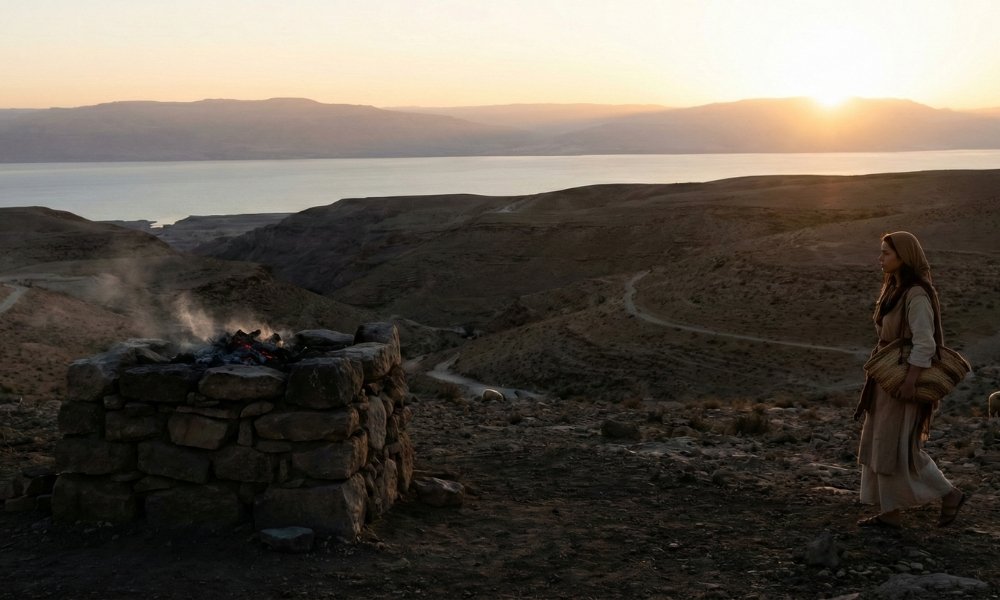
The Moabites were a Semitic nation living east of the Dead Sea, directly across from the tribe of Judah. They shared a close but fraught kinship with Israel, descending from Lot, Abraham’s nephew. Their history with Israel is a complex tapestry of war, peace, vassalage, and intermarriage. While they were frequently enemies who hired Balaam to curse Israel and oppressed them during the Judges era, they also provided a safe haven for David’s family and produced Ruth, the great-grandmother of King David. Their worship of the god Chemosh, which involved human sacrifice, was a major point of condemnation in the biblical narrative.
- Ancestry: Descendants of Moab (Son of Lot)
- Region: The plateau east of the Dead Sea
- Capital: Dibon / Kir-Hareseth
- Key God: Chemosh
- Key Figures: Balak, Eglon, Ruth, Mesha
- Biblical Role: Hostile cousins; symbol of pride; source of redemption
- Fate: Conquered by Babylon; absorbed into Arab populations
- Symbol: The High Place
Name Meaning
The name “Moab” literally means “From father.” This name serves as a perpetual reminder of their incestuous origin story found in Genesis, marking them from birth as a people born of shame yet preserved by God for a specific role in history.
Origin / Family Background
The Cave of Zoar: After the destruction of Sodom and Gomorrah, Lot fled to a cave with his two daughters. Fearing that no men were left on earth to preserve their line, the daughters made their father drunk and slept with him. The firstborn daughter gave birth to a son and named him Moab.
Kinship: Because Lot was Abraham’s nephew, the Moabites were second cousins to the Israelites. God instructed Moses not to harass the Moabites or provoke them to war during the Exodus because He had given them their land as an inheritance to Lot.
Biblical Era / Context
The Exodus: They refused Israel safe passage and hired the prophet Balaam to curse them. When the curse failed, Moabite women seduced Israelite men into idolatry at Peor, leading to a plague.
The Judges: King Eglon of Moab oppressed Israel for 18 years until the left-handed judge Ehud assassinated him in his private chamber.
The Monarchy: They were conquered by David but rebelled after King Ahab’s death. King Mesha of Moab is famous for leading a revolt that successfully drove Israel out of his territory.
Key Interactions / Events
Balaam and Balak: King Balak of Moab was terrified of the approaching Israelite horde. He hired the diviner Balaam to pronounce a supernatural curse. God intervened, turning every curse into a blessing, frustrating the King’s plans.
Ruth the Moabitess: During a famine, an Israelite family moved to Moab. Her sons married Moabite women. When the men died, Ruth famously clung to her mother-in-law Naomi and her God, Yahweh. She returned to Bethlehem and became the ancestor of Christ, proving that grace transcends national boundaries.
The Sacrifice of the Crown Prince: A coalition of Israel, Judah, and Edom attacked Moab. Trapped in his capital, King Mesha took his firstborn son and sacrificed him as a burnt offering on the city wall. The horrific sight caused such spiritual revulsion that the Israelite coalition withdrew.
Major Roles / Identity
The Seducers: Their primary threat to Israel was often spiritual rather than military. The incident at Baal of Peor, where Moabite women invited Israelites to their sacrifices, was one of the greatest apostasies in the wilderness era.
The Refuge: Paradoxically, Moab often served as a sanctuary. David took his parents to the King of Moab to keep them safe while he was on the run from Saul, likely relying on his descent from Ruth.
Notable Passages
Genesis 19:37: “The older daughter had a son, and she named him Moab; he is the father of the Moabites of today.”
Ruth 1:16: “Your people will be my people and your God my God.”
Isaiah 16:6: “We have heard of the pride of Moab—her overweening pride and conceit, her pride and her insolence.”
Jeremiah 48:42: “Moab will be destroyed as a nation because she defied the Lord.”
Legacy & Impact
The Line of Christ: The inclusion of Ruth in Matthew’s genealogy is a powerful theological statement. It validates the inclusion of Gentiles in the Kingdom of God and shows that lineage is defined by faith, not just blood.
Historical Confirmation: The events of the Moabite rebellion recorded in Kings are mirrored in ancient archaeological finds, confirming the political tension that existed between the House of Omri (Israel) and the House of Moab.
Symbolism / Typology
Pride: The prophets Isaiah and Jeremiah consistently associate Moab with arrogance and pride. They symbolize the carnal confidence of the flesh that resists the Spirit.
The Washbasin: In Psalm 60, God declares, “Moab is my washbasin.” This metaphor implies subjugation; a washbasin is a lowly vessel used for cleaning feet, indicating God will bring their pride down to the level of a servant.







Leave a Reply