
The Philistines were a seafaring people who settled on the southern coast of Canaan in the 12th century BCE. Unlike the Semitic Israelites or Canaanites, the Philistines were Aegean in origin (likely from Crete), part of the massive migration of “Sea Peoples” that disrupted the ancient Near East. They established a powerful confederation of five cities (the Pentapolis) that controlled the coastal plain and the vital trade routes. They are best known in the Bible as Israel’s most formidable military rival during the era of the Judges and the early Monarchy. Their monopoly on iron technology gave them a significant advantage over the bronze-equipped Israelites, leading to centuries of conflict involving major figures like Samson, Samuel, Saul, and David.
- Ancestry: Descendants of Mizraim (Son of Ham); from Caphtor (Crete)
- Region: The Southern Coastal Plain (Philistia)
- The Pentapolis: Gaza, Ashdod, Ashkelon, Ekron, Gath
- Key Gods: Dagon, Baal-Zebub, Ashtoreth
- Key Figures: Goliath, Achish, Delilah
- Biblical Role: The technologically superior arch-enemy
- Fate: Subjugated by David/Hezekiah; destroyed by Babylon
- Symbol: Iron Chariots / Dagon
Name Meaning
The name “Philistine” comes from the Hebrew Peleshet, meaning “migratory” or “invader.” This reflects their history as immigrants who arrived by sea. The modern name “Palestine” is derived directly from the Greek and Roman application of the name Philistia to the entire region.
Origin / Family Background
The Sea Peoples: The Philistines were not indigenous to the Levant. Biblical genealogy places them as coming from Casluhim and Caphtor (Crete). They were culturally connected to the Mycenaean Greeks, evidenced by their pottery and burial practices found in archaeology.
The Five Cities: Instead of a single kingdom, they operated as a confederation of five city-states (Gaza, Ashdod, Ashkelon, Ekron, and Gath), each ruled by a “Seren” (Lord). This decentralized but unified military structure made them incredibly resilient.
Biblical Era / Context
The Judges: They began to encroach on the tribe of Dan, forcing the Danites to migrate north. This is the era of Samson, whose strength was God’s answer to Philistine oppression.
The Iron Monopoly: During the time of King Saul, the Philistines held a strict monopoly on blacksmithing. They did not allow a single blacksmith to operate in Israel “lest the Hebrews make swords or spears.” This forced Israelites to go down to Philistia just to sharpen their farming tools, ensuring Israel remained militarily weak.
The Monarchy: They defeated Israel at the Battle of Aphek (capturing the Ark) and the Battle of Gilboa (killing King Saul). It was only under King David that their power was finally broken.
Key Interactions / Events
The Capture of the Ark: The Philistines captured the Ark of the Covenant and placed it in the temple of Dagon in Ashdod. The next morning, the idol of Dagon was found fallen on its face. The following day, it was fallen and broken. A plague of tumors then struck the city, forcing them to return the Ark to Israel.
Samson and Delilah: Samson’s entire ministry was a one-man guerilla war against the Philistines. He burned their crops, slaughtered them with a jawbone, and eventually pulled down the temple of Dagon upon their lords and himself.
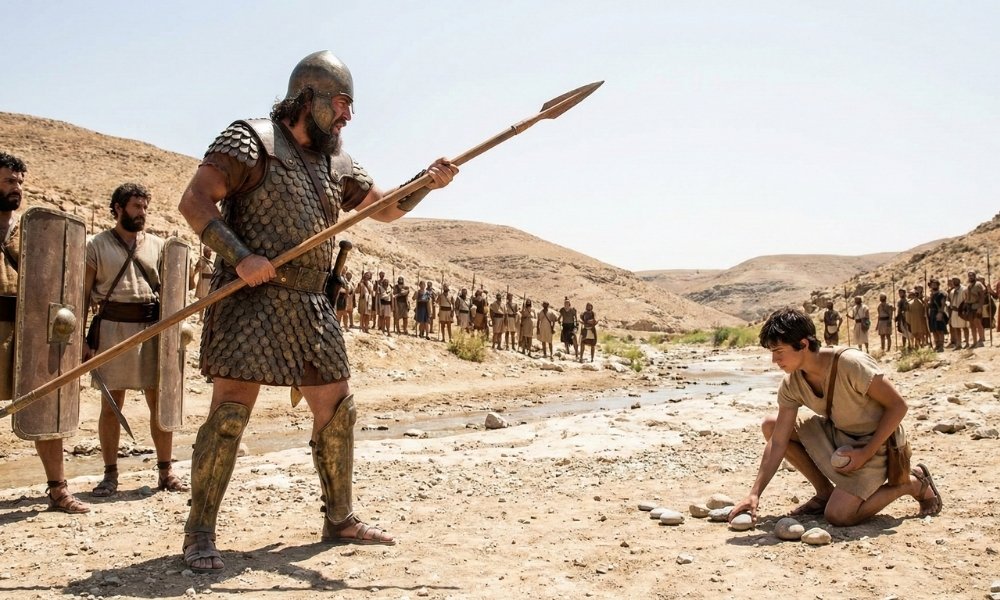
David and Goliath: The most famous duel in history occurred in the Valley of Elah. The giant Goliath of Gath challenged Israel for forty days until the shepherd boy David defeated him with a sling, proving that faith in Yahweh was superior to Philistine armor.
Major Roles / Identity
The Uncircumcised: They are frequently referred to with the derogatory epithet “the uncircumcised Philistines.” Since most neighbors of Israel (Egyptians, Edomites, Moabites) practiced some form of circumcision, the Philistines’ lack of it marked them as visibly distinct and ritually unclean foreigners.
The Iron Masters: They symbolize technological and military superiority. Their chariots and iron weapons represented the insurmountable odds facing the people of God.
Notable Passages
Exodus 13:17: “God did not lead them on the road through the Philistine country, though that was shorter. For God said, ‘If they face war, they might change their minds and return to Egypt.’”
1 Samuel 13:19: “Not a blacksmith could be found in the whole land of Israel, because the Philistines had said, ‘Otherwise the Hebrews will make swords or spears!’”
1 Samuel 17:4: “A champion named Goliath, who was from Gath, came out of the Philistine camp. His height was six cubits and a span.”
Legacy & Impact
The Name “Palestine”: After the Romans crushed the Jewish Bar Kokhba revolt in 135 CE, they renamed the province of Judea to Syria Palaestina (after the Philistines) to erase the Jewish connection to the land. Thus, the name of Israel’s ancient enemy is still stamped on the geography today.
Archaeology: Excavations at Gath (Tell es-Safi) have revealed massive fortifications and evidence of a destruction layer consistent with the biblical accounts of Hazael and Uzziah. Pottery finds confirm their Aegean cultural roots.
Symbolism / Typology
Dagon: The fish/grain god Dagon represents false religion that cannot stand in the presence of God (falling before the Ark).
Goliath: Represents the intimidation of the enemy. He relied on shield, spear, and size (carnal weapons), while David relied on the Name of the Lord (spiritual weapon).







Leave a Reply