
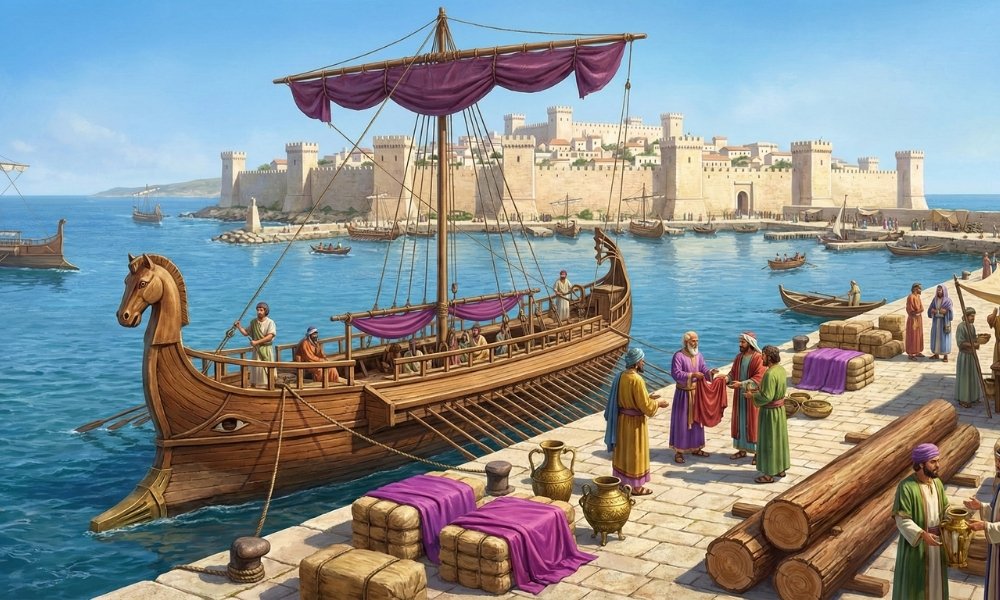
The Phoenicians were the undisputed master mariners and traders of the ancient world. Occupying the narrow coastal strip of modern-day Lebanon, they established a thalassocracy (empire of the sea) that spanned the entire Mediterranean. In the Old Testament, they are rarely referred to as “Phoenicians” (a Greek term) but are instead identified by their principal city-states: Tyre and Sidon. They were essential economic partners to Israel, providing the cedar wood, skilled labor, and gold for Solomon’s Temple. However, they were also the primary exporters of Baal worship, which constantly threatened the spiritual fidelity of Israel. Their invention of the phonetic alphabet and their monopoly on purple dye revolutionized ancient culture and commerce.
- Ancestry: Descendants of Canaan (Son of Ham)
- Region: The Levant Coast (Lebanon/Syria)
- Key Cities: Tyre, Sidon, Byblos, Carthage (colony)
- Key Deities: Baal, Ashtoreth, Melqart
- Key Figures: King Hiram (Ally), King Ethbaal, Queen Jezebel
- Biblical Role: Wealthy trading partners and religious corrupters
- Fate: Besieged by Nebuchadnezzar; island city destroyed by Alexander the Great
- Symbol: The Merchant Ship / Purple Dye
Name Meaning
The name “Phoenician” is derived from the Greek word Phoinikes, meaning “Purple People.” This name was given to them because they held a monopoly on the production of the precious Tyrian purple dye, extracted from the murex sea snail. In the Hebrew Bible, they are typically referred to as “Sidonians” or “Tyrians,” or generally as “Canaanites” (the merchant aspect of the term).
Origin / Family Background
The Coastal Canaanites: Geographically and ethnically, the Phoenicians were Canaanites who inhabited the northern coast. Unlike their inland cousins who were agricultural and often at war with Israel, the Phoenicians looked to the sea.
The City-State Structure: They were not a unified nation with a single capital but a confederation of independent city-states, chief among them Tyre (the impregnable island fortress) and Sidon (the mother city).
Biblical Era / Context
The Golden Age of Alliance: Under King David and King Solomon, the relationship between Israel and the Phoenician city of Tyre was remarkably peaceful. King Hiram of Tyre loved David and sent materials for his palace. Later, Hiram entered into a massive trade agreement with Solomon, exchanging Lebanon’s cedar and cypress timber for Israelite wheat and olive oil.
The Era of Apostasy: The relationship soured spiritually during the divided kingdom. The marriage of Ahab to the Phoenician princess Jezebel brought the militant worship of the Tyrian god Melqart (Baal) into Israel, leading to the confrontation at Mount Carmel.
The New Testament: Jesus visited the region of Tyre and Sidon, where he healed the daughter of a Syrophoenician woman. In Acts, the early church spread to Phoenicia following the persecution of Stephen.
Key Interactions / Events
The Building of the Temple: The First Temple in Jerusalem was largely a product of Phoenician craftsmanship. Solomon conscripted Israelites for labor, but the architectural expertise, the bronze casting, and the timber felling were managed by the skilled artisans of Hiram.
The Siege of Tyre: The prophets Isaiah, Jeremiah, and Ezekiel all predicted the fall of Tyre. The city was famous for its arrogance, believing its island fortress was untouchable. Nebuchadnezzar besieged the mainland city for 13 years. Later, Alexander the Great fulfilled the prophecy of Ezekiel 26 by scraping the rubble of the mainland city into the sea to build a causeway, destroying the island fortress completely.
Jonah’s Voyage: When Jonah fled from the Lord, he went to Joppa and found a ship bound for Tarshish. This was likely a Phoenician merchant vessel, as they were the only sailors capable of making such long-distance voyages to the western Mediterranean (Spain).
Major Roles / Identity
The Merchants of the Earth: They were the “middlemen” of the ancient world. They traded tin from Britain, silver from Spain, and ivory from Africa. Ezekiel 27 describes Tyre as a glorious ship made of the finest materials, laden with the wealth of nations.
The Alphabet Bringers: Archaeology confirms that the Phoenicians developed the first widely used phonetic alphabet. They passed this writing system to the Greeks and Hebrews, democratizing literacy which had previously been locked in complex hieroglyphs and cuneiform.
Notable Passages
1 Kings 5:1: “When Hiram king of Tyre heard that Solomon had been anointed king… he sent his envoys to Solomon, for he had always been on friendly terms with David.”
Ezekiel 27:3: “Say to Tyre, situated at the gateway to the sea, merchant of the peoples on many coasts… You say, ‘I am perfect in beauty.’”
Mark 7:26: “The woman was a Greek, born in Syrian Phoenicia. She begged Jesus to drive the demon out of her daughter.”
Legacy & Impact
The Spread of Culture: By establishing colonies like Carthage (in North Africa), the Phoenicians spread Semitic culture and language across the Mediterranean.
Spiritual Symbolism: In the Bible, Tyre/Phoenicia often represents the pinnacle of human economic success and pride. It is the archetype of the commercial world system—beautiful, wealthy, and efficient, but doomed because its heart is “proud as a god.”
Symbolism / Typology
The Ship of State: Ezekiel 27 compares the nation to a beautiful, sinking ship. It symbolizes the fragility of wealth; no matter how well-constructed the vessel of human commerce is, it cannot withstand the storm of God’s judgment.
Purple: Represents royalty and wealth, but also the superficial covering of the world that eventually fades.







Leave a Reply