
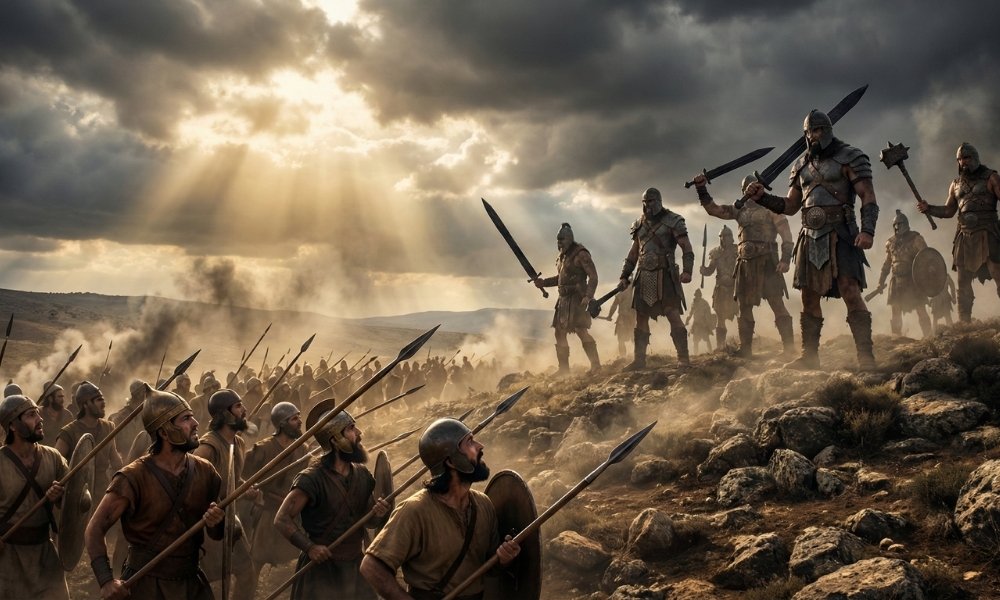
The Rephaites (or Rephaim) were an ancient group of people renowned for their immense physical stature and military prowess. Often referred to simply as “giants” in English translations, they inhabited the land of Canaan and the Transjordan region long before the Israelites arrived. Their presence struck terror into the hearts of the ten faithless spies, who described themselves as “grasshoppers” in comparison. The Rephaites are frequently linked with other giant clans like the Anakim and the Emim. By the time of the conquest, their numbers had dwindled, with Og, King of Bashan, being one of the last remaining survivors of their royal line.
- Ancestry: Uncertain; possibly indigenous or related to the Nephilim tradition
- Region: Bashan (Golan Heights), Ammon, Moab, and the Valley of Rephaim (near Jerusalem)
- Meaning: “Healers,” “Terrible Ones,” or “Ghosts/Shades”
- Key Figures: King Og of Bashan, Goliath (connected via Gath)
- Biblical Role: The formidable giants who tested Israel’s faith
- Fate: Defeated by Moses (East) and Joshua/David (West)
- Symbol: The Iron Bed of Og
Name Meaning
The word Rephaim has a dual meaning in Hebrew. Historically, it refers to this ethnic group of giants. However, the root rapha is also used in poetic texts (like Isaiah 14:9 and Job 26:5) to refer to the “spirits of the dead” or “shades” inhabiting the underworld (Sheol). This has led some scholars to suggest they were viewed as fearsome, semi-mythical ancestors or ghost-warriors.
Origin / Family Background
The Giant Clans: The Bible uses several regional names to describe people of the Rephaite stock:
- Anakim: Lived in Hebron (descendants of Anak).
- Emim: The Moabite name for them (“The Terrors”).
- Zamzummim: The Ammonite name for them (“The Murmurers”).
- Rephaim: The general term used in Bashan and western Israel.
The Nephilim Connection: Numbers 13:33 states, “We saw the Nephilim there (the descendants of Anak come from the Nephilim).” This suggests the Rephaites were viewed as preserving the bloodline or at least the physical characteristics of the antediluvian mighty men.
Biblical Era / Context
The Age of Abraham: In Genesis 14, a coalition of four eastern kings (led by Chedorlaomer) invaded the region and specifically targeted the Rephaite strongholds. They defeated the “Rephaities in Ashteroth Karnaim,” weakening their power centuries before Moses arrived.
The Conquest: Moses faced the greatest concentration of them in Bashan (modern Golan Heights). This region was called the “Land of the Rephaites.”
The Monarchy: A “Valley of Rephaim” existed just southwest of Jerusalem, serving as a strategic point for Philistine invasions against David. It was likely named after giants who once lived there.
Key Interactions / Events
The Defeat of Og: Og, King of Bashan, was the last of the Rephaites in the Transjordan. He ruled over sixty fortified cities with high walls and bronze gates. Moses and the Israelites killed him at the Battle of Edrei, a victory that was celebrated in Israel’s liturgy (Psalm 136) as a monumental act of God.
The Iron Bed: Deuteronomy 3:11 records a fascinating archaeological detail: “Only Og king of Bashan was left of the remnant of the Rephaites. His bed was made of iron and was more than thirteen feet long and six feet wide.” This artifact was kept on display in the Ammonite city of Rabbah as proof of his size.
David’s Giant Slayers: In 2 Samuel 21, late in David’s reign, several battles took place against the “descendants of Rapha” in Gath. David’s mighty men killed Ishbi-Benob (whose spear weighed 300 shekels), Saph, and a huge man with six fingers on each hand and six toes on each foot.
Major Roles / Identity
The Barrier to Promise: The Rephaites represent the ultimate physical obstacle. They were the reason the first generation of Israelites refused to enter the Promised Land (“The people are stronger and taller than we are… we saw the Anakim there”).
The “Test” of Faith: God allowed these giants to remain in the land to test whether Israel would trust in the “Lord of Hosts” or rely on their own small stature.
Notable Passages
Deuteronomy 2:10-11: “The Emites used to live there—a people strong and numerous, and as tall as the Anakites. Like the Anakites, they too were considered Rephaites.”
Deuteronomy 3:11: “Only Og king of Bashan was left of the remnant of the Rephaites. His bed… was more than thirteen feet long.”
2 Samuel 21:20: “In another battle with the Philistines at Gath, there was a huge man with six fingers on each hand and six toes on each foot—twenty-four in all. He also was descended from Rapha.”
Legacy & Impact
The Golan Heights: The region of Bashan remains a place of mystery. It is home to Gilgal Refaim (Wheel of Giants), a massive ancient megalithic structure similar to Stonehenge. Many associate this site with the Rephaite civilization, used for astronomical or burial purposes.
The Theological “Giants”: The defeat of the Rephaites demonstrated that no human power, no matter how physically imposing, can stand against the will of Yahweh. It became a permanent lesson that “the battle is the Lord’s.”
Symbolism / Typology
Spiritual Strongholds: The Rephaites symbolize the “giants” of sin, fear, and addiction that occupy the life of a believer. They are the established, fortified lies that seem impossible to remove but must be driven out to possess one’s spiritual inheritance.
The Kingdom of Death: Because the word Rephaim also means “shades of the dead,” they represent the culture of death and darkness that opposes the Kingdom of Life.







Leave a Reply