
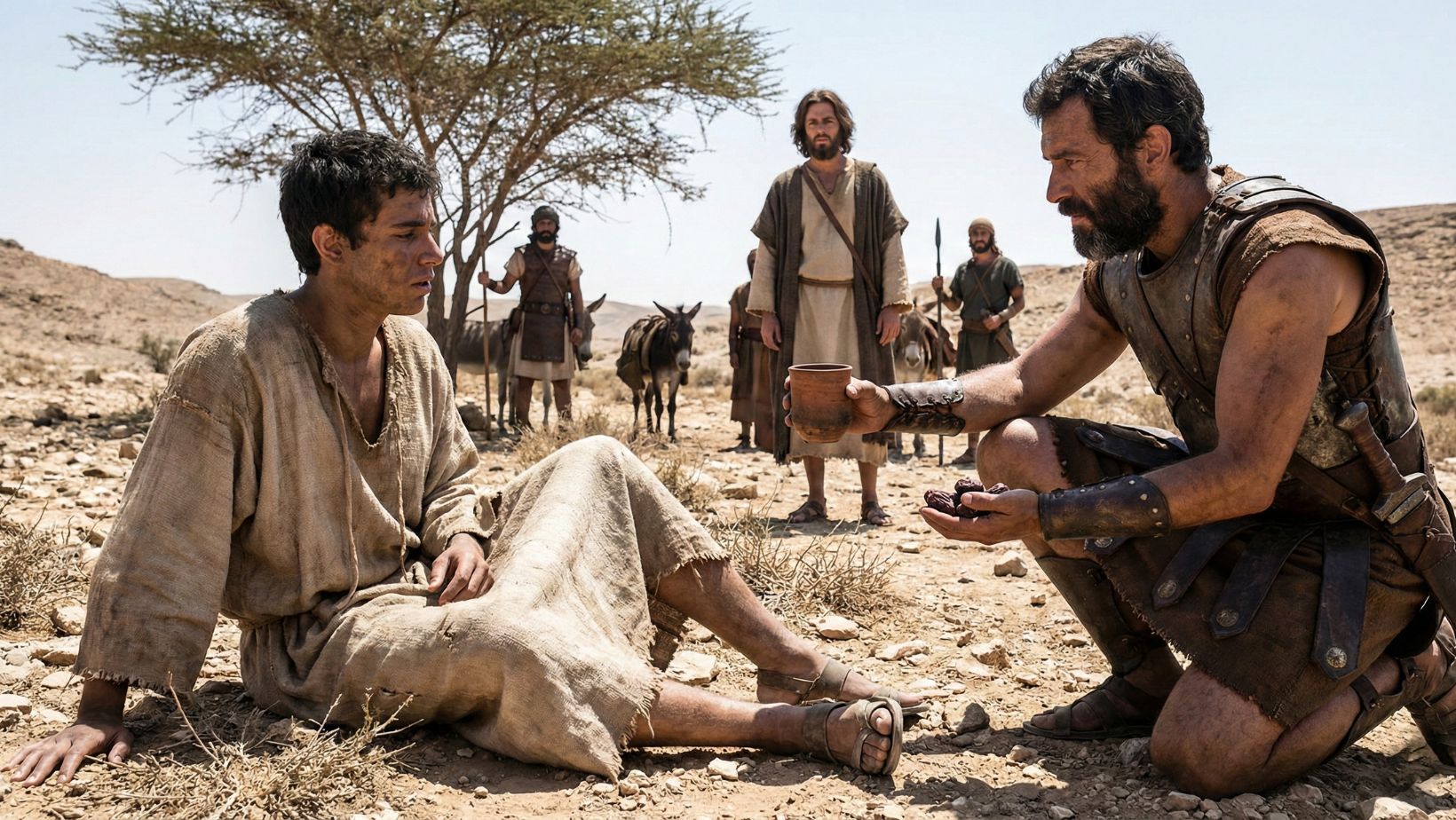
The unnamed Egyptian slave in 1 Samuel 30 is a minor but pivotal figure in the narrative of David’s rise to kingship. Found half-dead in the wilderness after being abandoned by his master, this young man becomes the providential link that allows David to track down the Amalekite raiders who had burned Ziklag and kidnapped the families of David and his men. His story is a striking illustration of divine providence working through the marginalized and a powerful lesson on the strategic value of kindness. While his former master discarded him as a burden, David’s mercy toward him unlocked the path to victory and restoration.
Quick Facts
- Name: Unnamed (identified only as “a young Egyptian”)
- Nationality: Egyptian
- Role: Slave / Servant to an Amalekite; later a guide for David
- Era: Late reign of King Saul / David’s exile (approx. 1010 BCE)
- Master: An unnamed Amalekite raider
- Condition: Found sick, starving, and abandoned for three days
- Key Action: Led David to the Amalekite camp, enabling the rescue of Ziklag’s captives
- Key Symbol: The “rejected stone” — the discarded servant who becomes the key to victory
Name Meaning
Unnamed: The text simply refers to him as “a young Egyptian” (1 Samuel 30:11). His lack of a name emphasizes his status in the eyes of his master as property rather than a person. However, his anonymity highlights a biblical theme: God often uses the obscure, the nameless, and the forgotten to alter the course of history.
Lineage / Family Background
Origin: Egypt. It is likely he was captured in a previous raid or sold into slavery, eventually ending up in the service of the Amalekites, a nomadic tribe known for raiding throughout the Negev and Sinai.
Social Status: The lowest tier of society—a foreign slave to a marauding band. He possessed no wealth, family influence, or freedom until his encounter with David.
Biblical Era / Context
Time: Following the Philistine rejection of David and immediately after the Amalekite raid on Ziklag.
Setting: The wilderness south of Ziklag (the Negev).
Cultural Context: In the ancient Near East, slaves who became sick or injured while traveling were often viewed as “dead weight.” Abandoning a sick slave in the desert was a pragmatic, albeit cruel, economic decision by the Amalekite master. This contrasts sharply with the Israelite ethic (and David’s specific action) of showing mercy to the stranger and the destitute.
Major Roles / Identity
The Discarded Victim: He represents the collateral damage of the Amalekite raids—used for labor and discarded when no longer useful.
The Recipient of Mercy: He becomes the object of David’s compassion. Despite David’s men being angry and in a hurry, they stopped to care for this dying stranger.
The Strategic Guide: He transforms from a liability into the most valuable intelligence asset David possesses. He is the only one who knows the location of the enemy camp.
Key Character Traits
Resilience: Survived three days and three nights in the open desert without food or water while sick.
Honesty: Clearly identified his background and his master when questioned.
Pragmatism: Negotiated for his safety (asking for an oath that he would not be killed or returned to his master) before giving up the information.
Main Life Events
The Raid on Ziklag: Participated (likely under duress) in the Amalekite raid that burned Ziklag and captured David’s wives (1 Samuel 30:1-2).
Sickness and Abandonment: Fell ill during the retreat. His master left him behind to die in the field rather than slow down the convoy (1 Samuel 30:13).
Discovery by David: Found by David’s scouts after three days of exposure. He was barely alive.
Revival: David’s men gave him bread, water, a piece of a cake of figs, and two clusters of raisins. “His spirit revived” (1 Samuel 30:12).
The Deal: He identified himself and agreed to lead David to the raiders on the condition of immunity and protection.
The Victory: He successfully guided David to the raiders, who were spread out eating and drinking. David attacked, recovered everything, and rescued all the captives.
Major Relationships
The Amalekite Master: A relationship defined by exploitation and cruelty. The master viewed the Egyptian as a disposable tool.
David: A relationship defined by mercy and mutual benefit. David treated the man with dignity (feeding him before questioning him), and the man reciprocated by solving David’s crisis.
Notable Passages
1 Samuel 30:11-12: “They found an Egyptian in the field and brought him to David. They gave him bread and he ate, and they gave him water to drink… for he had not eaten bread or drunk water for three days and three nights.”
1 Samuel 30:13: “David asked him, ‘To whom do you belong, and where do you come from?’ He said, ‘I am a young Egyptian, the servant of an Amalekite. My master left me behind because I fell sick three days ago.’”
1 Samuel 30:15: “He said, ‘Swear to me by God that you will not kill me or hand me over to my master, and I will take you down to this band.’”
Legacy & Impact
Restoration of the Kingdom: Though a minor character, without him, David might never have found the raiders. The recovery of his wives (Ahinoam and Abigail) and the wives and children of his men prevented a mutiny and secured David’s leadership just days before he was anointed King of Judah.
The Value of Mercy: His story serves as a moral lesson that compassion is not a weakness. David’s kindness to a “nobody” yielded a greater reward than military tracking skills could have provided.
Symbolism / Typology
Grace to the Gentile: The Egyptian represents the outsider/Gentile receiving mercy from the Lord’s anointed (David), foreshadowing the inclusion of Gentiles in God’s plan.
From Death to Life: His revival from near-death through bread and water parallels spiritual restoration.
Contrast of Kingship: The story sets up a sharp contrast between the “way of the world” (the Amalekite who discards the weak) and the “way of God” (David, the shepherd-king, who restores the weak).
Extra-Biblical References
Rabbinic Tradition: Some Jewish commentaries highlight this incident as a pivotal test of David’s character, proving he was fit to be king because he did not overlook the suffering of a single individual even while pursuing a great victory.







Leave a Reply