
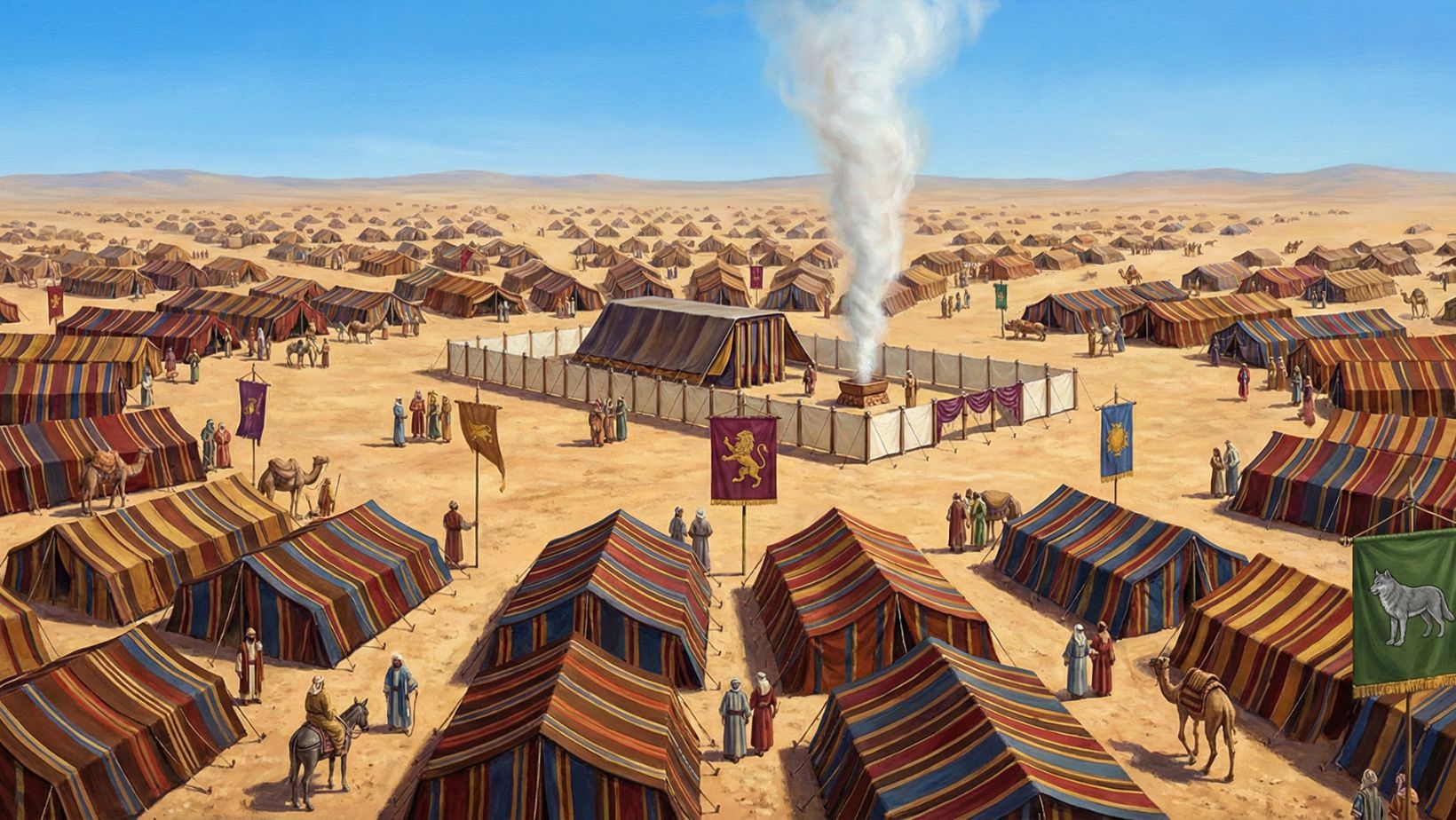
The Twelve Tribes of Israel represent the traditional divisions of the Jewish people, descended from the twelve sons of the patriarch Jacob (later named Israel). Their story is central to the Old Testament, tracing a journey from a single family in Canaan to a great nation. The tribal system defined the identity, land distribution, and spiritual life of the Israelites for centuries, illustrating themes of divine promise, internal struggle, and the unfolding of God’s plan for redemption.
- Ancestry: Sons of Jacob and his wives Leah and Rachel, and their handmaids Zilpah and Bilhah
- Era: Patriarchal Age to the Babylonian Exile (~17th century BCE – 6th century BCE)
- Key Figures: Jacob, Joseph, Joshua, King David
- Geographic Scope: Canaan (the Promised Land), divided among the tribes
- Core Texts: Genesis 49 (Jacob’s Blessing), Deuteronomy 33 (Moses’ Blessing), Joshua 13–21 (Land Allocation)
- Central Symbol: The Tabernacle (the tribes camped around it in a specific formation)
- Legacy: The foundation of the nation of Israel and the lineage of the Messiah through the tribe of Judah
Name Meaning and Origins
The “Twelve Tribes” are named after the sons of Jacob. The name Israel itself means “Struggles with God” or “Prince of God,” given to Jacob after he wrestled with an angel. Each tribe carried the name of a son, except for the “half-tribes” of Ephraim and Manasseh, who were the sons of Joseph.
Lineage / Family Background
The tribes are categorized by their maternal lineage, which often influenced their internal relationships and social standing:
- Leah’s Sons: Reuben, Simeon, Levi, Judah, Issachar, Zebulun
- Rachel’s Sons: Joseph (represented by Ephraim and Manasseh) and Benjamin
- Bilhah’s Sons (Rachel’s handmaid): Dan, Naphtali
- Zilpah’s Sons (Leah’s handmaid): Gad, Asher
Biblical Era / Context
The tribal structure began as a family unit in the book of Genesis. Following the Exodus from Egypt and 40 years of wandering in the desert, the tribes entered Canaan under the leadership of Joshua. The land was divided by lot, creating a confederacy of tribes. This era, known as the period of the Judges, eventually gave way to the United Monarchy under Saul, David, and Solomon.
Major Roles / Identity
Each tribe often had a specific reputation or vocational role within the nation:
- Levi: The priestly tribe; they did not receive a land inheritance but served in the Tabernacle and Temple.
- Judah: The royal tribe; destined for leadership and the lineage of the Davidic kings.
- Zebulun: Traditionally associated with maritime trade and the sea.
- Issachar: Noted for understanding the “signs of the times” and agricultural labor.
- Dan: Initially associated with the judiciary and later, unfortunately, with idolatry.
Key Character Traits of the Tribes
- Judah: Strength and leadership; symbolized by the lion.
- Benjamin: Fierce and warlike; described as a “ravenous wolf” in Jacob’s blessing.
- Naphtali: Known for grace and beautiful words; symbolized by a doe.
- Gad: Known for being brave and producing formidable warriors.
- Reuben: Noted for instability; though the firstborn, he lost his preeminence due to a lack of self-control.
Main Life Events of the Nation
- The Blessing of Jacob: Before his death, Jacob prophesied over each son, setting the trajectory for their future tribes (Genesis 49).
- The Exodus: The tribes emerged from Egypt as a unified nation of over 600,000 men.
- The Allotment of Land: Under Joshua, each tribe (except Levi) was given a specific territory in Canaan.
- The Division of the Kingdom: After Solomon, ten tribes formed the Northern Kingdom (Israel), while Judah and Benjamin formed the Southern Kingdom (Judah).
- The Assyrian Captivity: The ten northern tribes were exiled in 722 BCE, often referred to as the “Lost Tribes.”
Major Relationships
- The Tabernacle: During the wilderness wanderings, the tribes were organized in a strict square formation around the Tabernacle, symbolizing God at the center of their lives.
- The Levites and the People: The Levites lived in 48 specific cities scattered among the other tribes to provide spiritual guidance.
- Judah and Benjamin: These two tribes remained loyal to the Davidic line when the nation split.
Notable Passages
- Genesis 49:1–28: Jacob’s deathbed prophecies regarding the character and future of each tribe.
- Numbers 2: The specific arrangement of the tribal camps in the wilderness.
- Revelation 7:4–8: A symbolic listing of 12,000 from each tribe, representing the sealed servants of God.
Legacy & Impact
The Twelve Tribes provide the framework for the entire biblical narrative. They demonstrate that God works through a specific, diverse community to reach the world. The tribal identity remains a point of deep historical and prophetic interest in both Jewish and Christian theology, signifying the restoration of all Israel.
Symbolism / Typology
- The Number Twelve: Symbolizes divine government and organizational perfection.
- The High Priest’s Breastplate: Set with twelve stones, each engraved with a tribe’s name, signifying that the priest carried the whole nation on his heart before God.
- The New Jerusalem: In the Book of Revelation, the gates of the heavenly city are inscribed with the names of the twelve tribes.







Leave a Reply