
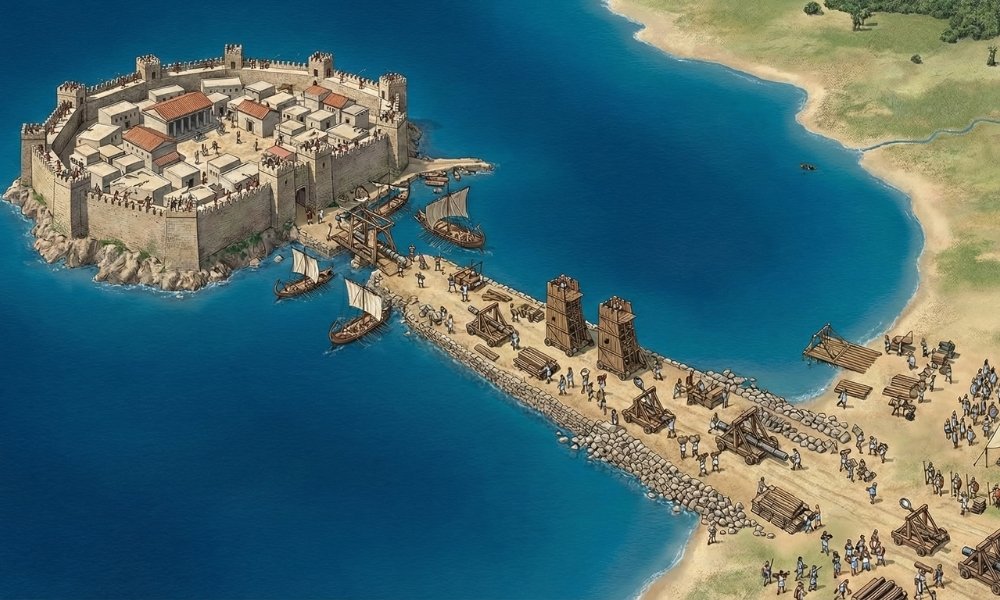
The Tyrians were the inhabitants of Tyre, the most powerful and celebrated city-state of ancient Phoenicia. Located south of Sidon, Tyre was unique because its primary stronghold was built on a rocky island about half a mile offshore, making it virtually impregnable to traditional land armies. In the Bible, the Tyrians appear in two sharply contrasting roles: first as the closest allies of Israel, supplying the materials and craftsmen for Solomon’s Temple under King Hiram, and later as the symbol of arrogant pride and spiritual corruption. The city was renowned for its immense wealth, its production of the royal purple dye, and its colonies (such as Carthage) that spread across the Mediterranean.
- Ancestry: Canaanites (Phoenician branch)
- Region: Southern Lebanon Coast
- City Structure: A mainland settlement (Old Tyre) and an island fortress (New Tyre)
- Key God: Melqart (The “King of the City,” often equated with Baal)
- Key Figures: King Hiram I, King Ethbaal, Jezebel, Prince of Tyre (Ezekiel 28)
- Biblical Role: Wealthy allies turned arrogant mockers
- Fate: Mainland destroyed by Babylon; Island destroyed by Alexander the Great
- Symbol: The Island Fortress / The Ship of State
Name Meaning
The Hebrew name for Tyre is Tzor, which literally means “Rock.” This descriptive name refers to the small, rocky island upon which the main city and its two harbors were built. It stood defiant against the crashing waves and invading armies, leading to its reputation as the unmovable city.
Origin / Family Background
The Daughter of Sidon: Originally, Tyre was considered a colony of Sidon (Isaiah 23:12 calls it the “daughter of Sidon”). However, by the time of the Israelite monarchy (10th century BCE), Tyre had eclipsed its mother city to become the dominant power of the Phoenician coast.
The Merchant Princes: Isaiah refers to the Tyrians as those “whose merchants are princes, whose traders are the renowned of the earth.” They were not a warrior culture by land, but an aristocracy of commerce who hired mercenaries to defend their vast wealth.
Biblical Era / Context
The United Monarchy (The Alliance): Tyre enjoyed a “brotherly covenant” (Amos 1:9) with Israel during the reigns of David and Solomon. King Hiram of Tyre was a sincere admirer of David. This era marked the zenith of cooperation, where Tyrian sailors and Israelite resources combined to build the Temple and a merchant fleet in the Red Sea.
The Divided Monarchy (The Corruption): The relationship grew toxic when Ethbaal, the High Priest of Astarte, seized the Tyrian throne. His daughter, Jezebel, married King Ahab of Israel, exporting the militant worship of the Tyrian Baal (Melqart) to Samaria.
The Prophetic Era (The Judgment): Because Tyre gloated over the fall of Jerusalem in 586 BCE—hoping to seize Israel’s trade share—God sent Ezekiel to pronounce a devastating judgment against the city’s pride.
Key Interactions / Events
Construction of the Temple: Solomon’s Temple was practically a Tyrian project funded by Israelite money. Hiram sent his most skilled bronze worker (Huram-Abi) to cast the two massive pillars, Jachin and Boaz, and the “Sea” (a massive bronze water basin).
The Siege of Nebuchadnezzar: After Jerusalem fell, the Babylonian king Nebuchadnezzar besieged Tyre for 13 years. He managed to destroy the mainland city, but the Tyrians simply retreated to their island fortress, using their navy to resupply. Nebuchadnezzar eventually gave up, unable to conquer the island.
The Causeway of Alexander: In 332 BCE, Alexander the Great accomplished what no one else could. Since he had no navy to attack the island, he demolished the ruins of Old Tyre on the mainland and threw the stones, timber, and rubble into the sea. He built a massive land bridge (mole) out to the island. His troops marched across the ocean surface, breached the walls, and obliterated the city, literally fulfilling Ezekiel’s prophecy that Tyre’s stones would be cast into the midst of the sea.
Major Roles / Identity
The Commercial Superpower: Ezekiel 27 describes Tyre as a majestic ship made of cypress, cedar, and oak, with sails of Egyptian linen. The cargo manifest listed therein includes silver, iron, ivory, ebony, emeralds, purple cloth, and even human slaves.
The Theological Villain: While Babylon represented political power and Egypt represented worldly reliance, Tyre represented Pride. It was the pride of self-made wealth and beauty. The “King of Tyre” passage in Ezekiel 28 is famously used by theologians to describe the fall of Satan, as the King’s pride mirrors the devil’s own fall from perfection.
Notable Passages
1 Kings 5:12: “The Lord gave Solomon wisdom… and there were peaceful relations between Hiram and Solomon, and the two of them made a treaty.”
Ezekiel 26:12: “They will plunder your wealth and loot your merchandise; they will break down your walls… and throw your stones, timber and rubble into the sea.”
Ezekiel 28:2: “In the pride of your heart you say, ‘I am a god; I sit on the throne of a god in the heart of the seas.’”
Amos 1:9: “For three sins of Tyre, even for four, I will not relent… because they disregarded a treaty of brotherhood.”
Legacy & Impact
Alexander’s Mole: The causeway Alexander built changed the geography of the coast permanently. Over centuries, sand deposits built up against the man-made bridge, turning the island of Tyre into a peninsula, which is how it exists today.
Cultural Diffusion: The Tyrians founded the city of Carthage in North Africa. Long after Tyre fell, the Carthaginian Empire (Punic Empire) continued to challenge Rome, preserving Tyrian culture, religion, and the influence of Baal worship for centuries.
Symbolism / Typology
The Fall of Satan: In Ezekiel 28:11-19, the lament over the King of Tyre transcends the human ruler. He is described as the “anointed guardian cherub” who was in “Eden, the garden of God,” until wickedness was found in him. The Tyrian king thus becomes the biblical type for Lucifer—a being created in perfect beauty who corrupted himself through pride and commerce.
The Harlot: Isaiah 23 compares Tyre to a forgotten prostitute who sings songs to attract customers again. It symbolizes the commercial system that sells itself for profit, lacking any true loyalty or morality.







Leave a Reply