
Settling Too Soon

Don’t settle for less than God’s promise—true obedience leads you across the Jordan into His fullness.


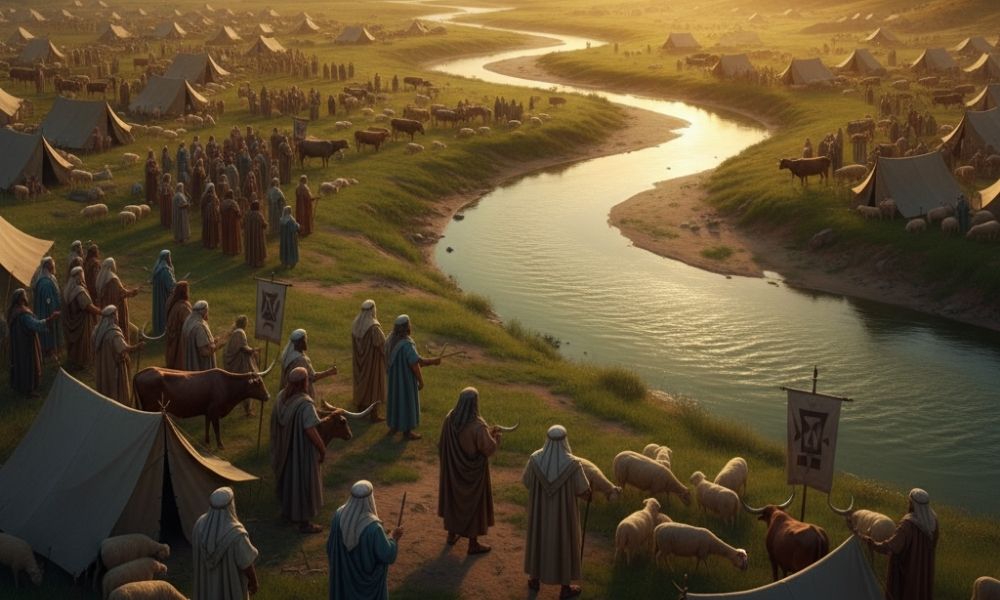
In Numbers 32:5, the Reubenites and Gadites made what seemed like a reasonable request—to stay in a land that looked good to them. But their request revealed a deeper issue: a desire for comfort rather than obedience. God had promised the land across the Jordan, yet they were ready to settle short of His full promise.

Many believers today face a similar temptation—to settle for good enough instead of God’s best.


1. Don’t Settle for Less Than God’s Promise

📖 Numbers 32:5 – “Let this land be given to your servants as our possession. Do not make us cross the Jordan.”

The tribes saw what was immediately beneficial and stopped there. They chose sight over faith.

  • The land looked good, but it wasn’t the Promised Land.
  • Sometimes what looks right in the moment isn’t right in God’s plan.
  • We can miss the fullness of God’s blessing when we stop where it’s comfortable.

🗣️ Application: Don’t let short-term convenience rob you of long-term promise.


2. Faith Requires Crossing the Jordan

📖 Joshua 1:2 – “Now then, you and all these people, get ready to cross the Jordan River into the land I am about to give to them—to the Israelites.”

Crossing the Jordan represented faith, obedience, and dependence on God.

  • It meant trusting God for what was unseen.
  • It required courage to move beyond comfort zones.
  • It symbolized stepping into destiny.

🗣️ Application: Every believer has a “Jordan” to cross—a moment when faith demands action.


3. Comfort Can Become a Spiritual Trap

📖 Amos 6:1 – “Woe to you who are complacent in Zion.”

The tribes of Reuben and Gad were satisfied with the land that looked peaceful and prosperous. But that comfort eventually led to vulnerability.

  • Later, these tribes were the first to fall when enemies attacked (1 Chronicles 5:26).
  • What looked like an advantage became a weakness.
  • Settling outside God’s will always leads to loss.

🗣️ Application: Be careful when comfort replaces calling.


4. God Calls Us to Participate in His Mission

Moses reminded them that all Israel must fight together to take the Promised Land (Numbers 32:6-7).

  • Unity mattered more than personal preference.
  • God’s plan required every tribe’s participation.

🗣️ Application: In the body of Christ, no one should stay behind while others fight. We’re called to stand together in faith.


Conclusion

Reuben and Gad teach us a valuable lesson:
God’s blessings are found not in where we stop, but in where we follow Him.

If you settle too soon, you may gain comfort—but lose calling. God is calling you to cross your Jordan, to step into His full promise.


Bottom Line

🔹 Key Thought: Don’t settle east of your promise.
🔹 Theological Point: God’s will often lies beyond the point of comfort—it demands faith, courage, and obedience.
🔹 Prayer: “Lord, help me not to settle for what’s easy. Give me courage to cross my Jordan and receive all that You have promised.”


Leave a Reply

Your email address will not be published. Required fields are marked *

Bible Characters

  • Mark (John Mark)
  • Mark (John Mark)

    John Mark was a young disciple who overcame early failure to become a trusted companion of Paul and Peter, ultimately authoring the dynamic Gospel that bears his name.


  • Matthew

    Matthew was a despised tax collector transformed by grace into a devoted apostle, whose Gospel bridges the Old and New Testaments by proclaiming Jesus as the promised Messiah and King.


  • Nabal

    Nabal was a wealthy but foolish landowner whose arrogance and refusal to show hospitality to David led to divine judgment and his sudden death.


Biblical Events

  • David lies to Ahimelech
  • Mark (John Mark)

    John Mark was a young disciple who overcame early failure to become a trusted companion of Paul and Peter, ultimately authoring the dynamic Gospel that bears his name.


  • Matthew

    Matthew was a despised tax collector transformed by grace into a devoted apostle, whose Gospel bridges the Old and New Testaments by proclaiming Jesus as the promised Messiah and King.


  • Nabal

    Nabal was a wealthy but foolish landowner whose arrogance and refusal to show hospitality to David led to divine judgment and his sudden death.


Bible Locations

  • Jezreel
  • Jezreel

    Jezreel was the fertile royal seat of King Ahab and Queen Jezebel, famous for the murder of Naboth and the site where divine judgment eventually wiped out their entire dynasty.


  • Aphek

    Aphek was a strategic military stronghold and staging ground on the Sharon Plain where the Philistines gathered to capture the Ark and where David was providentially released from the Philistine army.


  • Lachish

    Lachish was the second most powerful city in ancient Judah, a mighty fortress whose dramatic fall to Assyria and Babylon serves as a pivotal moment in biblical history and archaeology.


You May Also Like:

  • The Twelve Tribes of Israel were the tribal divisions descended from the sons of Jacob that formed the foundation of the Israelite nation and the prophetic lineage of the Messiah.

  • After burying Jacob in Canaan with great honor, Joseph reassures his fearful brothers that their past evil was overruled by God for good, and he dies in Egypt with a prophetic command that his bones be carried to the Promised Land.

  • On his deathbed, Jacob gathers his twelve sons to prophesy their destinies, disqualifying the firstborns for their sins and appointing Judah as the royal line and Joseph as the fruitful recipient of the double portion.

  • On his deathbed, Jacob adopts Joseph’s two sons as his own, deliberately crossing his hands to give the greater blessing to the younger Ephraim, declaring God as his Shepherd and Redeemer.

Bibliva

FREE
VIEW




