
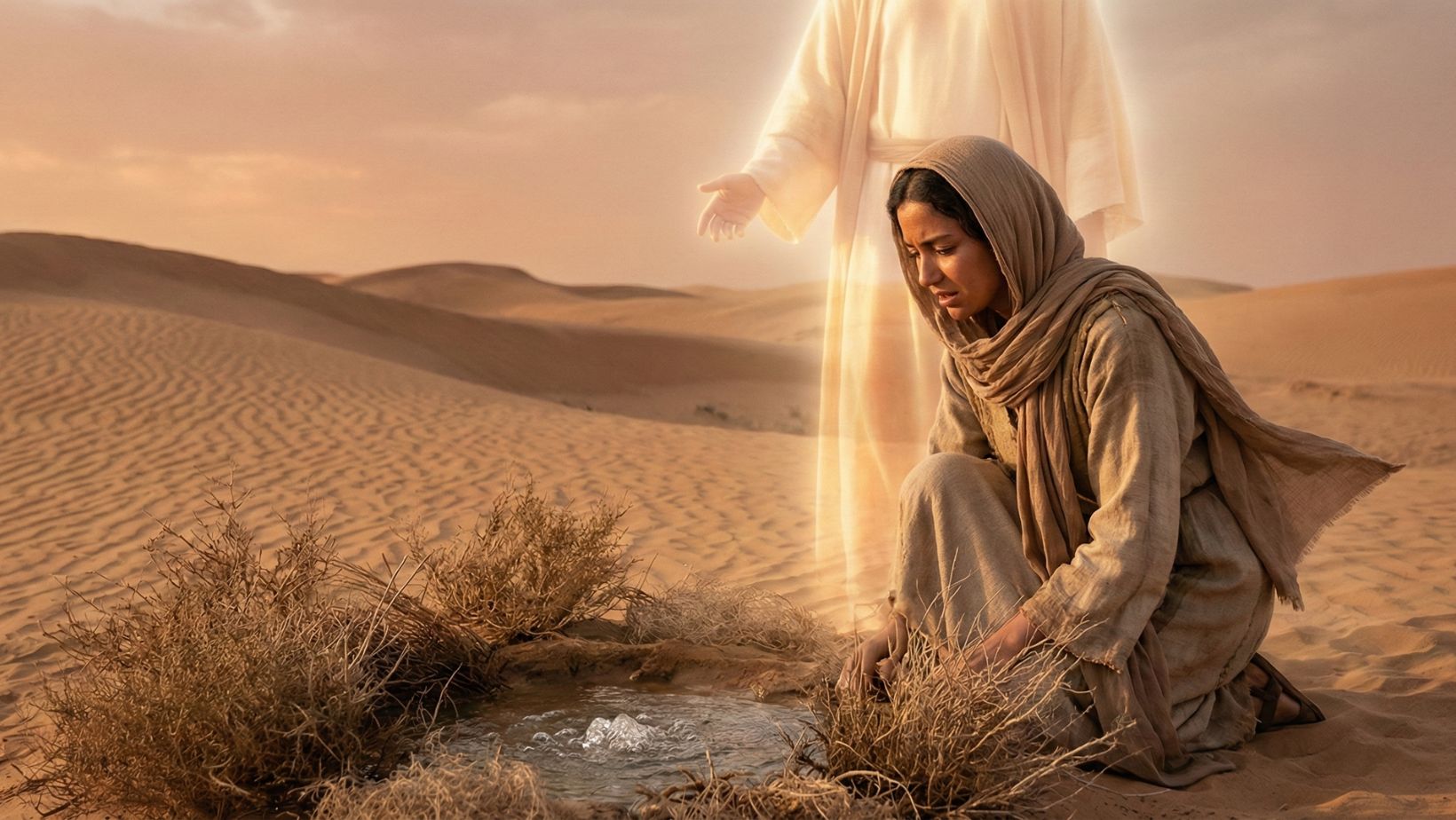
Main Scripture
Genesis 16:13 (NIV)
“She gave this name to the Lord who spoke to her: ‘You are the God who sees me,’ for she said, ‘I have now seen the One who sees me.’”
Introduction
Hagar’s encounter in the wilderness reveals a simple but life-changing truth: God sees us even when no one else does. She ran from pain, rejection, and hardship, yet God met her where she least expected Him. Her story teaches us that God’s awareness is constant, personal, and compassionate.
Illustration
A security guard watches a wall of camera feeds, seeing movement in every corner of a building. Though people walk unaware of being watched, the guard sees every angle.
Like this, but far more tenderly, God sees:
- Every tear
- Every struggle
- Every sacrifice
- Every quiet moment of faith
Hagar felt abandoned, but heaven was watching her the whole time.
1. God Sees You in Your Pain
Genesis 16:6 (NIV)
“Then Sarai mistreated Hagar; so she fled from her.”
Pain often pushes us into emotional or spiritual wilderness. Yet God does not turn His eyes away from suffering.
Psalm 34:18 (NIV)
“The Lord is close to the brokenhearted…”
God sees your pain even when:
- Others overlook it
- You cannot express it
- You are tired of explaining it
- You think no one cares
Human rejection never cancels divine attention.
2. God Sees You When You Feel Alone
Hagar stood isolated in the desert, believing no one knew her location or condition. Yet God found her precisely where she was.
Psalm 139:7 (NIV)
“Where can I go from your Spirit? Where can I flee from your presence?”
God sees you in moments such as:
- Sitting in a quiet room feeling forgotten
- Walking through life with unanswered questions
- Carrying burdens silently
- Feeling misunderstood or dismissed
Isolation is never the absence of God.
3. God Speaks Purpose Into Your Wilderness
Genesis 16:9–10 (NIV)
“Then the angel of the Lord told her, ‘Go back…’
‘I will increase your descendants…’”
God met Hagar with purpose, not pity. The wilderness became the turning point in her destiny.
Purposes God often reveals in difficult seasons:
- Clarity about your next step
- Strength you didn’t know you had
- A deeper reliance on Him
- A future bigger than your current pain
The wilderness is not punishment; it is preparation.
4. God Calls You by Identity, Not by Circumstance
Isaiah 43:1 (NIV)
“Fear not, for I have redeemed you; I have called you by name; you are mine.”
People defined Hagar by her role, but God addressed her with dignity. He speaks identity even when life speaks limitation.
You are not defined by:
- What you’ve been through
- How others treated you
- The mistakes you regret
- The labels people placed on you
God calls you His.
5. When God Sees You, Everything Changes
Genesis 16:13 (NIV)
“You are the God who sees me.”
Hagar returned to the same environment but with a renewed understanding of God. Awareness of God’s seeing brings transformation.
What changes when you know God sees you:
- Confidence grows
- Fear loses power
- Purpose becomes clearer
- Hope is restored
- You walk with assurance, not insecurity
Your outward conditions may remain, but your inner posture becomes stronger.
Bottom Line
Quote:
“Being seen by God is more powerful than being accepted by people.”
Theological Point:
El Roi reveals God’s intimate awareness and His ability to guide, comfort, and define His people through every circumstance.







Leave a Reply