
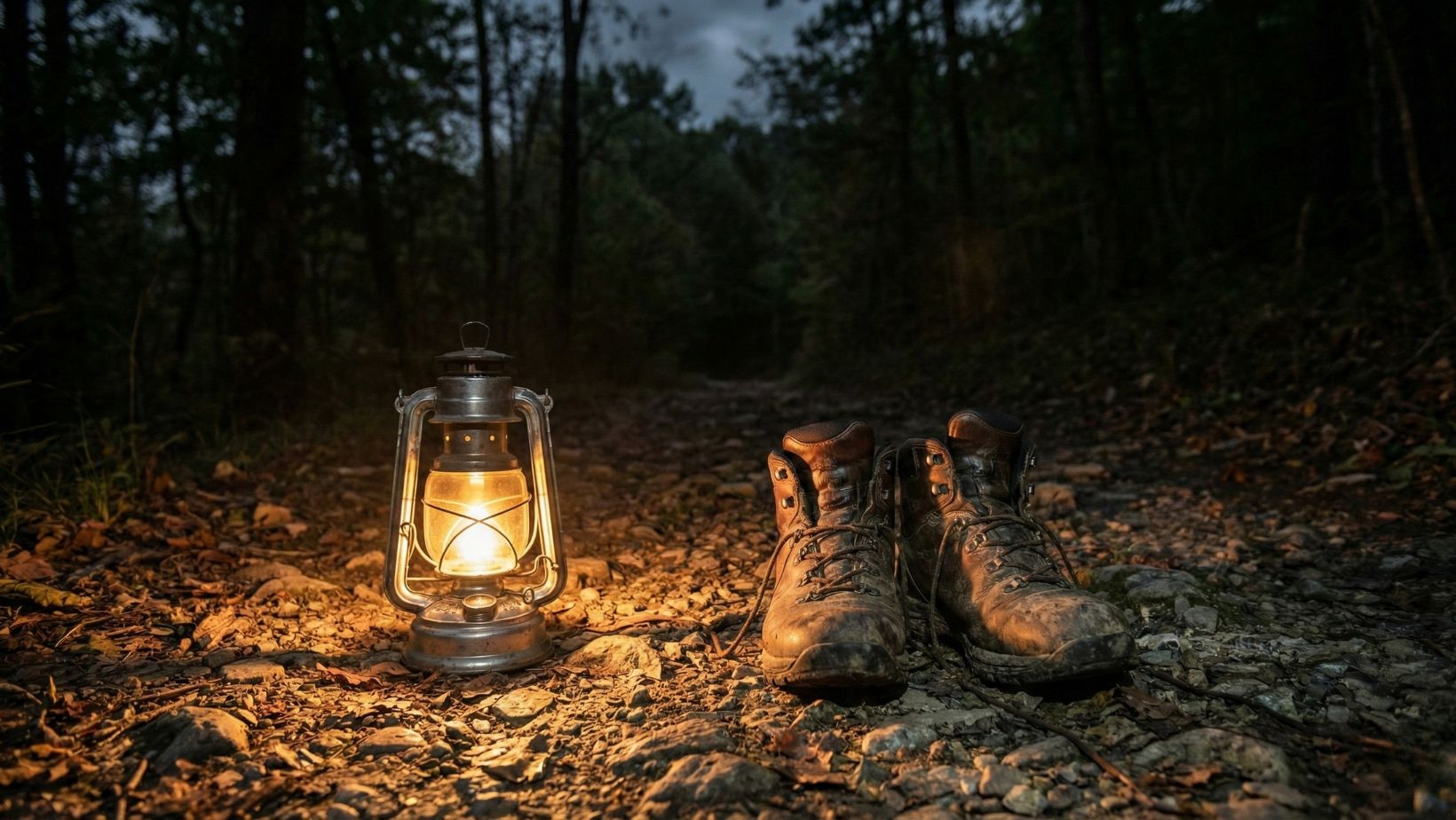
We live in an age that demands certainty. We want the five-year plan, the guarantee of success, and the roadmap that shows us exactly where we will be tomorrow. We are uncomfortable with mystery. When we face a major decision—a career change, a relationship issue, a medical diagnosis—we want a floodlight that illuminates the entire horizon. We want to see the destination before we take the first step. But God rarely works with floodlights. He works with lanterns. A floodlight removes the need for faith because you can see everything. A lantern only illuminates the immediate vicinity—just enough for your feet, just enough for the next step. The spiritual journey is not about knowing the future; it is about trusting the One who holds the light. The struggle we face is not usually a lack of light, but a lack of trust in the light we have been given.
Main Scripture
Psalm 119:105 (NIV) “Your word is a lamp for my feet, a light on my path.”
Quick Insights
- God gives us enough light for the step we are on, not the mile we haven’t reached yet.
- Faith is the courage to move forward when you only have partial understanding.
- The darkness of your situation does not dim the power of God’s Word.
- Obedience is the engine that drives clarity; if you stop moving, the light stops leading.
- We often want an explanation, but God offers us His presence.
- A lantern is useless if you stay standing still; it requires movement to be effective.
- Trust is not a feeling of safety; it is a commitment to follow the Guide.
Illustration
Imagine walking on a treacherous mountain path in the pitch black of night. You are holding an ancient oil lamp. If you hold the lamp up high to see the peak of the mountain, the wind might blow it out, or the light will simply disperse into the void, showing you nothing. But if you hold the lamp down low, near your boots, it casts a warm, steady glow on the three feet of ground directly in front of you. It reveals the loose rock, the sturdy root, and the safe place to step. God’s Word is that lamp. It is not designed to show you the peak of the mountain from the valley. It is designed to show you where to put your foot right now. We get paralyzed because we are straining to see the summit, while God is simply whispering, “Take the next step.”
1. The Mercy of Hidden Things
We often complain that God is hiding the future from us. We think that if we knew the outcome, we would have more peace. But is that true? If God showed you the entire journey—the heartbreaks, the struggles, the late nights, and the sheer difficulty of the road ahead—you might never start walking. God conceals the future not to torture us, but to protect us. He reveals only what we can handle in the moment.
Proverbs 3:5–6 (NIV) “Trust in the Lord with all your heart and lean not on your own understanding; in all your ways submit to him, and he will make your paths straight.” We lean on our understanding because we crave control. But our understanding is limited to our perspective. God sees the aerial view; we see the street view. Trusting God means accepting that He knows what is around the corner, even when we do not. The “straight path” He promises often looks like a winding road to us, but it is the most direct route to spiritual maturity.
2. The Wilderness of Dependence
Darkness has a way of stripping us of our pride. In the daylight, we feel self-sufficient. We can navigate, we can plan, we can run. But when the sun goes down and we cannot see our hand in front of our face, we are forced to reach out. We are forced to listen.
2 Corinthians 5:7 (NIV) “For we live by faith, not by sight.” Consider the Israelites in the wilderness. They did not have a map; they had a pillar of fire. They could not move unless the pillar moved. They could not stay if the pillar lifted. Exodus 13:21 (Summary) By day the Lord went ahead of them in a pillar of cloud to guide them on their way and by night in a pillar of fire to give them light. This season of uncertainty you are in is not a mistake. It is a wilderness designed to shift your reliance from your own vision to His presence. If you can see everything, you don’t need God. The darkness is the classroom where faith is graduated to trust.
3. The Surgeon’s Scalpel
When we are confused, our emotions lie to us. Fear tells us we are abandoned. Anxiety tells us we are doomed. In the fog of life, we need an instrument that can cut through the noise and reveal what is real. That instrument is the Word of God.
Hebrews 4:12 (NIV) “For the word of God is alive and active. Sharper than any double-edged sword, it penetrates even to dividing soul and spirit, joints and marrow; it judges the thoughts and attitudes of the heart.” The Word doesn’t just give us information; it performs surgery. It separates our fear from our faith. It separates what we feel is true from what God says is true. When you don’t know what to do, stop listening to your heart and start reading His Word. Your heart will fluctuate with the wind; His Word is the anchor that holds through the storm.
4. The Expiration Date of Light
There is an urgency to following God’s guidance. When the light shines on a specific step—an apology you need to make, a habit you need to break, a ministry you need to start—that light is an invitation. But light ignored eventually becomes darkness.
John 12:35 (NIV) “Walk while you have the light, before darkness overtakes you.” Delayed obedience is disobedience. We often say, “God, show me step two, and then I will take step one.” God replies, “Take step one, and then I will show you step two.” If you are feeling stuck or confused, ask yourself: What was the last thing God told me to do that I haven’t done yet? The clarity you are seeking for tomorrow is found in your obedience today. You cannot skip steps in the Kingdom of God. Walk while you have the light.
5. The Presence Within the Path
Finally, we must realize that the goal of the path is not just the destination; the goal is the company we keep along the way. We want the answer; God wants the relationship. We want the blessing; God wants to be the Blesser.
Psalm 27:1 (NIV) “The Lord is my light and my salvation—whom shall I fear?” David does not say, “The Lord gives me light.” He says, “The Lord is my light.” Even if the valley is deep and the shadow is dark, if He is with you, you are in the light. The path may be rocky, but the Shepherd is capable. We do not trust in a plan; we trust in a Person. As long as you are walking with Him, you are never truly in the dark.
Conclusion: The Anchor in the Pause
- Quote: “You don’t need to see the whole path—just trust the One who lights it.”
- Theological Point: God does not always remove the uncertainty of the future, but He faithfully provides the guidance of His Word to those who are willing to walk by faith and not by sight.
- Prayer Guide: Lord, I confess that I want control more than I want guidance. Forgive me for demanding a floodlight when You have given me a lamp. I choose today to take the next step of obedience, even if my hands are shaking. Be my Light, be my Guide, and be my Comfort.
- Summary: True faith is the willingness to take the next step in the dark, trusting that God’s Word will illuminate the ground exactly when your foot needs to land.







Leave a Reply