
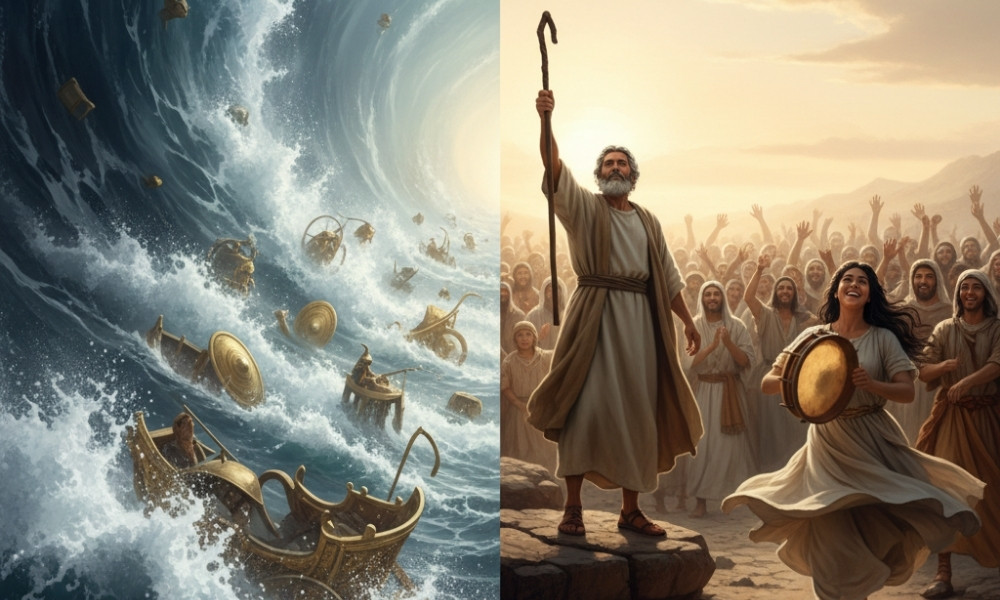
The Song of Moses, also known as the “Song of the Sea” (Shirat HaYam), is the first great anthem of the Bible. Recorded in Exodus 15, it is a triumphant victory hymn sung by Moses and the Israelites immediately after the crossing of the Red Sea. Unlike previous interactions where Moses spoke to God or God spoke to Moses, this is the nation speaking about God in a unified voice of praise. It marks a theological turning point: the Israelites are no longer just escaped slaves; they are a people possessed by a Warrior King. This ancient poem looks backward at the destruction of Egypt and forward to the conquest of Canaan, establishing Yahweh’s reputation among the nations.
- Title: The Song of the Sea (Shirat HaYam)
- Scripture: Exodus 15:1–18
- Lead Singers: Moses (men) and Miriam (women)
- Occasion: The destruction of Pharaoh’s army in the Red Sea
- Genre: Victory Hymn / Divine Warrior Poetry
- Key Declaration: “The LORD is a man of war; the LORD is his name.” (Exodus 15:3)
- Legacy: Recited daily in Jewish liturgy; sung by martyrs in Revelation 15
Context & Setting
Time: ~1446 BCE (Immediately post-Exodus).
Location: The eastern shore of the Red Sea (Yam Suph).
The Atmosphere: The Israelites had just witnessed a dual miracle—the waters parting to save them and collapsing to destroy their pursuers. The song is a spontaneous reaction to the sight of Egyptian armor and bodies washing up on the shore (Exodus 14:30), confirming that their oppression was definitively over.
Structure of the Song
The poem is structured in three escalating movements (stanzas), moving from the specific battle to the eternal reign of God.
Stanza 1: The Praise of the Victor (vv. 1–5)
- Focuses on God’s personal triumph.
- “I will sing to the LORD, for he has triumphed gloriously; the horse and his rider he has thrown into the sea.”
Stanza 2: The Method of Destruction (vv. 6–12)
- Describes the mechanics of the miracle—God’s “right hand” and the breath of His nostrils piling up the waters.
- It mocks the arrogance of the enemy who said, “I will pursue, I will overtake…” only to be swallowed by the deep.
Stanza 3: The Future Terror & Settlement (vv. 13–18)
- Prophetically looks forward. Because God defeated Egypt (the superpower), the lesser nations (Philistia, Edom, Moab) are terrified.
- Predicts the planting of Israel in God’s “holy abode” (the Promised Land).
Key Theological Themes
Yahweh as the Divine Warrior: This is the first time in Scripture God is explicitly described as a warrior (Exodus 15:3). He fights for His people, not with sword and spear, but with the elements of creation (wind and water). This demilitarizes Israel—they didn’t lift a finger; God did the fighting.
Monotheism (Incomparability): “Who is like you, O LORD, among the gods?” (Exodus 15:11). This rhetorical question asserts that the gods of Egypt were powerless against the Creator.
Covenant Loyalty (Hesed): Verse 13 mentions, “You have led in your steadfast love (hesed) the people whom you have redeemed.” The deliverance was not just a military act but an act of covenant devotion.
Kingship: The song concludes with “The LORD will reign forever and ever” (v. 18). This is the first reference to God’s eternal Kingship in the Bible, anticipating the theocracy of Israel.
Major Roles / Participants
Moses: The composer and lead singer. He directs the song toward God, setting the precedent that salvation should result in doxology (worship).
Miriam: Moses’ sister, identified here as a “prophetess.” She leads the women with tambourines and dancing, singing the antiphonal response (Exodus 15:20–21). This highlights the role of women in Israel’s public worship and victory celebrations.
The Enemy (Pharaoh): Portrayed not as a terrifying rival, but as a helpless object (“like a stone,” “like lead”) sinking into the water.
Notable Passages
Exodus 15:2: “The LORD is my strength and my song, and he has become my salvation; this is my God, and I will praise him.” (Personal appropriation of faith).
Exodus 15:3: “The LORD is a man of war; the LORD is his name.” (The definition of God’s militant protection).
Exodus 15:11: “Who is like you, O LORD, among the gods? Who is like you, majestic in holiness, awesome in glorious deeds, doing wonders?” (The Mi Chamocha prayer).
Legacy & Impact
Jewish Tradition:
- The Shirat HaYam is considered so holy that the Talmud discusses its formatting in the Torah scroll—it is written in a unique brickwork pattern to resemble waves.
- It is recited every morning in the Pesukei Dezimra (Verses of Praise) service.
- The seventh day of Passover celebrates the crossing of the sea, and this song is the central reading.
Christian Typology:
- The crossing of the Red Sea is viewed as a type of Baptism (1 Corinthians 10:1–2)—passing from death/slavery to life.
- The Song of Moses is paired with the “Song of the Lamb” in Revelation 15:3, sung by those who have conquered the “beast” (the ultimate Pharaoh figure), linking the Exodus to the final judgment.
Musical History:
- This text is the root of the entire Judeo-Christian hymn tradition. It established that the community of faith is a singing community.
Distinction Note
Do not confuse this “Song of Moses” (Exodus 15) with the Second Song of Moses (Deuteronomy 32).
- Exodus 15: A song of victory and praise at the beginning of the wilderness journey.
- Deuteronomy 32: A song of warning and witness at the end of the wilderness journey, shortly before Moses dies.







Leave a Reply