
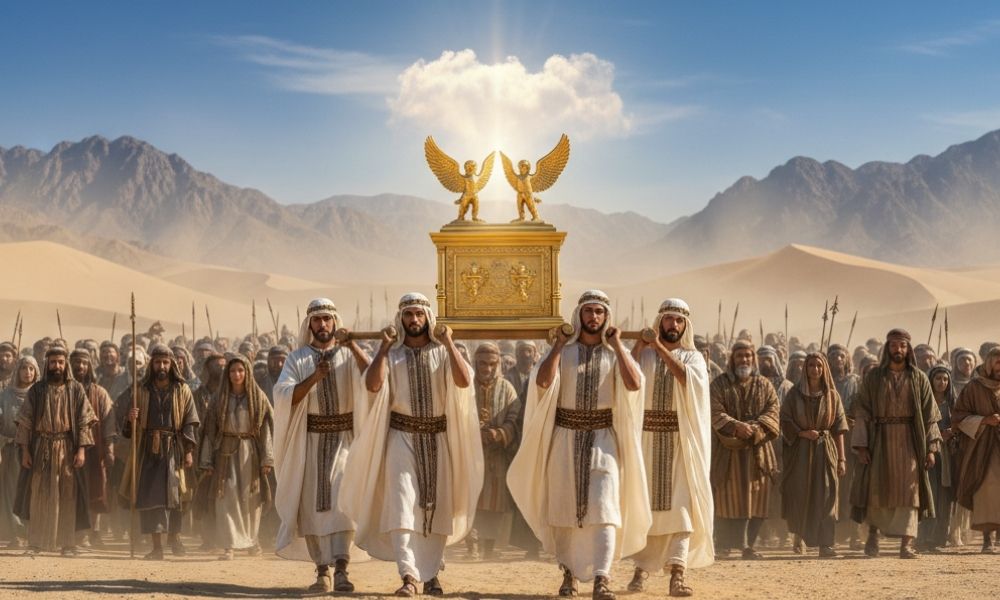
The Ark of the Covenant (Hebrew: ’Aron ha-Berit) was the sacred chest built by Moses and the Israelites at God’s command to house the tablets of the Ten Commandments, representing God’s covenant with His people. It was the central object of Israel’s worship, symbolizing God’s throne on earth, His holiness, power, and presence among His people.
The Ark stood at the very heart of Israel’s faith — first in the Tabernacle and later in the Temple of Solomon — as the physical manifestation of the covenant relationship between Yahweh and Israel.
Quick Facts
Name: Ark of the Covenant (’Aron ha-Berit, Hebrew for “Chest of the Covenant”)
Other Names: Ark of the Testimony (’Aron ha-Eduth), Holy Ark
Constructed by: Bezalel, under Moses’ direction (Exodus 37:1–9)
Date of Construction: c. 1440–1400 BCE (during the wilderness period)
Dimensions:
– Length: 2.5 cubits (~45 inches / 1.15 m)
– Width: 1.5 cubits (~27 inches / 0.68 m)
– Height: 1.5 cubits (~27 inches / 0.68 m)
Materials: Acacia wood overlaid with pure gold, inside and out
Contents:
– The two stone tablets of the Ten Commandments (Exodus 25:16)
– A golden pot of manna (Exodus 16:33; Hebrews 9:4)
– Aaron’s rod that budded (Numbers 17:10; Hebrews 9:4)
Location:
– Wilderness: Tabernacle’s Holy of Holies
– Canaan: Shiloh, then various cities (1 Samuel 4–7)
– Jerusalem: City of David under King David (2 Samuel 6)
– Temple of Solomon (1 Kings 8:1–9)
Disappearance: After Babylon’s destruction of Jerusalem (586 BCE)
1. Divine Instructions and Construction
The Ark was designed by God Himself. On Mount Sinai, the LORD gave Moses specific instructions:
“They shall make an ark of acacia wood… and you shall overlay it with pure gold, inside and out… and make on it a crown of gold round about.”
— Exodus 25:10–11
Construction Features:
- Box Structure: Made from durable acacia wood, resistant to decay, overlaid with pure gold inside and out.
- Gold Rings and Poles: Four gold rings at its corners held acacia poles, also overlaid with gold, allowing priests to carry the Ark without touching it (Exodus 25:14–15).
- Mercy Seat (Hebrew: Kapporet): The solid gold cover on top, featuring two cherubim with wings outstretched toward each other, facing the center (Exodus 25:17–20).
- Divine Presence: God promised, “There I will meet with you, and I will speak with you from above the Mercy Seat.” (Exodus 25:22)
The Ark thus served as a meeting point between heaven and earth, where the invisible God revealed His presence among His people.
2. Symbolic and Theological Meaning
A. The Presence of God
The Ark symbolized the very presence of Yahweh:
“The LORD of hosts, who dwells between the cherubim.” (1 Samuel 4:4)
The cloud of God’s glory (Shekinah) would appear above the Mercy Seat, marking His dwelling among the Israelites (Exodus 40:34–35).
B. The Covenant Relationship
It was the physical reminder of the Covenant — the binding relationship between God and His people, sealed by His law and mercy.
C. The Mercy Seat — Atonement and Grace
The Mercy Seat represented God’s mercy covering His law.
On the Day of Atonement (Yom Kippur), the high priest sprinkled sacrificial blood upon the Mercy Seat to atone for the sins of the nation (Leviticus 16:14–15).
This act symbolized forgiveness through substitutionary sacrifice, foreshadowing Christ’s ultimate atonement.
D. The Contents — Spiritual Significance
Each item inside the Ark reflected a key aspect of Israel’s covenant life:
- Stone Tablets: God’s moral law — His righteous standard.
- Manna Jar: God’s provision — His faithfulness in the wilderness.
- Aaron’s Rod: God’s authority — His chosen priesthood.
Together they represented law, provision, and priesthood — all fulfilled perfectly in Jesus Christ.
3. The Ark in Israel’s History
A. The Wilderness Journey
- The Ark was kept in the Most Holy Place of the Tabernacle.
- When Israel moved, priests carried it before the people, and God’s presence guided them as a pillar of cloud by day and fire by night (Numbers 10:33–36).
B. Crossing the Jordan (Joshua 3–4)
When the priests carrying the Ark stepped into the Jordan River, the waters miraculously stopped, allowing the Israelites to cross on dry ground — a visible demonstration of God’s power and faithfulness.
C. Fall of Jericho (Joshua 6)
The Ark was carried around the walls of Jericho once daily for six days and seven times on the seventh day. When the priests blew their trumpets, the walls fell — the Ark symbolizing God’s divine victory.
D. Time of the Judges and Samuel
- The Ark was stationed at Shiloh for centuries (1 Samuel 1:3).
- When Israel presumptuously took it into battle against the Philistines, it was captured — a sign that God’s favor does not follow ritual, but righteousness (1 Samuel 4).
- The Philistines suffered plagues until they returned it, recognizing its holiness (1 Samuel 5–6).
E. King David and the Ark (2 Samuel 6)
David sought to bring the Ark to Jerusalem. When Uzzah touched it irreverently and died, David realized the need for reverent obedience to God’s holiness. Later, with proper ceremony and sacrifice, the Ark was brought to the City of David, accompanied by worship and rejoicing.
F. Solomon’s Temple (1 Kings 8)
Solomon placed the Ark in the Holy of Holies of the newly built Temple.
When the priests withdrew, the glory of the LORD filled the Temple — a powerful confirmation of God’s dwelling among His people.
4. The Ark’s Disappearance and Mystery
The Ark’s fate after 586 BCE remains unknown. When Babylon destroyed Jerusalem and the Temple, the Ark vanished from recorded history.
Major Theories:
- Hidden by Priests: 2 Maccabees 2:4–8 records that the prophet Jeremiah hid the Ark in a cave on Mount Nebo before the Babylonian invasion.
- Destroyed or Taken: Some believe it was destroyed or seized by the Babylonians.
- Ethiopian Tradition: The Ethiopian Orthodox Church claims it is kept in Axum, in the Church of Our Lady Mary of Zion.
- Heavenly Vision: Revelation 11:19 depicts “the ark of His covenant” in heaven — symbolizing divine permanence and the heavenly counterpart to the earthly Ark.
5. The Ark’s Fulfillment in Christ
In the New Testament, the Ark finds its spiritual fulfillment in Jesus Christ, who embodies all that it represented:
| Ark Symbolism | Fulfillment in Christ |
|---|---|
| The Law inside the Ark | Jesus is the Word made flesh (John 1:14) |
| The Mercy Seat (atonement) | Jesus’ blood provides eternal atonement (Romans 3:25; Hebrews 9:11–12) |
| The Manna | Jesus is the Bread of Life (John 6:35) |
| Aaron’s Rod | Jesus is our eternal High Priest (Hebrews 5:4–10) |
| God’s Presence above the Ark | In Christ, “God with us” — Emmanuel (Matthew 1:23) |
Thus, the Ark foreshadows Christ’s redemptive work:
- He is the meeting place between God and humanity.
- His sacrifice is the true “Mercy Seat,” reconciling us to God.
- His indwelling Spirit now makes believers the living temple (1 Corinthians 3:16).
6. Legacy and Enduring Influence
- Central to Jewish Faith: The Ark was the visible assurance of God’s covenant presence and authority.
- Theological Symbolism: It became a type of Christ’s person and work — God’s holiness, justice, and mercy united.
- Cultural and Historical Impact: The Ark continues to inspire theological thought, art, literature, and even archaeology — from ancient Jewish writings to modern works like Raiders of the Lost Ark.
- Eschatological Hope: Revelation portrays the Ark in God’s heavenly temple, reminding believers that God’s covenant is eternal and His presence everlasting.
7. Summary
| Aspect | Description |
|---|---|
| Purpose | Symbol of God’s covenant, presence, and atonement |
| Location | Holy of Holies in the Tabernacle and Temple |
| Materials | Acacia wood overlaid with gold |
| Contents | Ten Commandments, manna, Aaron’s rod |
| Symbolism | God’s law, mercy, provision, and authority |
| Fulfillment | Jesus Christ — the true Ark and Mercy Seat |







Leave a Reply