
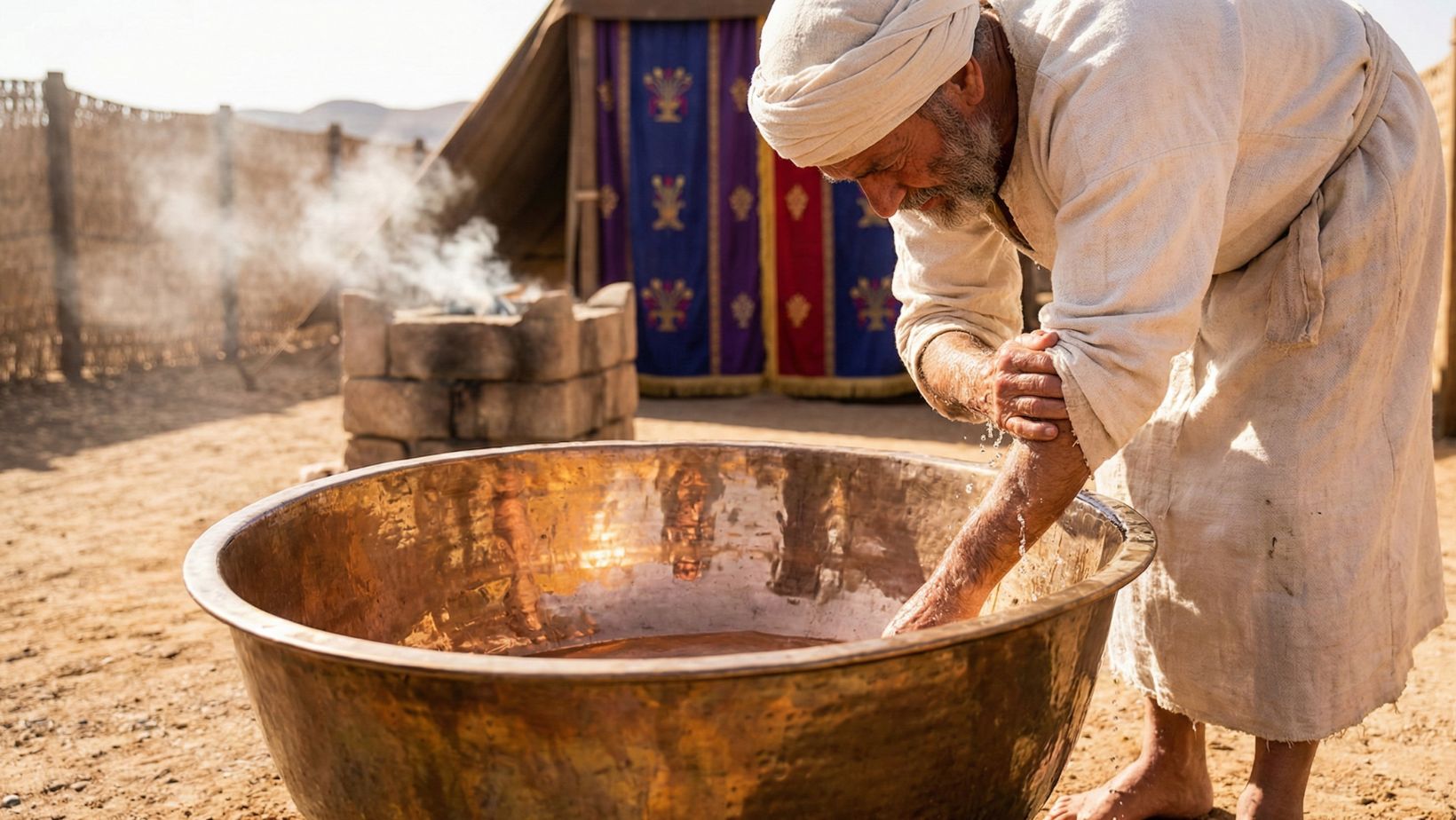
The Bronze Laver (Kiyyor in Hebrew) was a sacred vessel of purification located in the courtyard of the Tabernacle, standing as a critical barrier between the outer world and the Holy Place. Unlike the Altar of Burnt Offering, which dealt with the payment for sin, the Laver dealt with the pollution of sin. It was the wash basin where priests were required to cleanse their hands and feet before ministering to the Lord, serving as a solemn reminder that while redemption is a one-time event, sanctification (cleansing) is a daily necessity for those who draw near to a holy God.
Quick Facts
- Name: Bronze Laver (Hebrew: Kiyyor, meaning “Round Basin” or “Cauldron”)
- Material: Solid Bronze (made from polished mirrors of the women)
- Location: Courtyard, between the Altar of Burnt Offering and the Tent of Meeting
- Scripture Reference: Exodus 30:17–21, Exodus 38:8
- Dimensions: Unrecorded (the only piece of furniture with no specified measurements)
- Purpose: Ceremonial washing for priests to prevent death upon entering the Holy Place
- Key Element: Water (Living Water)
Name Meaning
Kiyyor Nechoshet: The Hebrew word Kiyyor implies a round vessel, pot, or basin excavated or hammered out. It specifically refers to a vessel used for washing or cooking. In the context of the Tabernacle, it is the “Basin of Bronze,” emphasizing both its durability and its function as a vessel of preparation.
Physical Description & Origin
Material: It was unique among the furniture because it was not made from a general offering of bronze. Instead, it was crafted exclusively from the bronze mirrors of the women who served at the entrance of the Tent of Meeting (Exodus 38:8).
Structure: It consisted of two parts:
- The Bowl: The basin holding the water.
- The Base (Ken): A pedestal or stand that supported the bowl.
No Dimensions: The Bible gives specific measurements for the Ark, the Table, and the Altars, but none for the Laver. Many scholars suggest this symbolizes the limitlessness of God’s grace and the infinite capacity of the Holy Spirit to cleanse.
Biblical Era / Context
Setting: The Wilderness Wanderings (approx. 1446 BCE).
Cultural Context: In ancient Egypt and the Near East, bronze mirrors were luxury items, highly polished to provide a reflection. By giving up these instruments of vanity and self-admiration, the women demonstrated a shift from focusing on outward appearance to inward holiness.
Religious Context: It marked the transition from the “outer court” ministry (dealing with the world and sacrifice) to the “inner court” ministry (intercession and intimacy with God).
Major Roles / Function
The Agent of Separation: It separated the common priest from the Holy God. A priest could be ordained and wearing holy garments, but if he had “earth” on his hands or feet from the camp, he could not enter.
The Preventer of Death: God’s command was strict: “They shall wash with water, so that they will not die” (Exodus 30:20). Purity was a matter of life and death.
The Mirror of the Soul: Because it was made of polished mirrors, when a priest looked down to wash, he likely saw his own reflection. This symbolizes the Word of God, which both reveals our filth (reflection) and provides the means to remove it (water).
Key Attributes
Reflective: It forced the worshiper to examine himself before approaching God. Cleansing: It removed the defilement of daily service and contact with the world. Holy: Like the other furniture, it was anointed with holy oil (Leviticus 8:11), setting it apart as “most holy.”
Main Events / History
The Donation of Mirrors: The devout women at the entrance of the Tabernacle surrendered their mirrors. Moses accepted this offering to construct the vessel of sanctification.
Daily Use: For nearly 500 years (from Sinai to Shiloh to Gibeon), every priest who offered incense or lit the Menorah first stopped here to wash.
Evolution into “The Sea”: In Solomon’s Temple, the humble portable Laver was replaced by the “Molten Sea,” a massive basin resting on the backs of 12 bronze oxen, holding roughly 11,000 to 16,000 gallons of water (1 Kings 7:23–26).
Major Relationships
The Altar of Burnt Offering: The Altar (Justification) came before the Laver (Sanctification). One must be saved by blood before being cleansed by water.
The Priests (Aaron & Sons): The Laver was exclusively for their use. It was the tool that kept them fit for service.
The Dust of the Ground: The priests washed their hands (works) and feet (walk) to remove the dust of the cursed earth before entering the presence of God.
Notable Passages
Exodus 30:19–20: “Aaron and his sons shall wash their hands and their feet from it… so that they will not die.”
Exodus 38:8: “He made the laver of bronze… from the mirrors of the ministering women who ministered at the entrance of the tent of meeting.”
Ephesians 5:26 (New Testament Fulfillment): “…that He might sanctify and cleanse her with the washing of water by the word.”
Legacy & Impact
The Concept of Sanctification: The Laver established the theological truth that a believer is “bathed” (saved) once, but needs “washing” (daily cleansing) repeatedly (John 13:10).
Baptism: It foreshadows Christian baptism—a washing of water that signifies a clear conscience toward God.
Living Water: It points to the need for a constant supply of the Spirit to wash away the grime of the world.
Symbolism / Typology
The Water = The Word of God: Just as water cleanses dirt, the Bible cleanses our minds and hearts (John 15:3). The Mirrors = Self-Examination: The Law and the Word act as a mirror (James 1:23–25), showing us our true state so we can be washed. The Bronze = Judgment: Bronze in the Bible typically typifies judgment. At the Laver, the believer judges himself (confession) so he will not be judged by God. Hands and Feet:
- Hands: What we do (Service/Works).
- Feet: Where we go (Walk/Conduct).
Extra-Biblical References
Rabbinic Tradition: Midrashic texts (e.g., Tanhuma) recount that Moses was initially hesitant to accept the mirrors because they were made for vanity and attraction. God rebuked Moses, saying, “Accept them, for these are dearer to Me than all other gifts,” because the women used them to beautify themselves for their husbands to sustain life and hope even during the slavery in Egypt. Thus, the instruments of desire were transformed into instruments of holiness.







Leave a Reply