
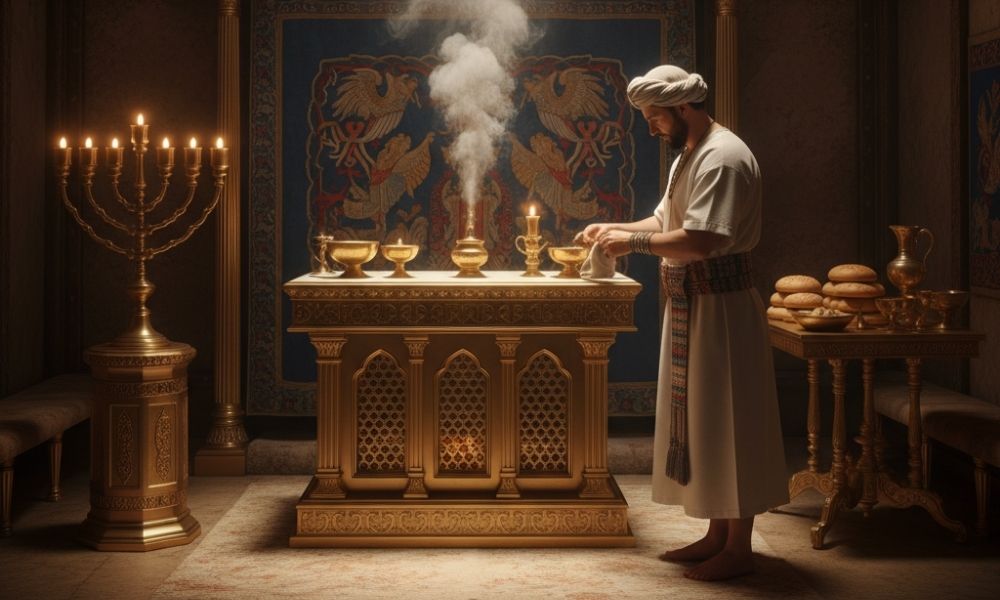
The Golden Altar of Incense (also called the Altar of Incense or Altar of Perfume) was a sacred piece of furniture in the Tabernacle and later in the Temple of Jerusalem, symbolizing the prayers and worship of God’s people rising before Him. Placed just outside the Most Holy Place, before the veil that separated it from the Ark of the Covenant, it represented continual fellowship and intercession between God and His people. The fragrant smoke ascending from the altar reflected holiness, purity, and the pleasing aroma of true devotion before the Lord.
Quick Facts
Name: Golden Altar of Incense (Hebrew: Mizbeach HaKetoret)
Location: In the Holy Place, before the veil separating the Holy of Holies (Exodus 30:6)
Material: Acacia wood overlaid with pure gold (Exodus 30:1–3)
Dimensions: 1 cubit long, 1 cubit wide, and 2 cubits high (~18x18x36 inches)
Use: Burning sweet incense every morning and evening by the priest
Symbolism: Prayer, intercession, and the continual worship of God
Key Scriptures: Exodus 30:1–10; Leviticus 16:12–13; Revelation 8:3–4
Biblical Description
God commanded Moses to build the Golden Altar according to His divine pattern:
“Make an altar of acacia wood for burning incense… Overlay it with pure gold—its top and all the sides and its horns—and make a gold molding around it.”
— Exodus 30:1–3
The altar stood in front of the veil, opposite the Ark of the Covenant. Every morning and evening, the priest would burn a special blend of sacred incense on it — a continual act of worship symbolizing Israel’s prayers ascending to heaven.
The Sacred Incense
God gave specific instructions for the incense mixture (Exodus 30:34–38), consisting of stacte, onycha, galbanum, and pure frankincense. This incense was holy and could not be used for any common purpose — a picture of the sacred nature of prayer and worship.
Spiritual Symbolism
- Prayer and Intercession: The rising smoke represented prayers ascending to God. “May my prayer be set before You like incense.” — Psalm 141:2
- Continual Worship: The incense was to burn perpetually, showing that communion with God is constant.
- Mediation: Only the priest could offer incense, foreshadowing Christ, our Great High Priest, who continually intercedes for us (Hebrews 7:25).
- Holiness: The altar’s gold overlay represented purity and divine glory.
The Golden Altar in the New Testament
In Revelation 8:3–4, John sees an angel offering incense with the prayers of the saints before God’s throne:
“The smoke of the incense, together with the prayers of God’s people, went up before God from the angel’s hand.”
This reveals that the altar’s symbolism continues eternally — our prayers are precious and accepted through the mediation of Christ.
The Day of Atonement Connection
Once a year, on the Day of Atonement (Yom Kippur), the high priest would apply the blood of the sin offering to the horns of the altar (Leviticus 16:18–19). This act purified the altar and the people, showing that even worship must be sanctified by atoning blood — a foreshadowing of the cleansing power of Jesus’ sacrifice.







Leave a Reply